



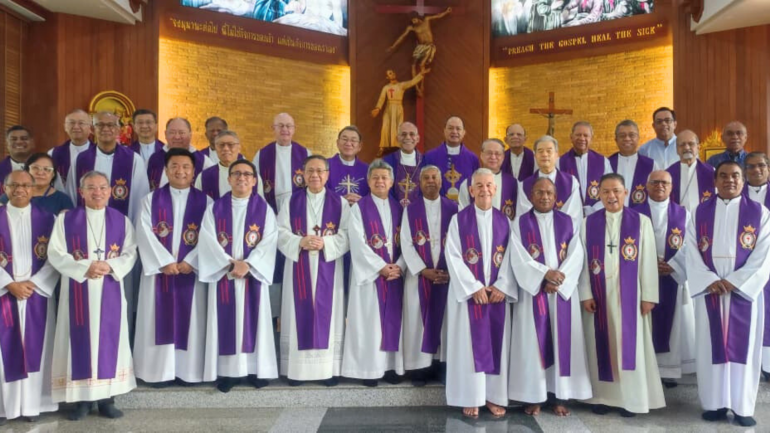
The Federation of Asian Bishops’ Conferences (FABC) organized a Eucharistic Adoration service on March 3, 2026, to pray for peace in the Middle East amid escalating tensions involving Iran, Israel, and the United States.
The prayer service took place during the FABC Annual Central Committee Meeting, being held from March 2 to 6, 2026, at the Camillian Pastoral Care Centre in Bangkok, Thailand. The Central Committee is composed of the presidents of the Episcopal Conferences across Asia and meets annually along with the chairman bishops and executive secretaries of the FABC’s nine offices.
Responding to an urgent appeal for peace from Pope Leo XIV, the bishops, under the leadership of FABC President Cardinal Filipe Neri Ferrão, dedicated an hour of Eucharistic Adoration from 6:00 p.m. to 7:00 p.m. in the chapel.
The atmosphere was prayerful and contemplative, marked by silence, hymns, and scriptural reflections centered on peace and reconciliation. A reading from James 3:13–18 recalled that “the fruit of righteousness is sown in peace for those who cultivate peace.” The Gospel passage from John 14:23–29 echoed Christ’s assurance: “Peace I leave with you; my peace I give to you… Do not let your hearts be troubled or afraid.”
Special intercessions were offered for people living in conflict zones, for the leaders of Iran, Israel, and the United States, that they may choose dialogue over violence, and for the victims of war, including the wounded, refugees, and displaced families.
During the service, the bishops also reflected on the peace message of the late Holy Father, Pope Francis, who emphasized that there is no future without peace and that prayer is at the root of authentic reconciliation.
The Eucharistic Adoration concluded with Benediction led by Bishop Allwyn D’Silva, Chairman, FABC Office Of Human Development.
The prayer gathering reaffirmed the Church’s social teaching on the dignity of every human person and its firm stance against war. It underscored the Church’s solidarity with those suffering from displacement, loss, and trauma, and manifested her prophetic voice in calling for peace and reconciliation among nations.
The event served both as a spiritual act of intercession and as a public witness to the Gospel’s enduring call to peace.