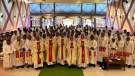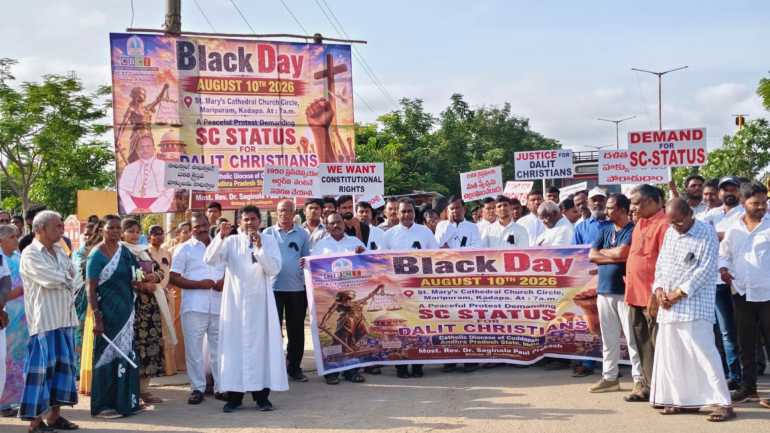
Dalit Christians and Dalit Muslims across India observed Aug. 10 as a National Day of Prayer and Protest, renewing their call for Scheduled Caste (SC) status and equal constitutional rights.
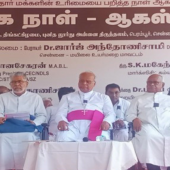
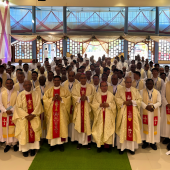
Dioceses across the country organized prayer services, peaceful demonstrations, seminars, awareness programs, and public meetings in collaboration with ecumenical churches, civil society groups, people's movements, and other organizations. Memoranda were also submitted to government authorities urging action on the longstanding demand.
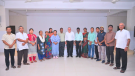
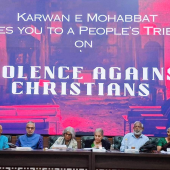
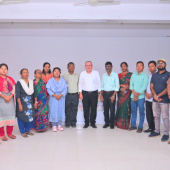
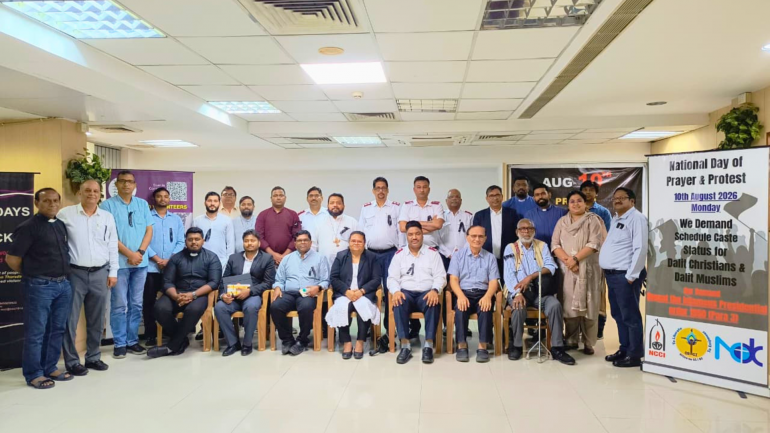
In New Delhi, Christian leaders and representatives of various Churches and organizations gathered at the Church of North India Bhawan for a consultation organized jointly by the National Council of Churches in India (NCCI) and the Catholic Bishops' Conference of India (CBCI) Office for Scheduled Castes and Backward Classes.
Participants discussed ways to strengthen advocacy for Dalit Christians and Dalit Muslims through prayer, legal action, public awareness, and democratic engagement.
Bishop Jayarao Polimera, chairperson of the CBCI Office for Scheduled Castes and Backward Classes, encouraged dioceses across India to observe the day in solidarity with the campaign for justice and equality.
Fr. Devasagayaraj M. Zackarias, national secretary of the CBCI Office for Scheduled Castes and Backward Classes, said the exclusion of Dalit Christians and Dalit Muslims from SC status amounts to discrimination based on religion and caste.
He argued that the exclusion violates constitutional principles and religious freedom in a secular country, while denying members of historically disadvantaged communities access to protections and benefits associated with SC status.
The observance has its roots in the Constitution (Scheduled Castes) Order of 1950, issued on Aug. 10 that year. Paragraph 3 of the order originally restricted SC status to people professing Hinduism. The provision was amended in 1956 to include Sikhs and again in 1990 to include Buddhists, while Dalit Christians and Dalit Muslims remain excluded.
Representatives of Dalit Christians and Muslims have long argued that the distinction amounts to religion-based discrimination, particularly because Dalits who converted to Sikhism or Buddhism were subsequently included in the SC category.
The issue has remained the subject of legal and political advocacy for decades. The challenge to the exclusion of Dalit Christians and Dalit Muslims has also been pending before the Supreme Court of India for more than two decades.
The annual observance of Aug. 10 seeks to keep the issue in public attention and mobilize support for equality, justice, dignity, and constitutional rights.
In Delhi, participants also emphasized the need to strengthen the movement through research, youth engagement, civil society partnerships, legal advocacy, and wider public awareness.
Human rights activist Dr. John Dayal, a former member of India's National Integration Council, called for renewed strategies in response to political and legal obstacles facing the campaign.
“The movement demanding Scheduled Caste status needs to gather more data, develop deep roots in the youth and secular Dalits, civil society and the international community,” Dr. John Dayal said.
The nationwide observance demonstrated continued cooperation among Dalit Christians, Dalit Muslims, Churches, ecumenical organizations, and people's movements in their pursuit of equal rights and protection under Indian law.
Radio Veritas Asia (RVA), a media platform of the Catholic Church, aims to share Christ. RVA started in 1969 as a continental Catholic radio station to serve Asian countries in their respective local language, thus earning the tag “the Voice of Asian Christianity.” Responding to the emerging context, RVA embraced media platforms to connect with the global Asian audience via its 21 language websites and various social media platforms.
Latest News