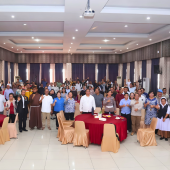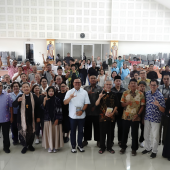



Catechetical commissions from seven Catholic dioceses in Java, Indonesia, have called for a shift from “catechesis for families” to “catechesis with families,” emphasizing that families should be active participants in faith formation rather than simply recipients of Church programs.
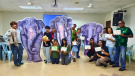
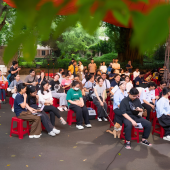
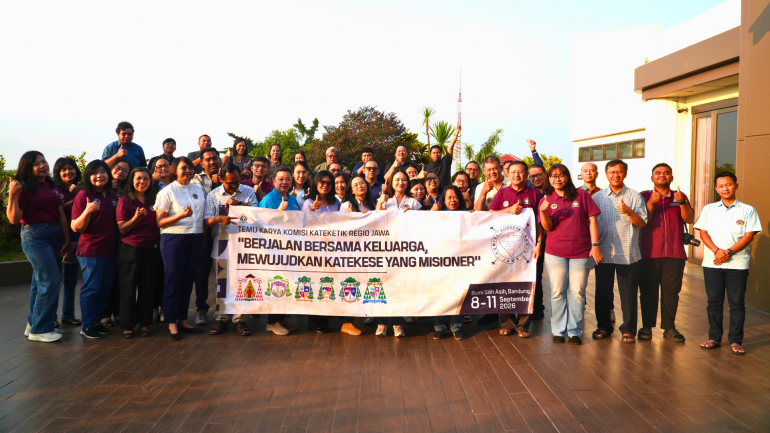
The call emerged from the Gathering of the Catechetical Commissions of the Java Region, held September 8–11 at Bumi Silih Asih, the pastoral center of the Diocese of Bandung in West Java. The meeting brought together 57 representatives from seven dioceses, along with members of the Indonesian Bishops’ Conference (KWI) and pastoral workers.
Java, Indonesia’s most populous island and home to the country’s capital region, has a diverse Catholic population spread across urban and rural communities. The gathering focused on the theme “Walking with Families, Making Catechesis Missionary.”
Participants said catechesis should go beyond transmitting doctrine by fostering encounters, witnessing through daily life and accompanying families in their concrete circumstances.
They recommended closer cooperation between diocesan catechetical and family ministry commissions through regular coordination and joint programs. Dioceses were also encouraged to identify and strengthen existing resources, including catechists, married couples, psychologists, educators and pastoral workers, while developing networks to share personnel and experiences.
The gathering proposed developing a regional “Catechesis with Families” module that would respond to different family situations, including economic hardship, young families, parents who struggle to pass on the faith, families raising Generation Alpha children and those experiencing particular vulnerabilities.
Participants noted that some Catholic families live far from churches and have limited access to priests and parish programs. In such settings, catechesis cannot depend solely on church buildings, fixed schedules or the regular presence of clergy. The family home can itself become a place of prayer, faith formation and encounter.
The gathering also emphasized a changing role for catechists. Rather than functioning only as teachers, they are called to accompany families as witnesses, educators and guides in the life of faith.
Family prayer, parents blessing their children, praying the Rosary and other practices in the home were identified as forms of ongoing catechesis. Participants stressed that faith formation should continue beyond the reception of Baptism, First Communion and Confirmation.
Special attention was given to families experiencing difficulties, including single mothers and other vulnerable families. Participants called for pastoral approaches based on listening, accompaniment and inclusion rather than judgment.
The gathering also addressed the impact of digital technology, social media, artificial intelligence and algorithms on family relationships. It called for parents to develop digital literacy and strengthen communication with children, particularly amid concerns about loneliness, anxiety and excessive digital engagement.
The gathering concluded that the focus should be not simply on creating new programs but on changing how the Church accompanies families: walking with them, listening to their experiences and helping them discover how faith can be lived in everyday circumstances.
Follow-up plans will be developed by each diocese according to its pastoral needs. The next Java Region gathering is scheduled for January 13–15, 2027, in East Jakarta.
Radio Veritas Asia (RVA), a media platform of the Catholic Church, aims to share Christ. RVA started in 1969 as a continental Catholic radio station to serve Asian countries in their respective local language, thus earning the tag “the Voice of Asian Christianity.” Responding to the emerging context, RVA embraced media platforms to connect with the global Asian audience via its 21 language websites and various social media platforms.
Latest News