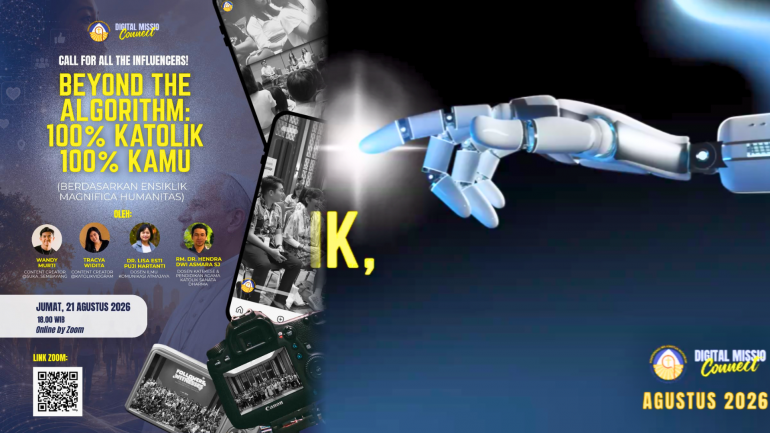
Catholic digital missionaries in Indonesia have been urged to remain authentic and place faith, human relationships and conscience at the center of evangelization as artificial intelligence rapidly transforms digital communication.
The call came during the first episode of Digital Misio Connect, held online on August 21 under the theme “Beyond the Algorithm: 100% Catholic, 100% You.” About 80 Catholic content creators, digital missionaries and Church communicators from across Indonesia participated.
Organized with the involvement of the Indonesian Bishops’ Conference (KWI), the gathering examined how Catholics can proclaim the faith responsibly in a digital environment increasingly shaped by artificial intelligence.
Fr. Frans Kristi Adi Prasetya, executive secretary of the KWI Youth Commission, recalled the 2025 Meeting of Indonesian Catholic Digital Missionaries and Influencers, which brought together 78 Catholic influencers and content creators in Jakarta under the theme “From Followers to Witnesses.”
Fr. Frans Kristi emphasized that the primary measure of digital evangelization is not views or follower numbers, but whether Christ remains at its center.
Social media influence, he said, also carries responsibility. Content created for evangelization should avoid hate speech, false information and material that demeans people or exploits sensitive issues involving ethnicity, religion, race and social relations.
The greater the audience, the greater the responsibility, he stressed.
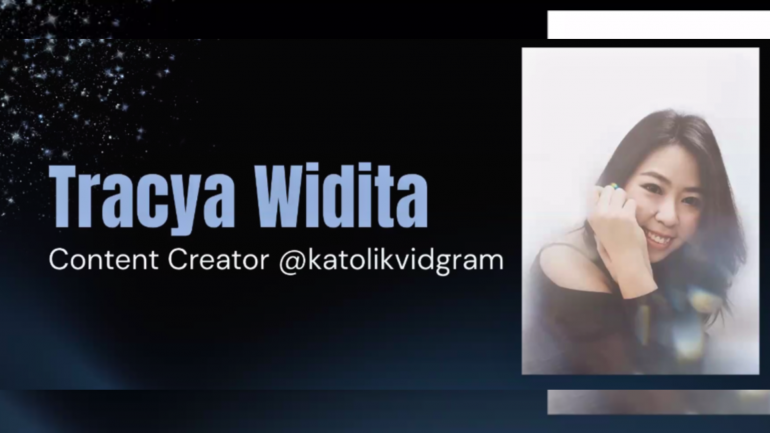
Tracya Widita, a content creator with KatolikVidGram, said authentic Catholic content must grow from lived experience. After more than a decade of creating Catholic content, she said consistency cannot depend solely on trends but requires continuous learning and reflection.
Content may be technically polished, she said, but if it does not arise from lived faith, it can become “dry.”
The concern is particularly relevant as AI makes it increasingly easy to generate texts, images and videos. While technology can assist content creation, it cannot reproduce the experience of prayer, personal struggle, conversion or a relationship with God.
Tracya also noted that social media can become a first gateway to the Catholic Church. Some people who interact with Catholic creators online eventually share personal struggles, seek to learn more about the faith and are directed to nearby parishes.
This requires parishes to be prepared to receive people who approach the Church through digital platforms, participants noted. Digital evangelization, therefore, should lead to real human and community encounters rather than remain an end in itself.

Wandy Murti, creator of Suka Sembahyang and a participant in the OMK Academy for young Catholic content creators, similarly shared how ordinary faith experiences can become opportunities for evangelization and pastoral accompaniment.
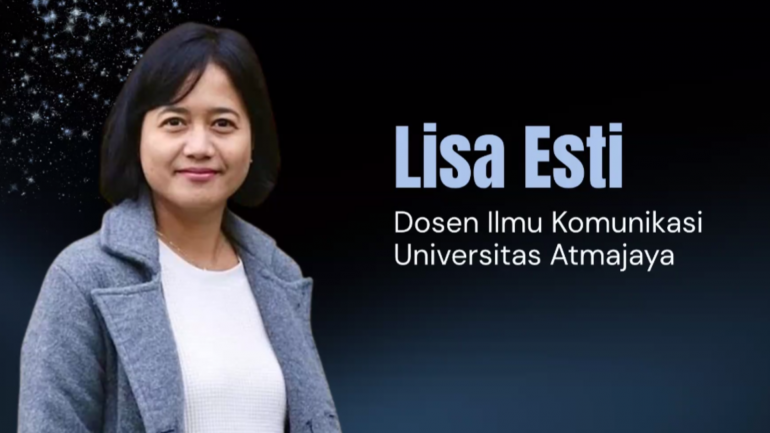
Dr. Lisa Esti Puji Hartanti, a communications lecturer at Atma Jaya University Jakarta and member of the KWI Youth Commission’s executive board, warned against excessive dependence on AI. While the technology can improve efficiency, overreliance on instant solutions could weaken human skills and critical thinking.
Fr. Alexander Hendra Dwi Asmara, SJ, a lecturer at Sanata Dharma University, placed the discussion within a theological framework, emphasizing that technological development must serve human dignity.
He urged participants to develop digital literacy rooted in Christian ethics and to ask not only what technology can do, but what kind of human beings society wants to preserve.
Participants also highlighted the importance of discernment in an environment flooded with AI-generated information. They stressed the need to consider who produced information, why it was produced, whether it is accurate and how it affects others.
Fr. Frans Kristi said discussions also revealed a growing desire for face-to-face encounters among digital missionaries who often collaborate across regions and countries.
The initiative also highlighted the need to prepare seminarians and priests for ministry in digital spaces while maintaining appropriate boundaries and pastoral wisdom.
Digital Misio Connect is expected to strengthen collaboration among KWI commissions, particularly those responsible for social communications, catechesis and youth ministry, through ongoing formation, retreats, catechetical programs and opportunities for community building.
For Catholic digital missionaries, the challenge is not to compete with AI, but to ensure that technology remains a tool for evangelization rather than a substitute for faith, human encounter and authentic Christian witness.
Radio Veritas Asia (RVA), a media platform of the Catholic Church, aims to share Christ. RVA started in 1969 as a continental Catholic radio station to serve Asian countries in their respective local language, thus earning the tag “the Voice of Asian Christianity.” Responding to the emerging context, RVA embraced media platforms to connect with the global Asian audience via its 21 language websites and various social media platforms.
Latest News