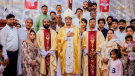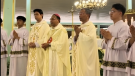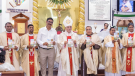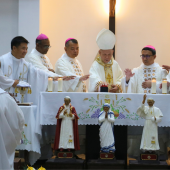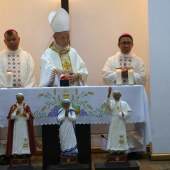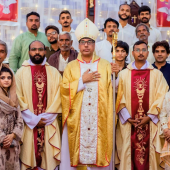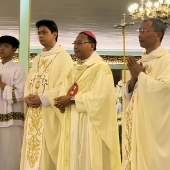



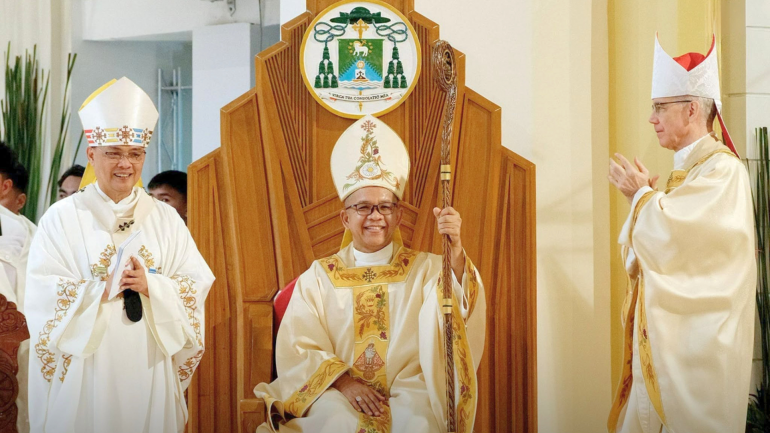
The Catholic Church in the Philippines celebrated a historic milestone as the Apostolic Vicariate of Calapan was officially elevated to the Diocese of Calapan on August 7, opening a new chapter in the Church's mission on the island province of Oriental Mindoro.
Located south of Luzon, Oriental Mindoro is home to farming and fishing communities, the indigenous Mangyan peoples, and a vibrant Catholic population whose faith has been nurtured by missionaries for nearly a century. Calapan City, the provincial capital, now serves as the seat of the country's newest diocese.
The canonical erection of the diocese and the installation of Bishop Moises M. Cuevas as its first diocesan bishop brought together Church leaders from across the Philippines, including Archbishop Charles John Brown, Apostolic Nuncio to the Philippines; Manila Archbishop Cardinal Jose Advincula; Archbishop Gilbert Garcera, president of the Catholic Bishops' Conference of the Philippines; bishops, priests, religious, government officials, and thousands of lay faithful.
Reflecting on the long journey of the local Church, Bishop Cuevas recalled an entry from the diary of Bishop William Duschak, SVD, written during the dedication of the cathedral in 1962, describing Mindoro as being "on the way to becoming a diocese."
"It was 1962. If it was a dream back then, now it is a blessing received," Bishop Cuevas said, describing the elevation as the fulfillment of a vision first imagined more than six decades ago.
Drawing on the commonly associated meaning of Mindoro as Mina de Oro ("Gold Mine"), the bishop reminded the faithful that the island's greatest treasure is not found beneath its soil but in its people.
"If Mindoro is a gold mine, where is the real gold of Mindoro? The real gold of Mindoro is the Holy Spirit who continues to move in this people," he said.
He paid tribute to generations of missionaries, catechists, religious, and lay faithful whose sacrifices laid the foundations of the local Church during its 75 years as an apostolic vicariate.
"We have inherited the sacrifice of the missionaries. We have inherited the sweat of the catechists. We have inherited the prayers of our grandparents. We have inherited the steadfastness and humility of the Mangyan people. We have inherited the service of priests, religious, and lay faithful," he said.
Quoting Pope Leo XIV, Bishop Cuevas said becoming a diocese also marks a renewed missionary responsibility.
"With the light and strength of the Holy Spirit, let us build a Church that is a sign of unity, a missionary Church," he said. "Being a full diocese means being sent out more fully as a missionary people journeying together under the guidance of the Holy Spirit."
In his message, Archbishop Garcera described the creation of the Diocese of Calapan as "a unique blessing" that reflects God's enduring faithfulness.
"I pray that the new Diocese of Calapan will remain close to the heart of Jesus, the Good Shepherd. May it become a source of communion, a bridge of reconciliation, and a community of missionary disciples who bring hope in our time," he said.
Archbishop Brown highlighted the area's rich missionary heritage, paying tribute to Bishop William Finnemann, SVD, the first Apostolic Prefect of Mindoro, who was martyred during the Second World War.
"Your first bishop was a martyr. He gave his life for his people. The blood of the martyrs is the seed of new Christians," the nuncio said, urging the faithful to continue witnessing to the Gospel through lives marked by charity, integrity, and service.
The Diocese of Calapan covers approximately 4,365 square kilometers across Oriental Mindoro and serves about 941,000 Catholics.
Calling the occasion more than an administrative milestone, Manila Archbishop Cardinal Jose Advincula said the establishment of the diocese is "a renewed call to holiness and evangelization."
For the Catholics of Oriental Mindoro, what was once a distant dream has become both a grace received and a renewed missionary mandate.
Radio Veritas Asia (RVA), a media platform of the Catholic Church, aims to share Christ. RVA started in 1969 as a continental Catholic radio station to serve Asian countries in their respective local language, thus earning the tag “the Voice of Asian Christianity.” Responding to the emerging context, RVA embraced media platforms to connect with the global Asian audience via its 21 language websites and various social media platforms.
Latest News