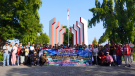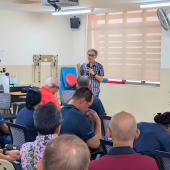



About 20 visitors joined a free guided tour of St. Joseph’s Church in Bukit Timah, Singapore, on October 31, exploring its 180-year history, architecture and Catholic heritage.
The tour was organized by the Catholic Architectural Guild, a lay apostolate of Catholic architects, in collaboration with the parish’s heritage guides. The initiative welcomes visitors of all backgrounds, including non-Catholics, to discover the Catholic faith through church architecture and history.
Architect Thomas Lew, who designed the church’s seven-bell tower with his wife, explained the inspiration behind the structure.
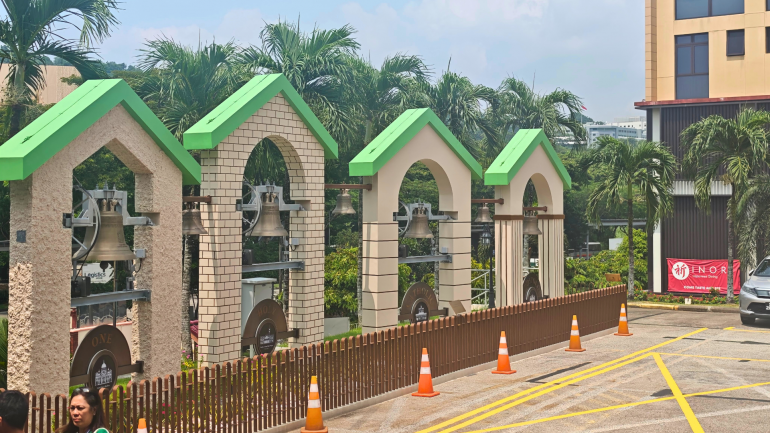
The seven bells hang in four small arched towers beside the church. Lew said his original design featured seven towers arranged in a row, one for each bell, resembling “seven people standing together for the photo shoot.”
Differing in height, width and color, the towers represented the Church’s teaching that people are equal despite their differences.
“To God’s eye, everybody is the same,” he told visitors.
The parish invited architects in April 2024 to design the bell tower, which could be no more than 5 meters high and 10 meters long, Lew said. Describing the brief he set himself, he added, “It must be timeless.”
To save space and construction costs, the original seven-tower design was reduced to four. Monsignor Peter Zhang, then an assistant parish priest, connected the four towers to the four marks of the Church professed in the Creed: one, holy, catholic and apostolic. They also represent Rome’s four papal basilicas.
The seven bells are named after St. Joseph, the church’s patron; Mary, Mother of Jesus; St. Francis Xavier, patron of missions; St. Carlo Acutis, patron of youth; St. Agnes, representing consecrated persons; St. Vincent de Paul, patron of the poor; and St. Faustina, associated with Divine Mercy.
They ring before the noon Angelus, before weekend Masses and during funerals.
“When you hear the church bell ring, you know you are near the church. You feel good,” Lew said.
St. Joseph’s Church traces its beginnings to 1846, when French missionary Fr. Anatole Mauduit of the Paris Foreign Missions Society established a small chapel near the Kranji River for Chinese Christians working on plantations.
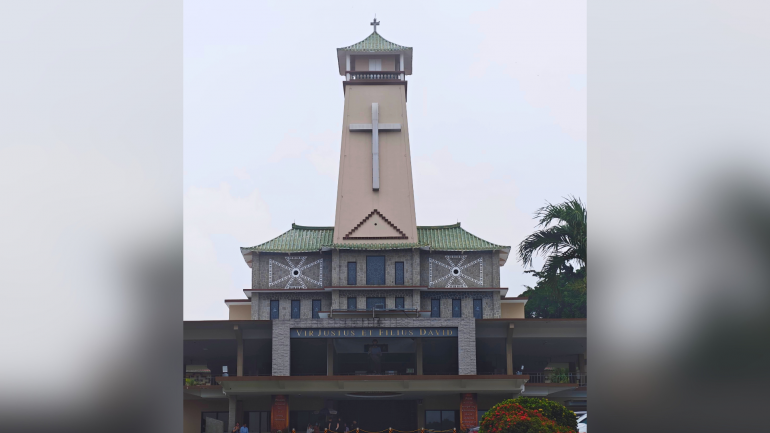
In 1853, the Catholic community moved to its present location in Bukit Timah, in western Singapore. The church was subsequently rebuilt and enlarged under Father Joachim Teng and blessed on Aug. 30, 1964. Its architecture features a distinctive Chinese-style green roof.
The parish is marking its 180th anniversary in 2026, with Pope Leo XIV granting a plenary indulgence for the anniversary observance.
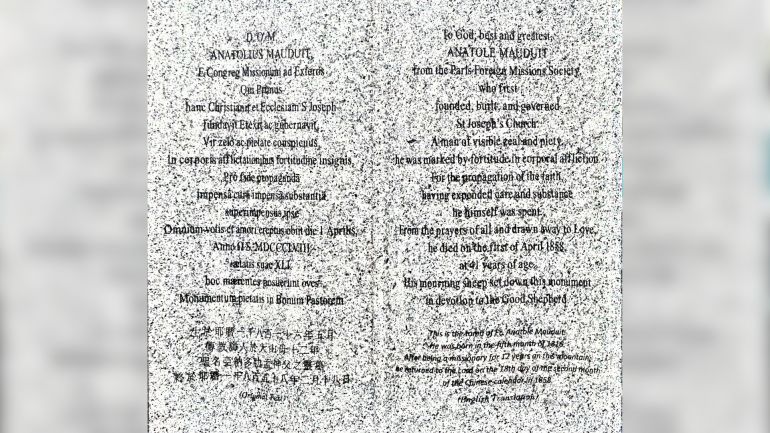
Visitors also explored the parish’s Rosary Garden, where Fr. Mauduit’s gravestone records that he served as a missionary “for 12 years on this mountain.”
Other features included a velvet apple tree brought by Monsignor Francis Lau from the former seminary in Punggol and planted in 1962, and a vegetable garden maintained by the parish’s Society of St. Vincent de Paul to provide food for families receiving assistance.
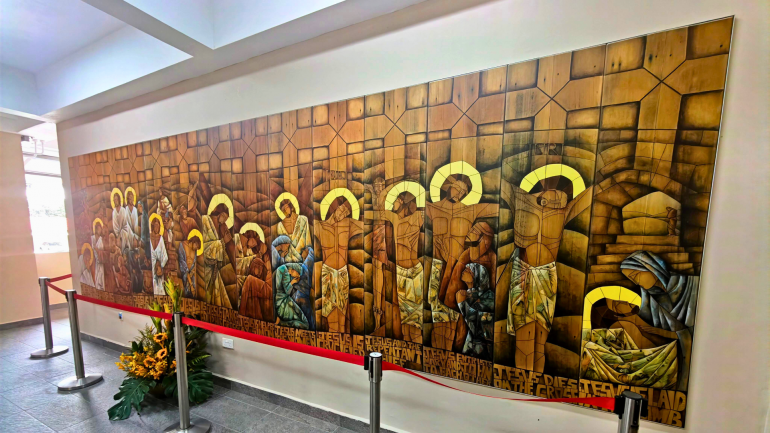
Inside the church, visitors viewed the Scriptural Stations of the Cross by artist Dianne Minnaar. The paintings were created on kneelers salvaged from old church pews. Their worn edges and nail holes were deliberately retained “to symbolise Christ’s suffering,” according to an accompanying plaque.
Jason Wong, 55, a self-employed visitor who is Anglican and comes from a Catholic family, joined the tour out of curiosity.
He said what stood out was “the effort put in to start the church, the history and how the Bukit Timah location was chosen,” as well as the story of the bell tower.
He came away impressed by “the growth of the Catholic faith and the amount of commitment” reflected in every part of the church, “and trees even.”
The tour concluded at the bell tower shortly before noon, when all seven bells rang.
Those unable to visit in person can explore the church through its virtual tour.
Radio Veritas Asia (RVA), a media platform of the Catholic Church, aims to share Christ. RVA started in 1969 as a continental Catholic radio station to serve Asian countries in their respective local language, thus earning the tag “the Voice of Asian Christianity.” Responding to the emerging context, RVA embraced media platforms to connect with the global Asian audience via its 21 language websites and various social media platforms.
Latest News