


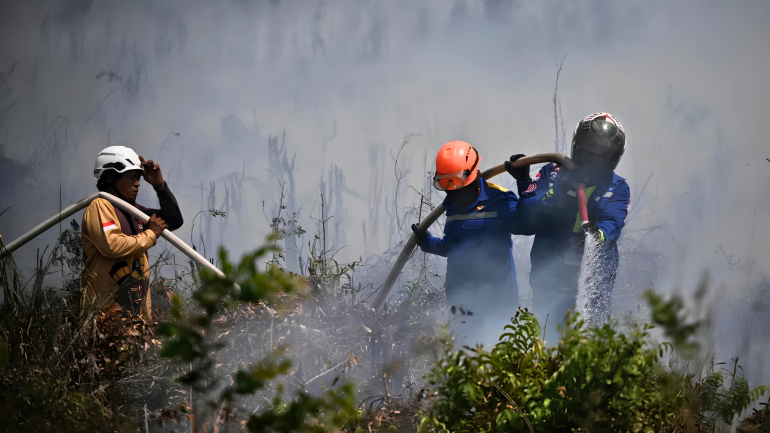
Catholics in Singapore are calling for ecological conversion and greater regional cooperation as smoke from forest and peatland fires in neighboring Indonesia blankets the city-state, raising concerns about public health and the destruction of the environment.
Parishioners at the Church of the Holy Family in Singapore prayed on October 13 for God to “dispel the haze that is engulfing the region and affecting the health of so many.” The prayer, composed by a parishioner during a faith formation session, also asked God to “remove the root cause of the haze and help us all to restore your creation to its health and beauty.”
Three days later, Singapore’s National Environment Agency reported 24-hour Pollutant Standards Index readings in the “very unhealthy” range in three of the city-state’s five regions. Authorities also said they would issue notices to seven companies in Indonesia linked to fires on their land.
The recurring haze crisis highlights the environmental and public health consequences of fires in forests and peatlands across Southeast Asia, where smoke can travel across national borders and affect communities far from the areas where fires originate.
From South Kalimantan province in Indonesian Borneo, Fr. Wilbrodus Andreas Bisa, head of the Justice, Peace and Integrity of Creation Commission of the Diocese of Banjarmasin, urged Singaporean Catholics to continue speaking out for ecological responsibility.
“It cannot be denied that your country has now been affected by the ‘export of smoke’ from the fires,” the Franciscan priest said in written responses in Indonesian. “May your critical voice and good intentions to keep speaking out about the fires move the hearts of more and more people to sharpen their ecological sensibility.”
Reflecting on St. Francis of Assisi’s Canticle of the Creatures, which praises God “through Brother Fire,” Fr. Bisa warned that the misuse of fire can turn nature’s beauty into destruction.
“When fire is used without respect and caution, the goodness and beauty of nature turn into a disaster that destroys everything,” he said.
Capuchin Father Pionius Hendi, who chairs Inter-Franciscans for Justice, Peace and Integrity of Creation (INFO JPIC) Indonesia, told Catholics in Singapore that “we share the same air, interconnected ecosystems and the same future.”
“The ecological crisis in Kalimantan is not merely Indonesia’s problem. It is also a regional and global problem,” he said in written answers in Indonesian.
Friar John Paul Tan, a Singaporean Franciscan who directs Fraternitas, the Order of Friars Minor’s ministry to young adults, also called for a change in attitudes toward creation, wealth and human relationships.
Writing from Assisi, Italy, the birthplace of St. Francis, he said the crisis requires “the personal conversion that views others, creation and wealth as a shared common enterprise.”
He urged Catholics to pray for the conversion of those involved in the palm oil industry, civic leaders responsible for serving their communities, and resources to assist poor people affected by the crisis.
Friar John Wong, OFM, General Definitor for Asia-Oceania of the Order of Friars Minor, said from Rome the haze disrupts health, education, livelihoods and daily life, making it a shared regional concern rather than a cause for division.
“We should not allow environmental crises to become occasions for division,” he said. “They should move us towards greater solidarity, honest dialogue and practical cooperation.”
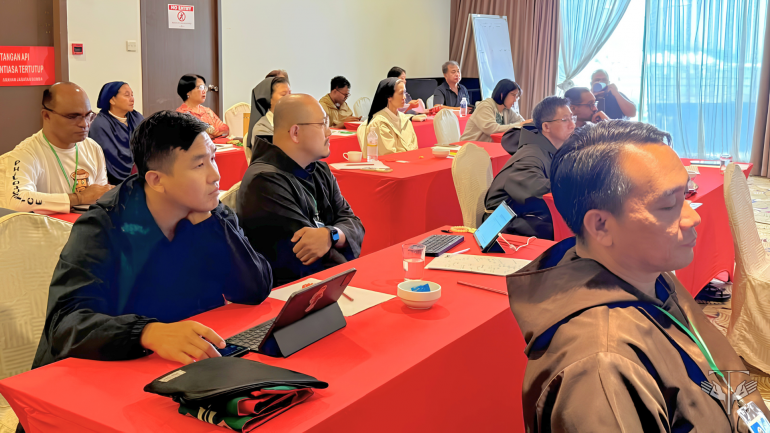
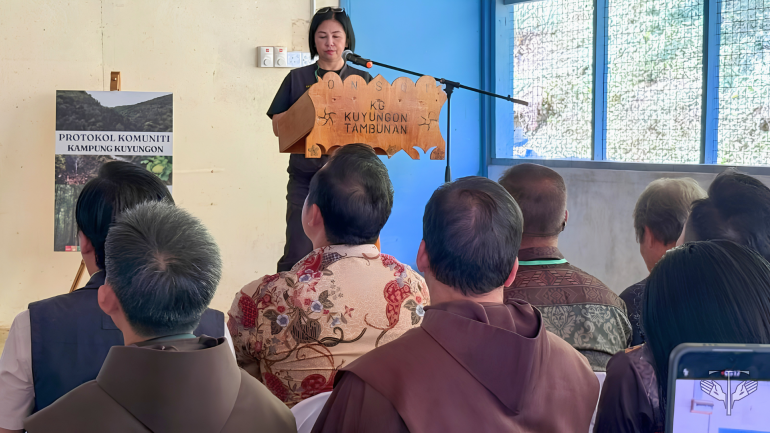
The Franciscan tradition, he added, offers a spiritual foundation for responding to the crisis.
“The Canticle of the Creatures teaches us to recognise creation as our kin,” he said. “For the Franciscan family, the haze is a call to prayer and action.”
G. Clare Westwood, regional director of the Roman Catholic Episcopal Commission for Creation Justice of Malaysia, Singapore and Brunei, said the crisis reflects a failure to fulfill humanity’s responsibility to care for the natural world.
“In Genesis, we are called to be stewards. We are failing in this responsibility by causing the haze and allowing it to continue,” she said.
Westwood also cited UNICEF’s Children’s Climate Risk Report 2026, which found that 2.3 billion children live in areas with unhealthy air. She urged Church leaders to use their platforms to promote ecological responsibility.
“Clergy can use the pulpit for advocacy for ecological justice too,” she said.
The Catholic responses bring together prayer, public advocacy and calls for cooperation across national borders. As haze from Indonesian fires affects communities in neighboring countries, Church leaders are urging people to address not only the immediate effects of smoke but also the human choices that contribute to environmental destruction.
Their message echoes the Franciscan understanding of creation as a shared gift that calls for respect, responsibility and solidarity, particularly with those whose health and livelihoods are most vulnerable to environmental damage.
Radio Veritas Asia (RVA), a media platform of the Catholic Church, aims to share Christ. RVA started in 1969 as a continental Catholic radio station to serve Asian countries in their respective local language, thus earning the tag “the Voice of Asian Christianity.” Responding to the emerging context, RVA embraced media platforms to connect with the global Asian audience via its 21 language websites and various social media platforms.
Latest News