The Church understands herself as the People of God, a pilgrim community called into communion and mission. Within this assembly, leadership is not power but service. Whether exercised by ordained ministers or lay faithful leading associations and parish initiatives, servant leadership is essential for fostering unity and strengthening communion.
At times, some faithful experience distance from ecclesial life. Such moments invite the Church, not to self-criticism, but to renewed pastoral closeness, attentive listening, and shared responsibility.
A pastoral experience illustrates this.
In a poor mission village where electricity was installed for the first time, the Catholic community decided to celebrate Midnight Christmas Mass. A man named Michael threatened to cut off the electricity if the Mass was held. Rather than responding with confrontation, the parish priest chose a synodal path. Together with the Parish Pastoral Council, he prepared alternative arrangements and entrusted the situation to God.
During the Mass, the priest noticed Michael pacing outside. In the homily, he spoke simply: “Love is born today, and this same love has saved us.” After the final hymn, still vested, the priest went outside and said, “Michael, come in. Today we are celebrating Christmas. Jesus loves you.” Michael broke down, held the priest’s feet, and said, “Father, I am sorry.”
This act reflects the heart of servant leadership: not power, but mercy; not exclusion, but communion. It mirrors Christ, who came not to condemn but to save (cf. Jn 3:17), and the Good Shepherd who seeks the lost (cf. Lk 15:4–7).
Biblical Foundations of Servant Leadership
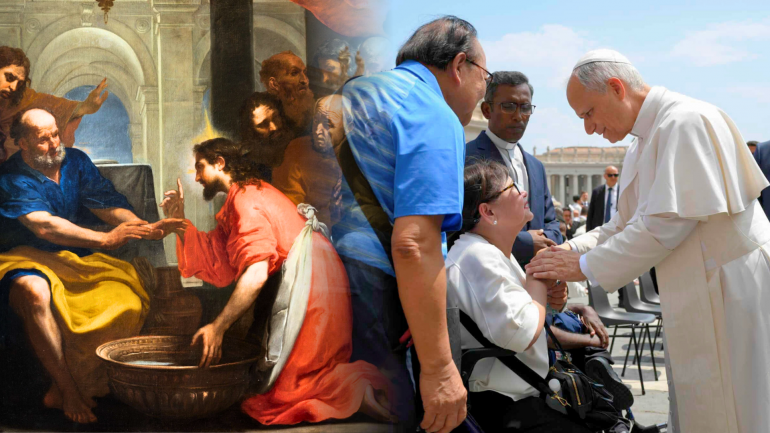
Servant leadership finds its model in Jesus Christ. When the disciples sought honor, He redefined authority: “Whoever wishes to be great among you must be your servant” (Mk 10:43). At the Last Supper, He washes the feet of His disciples (Jn 13:1–15), revealing leadership as humility and self-giving love. By serving all, including Judas, He establishes a leadership rooted in a shared “we.” “I have given you an example” (Jn 13:15). This is fulfilled on the Cross (Phil 2:7). The early Church embodied this through prayer, discernment, and shared responsibility (cf. Acts 6:1–6; Acts 15).
Servant Leadership and the People of God
The Second Vatican Council affirms that all the baptized share in Christ’s mission (Lumen Gentium, 31). Servant leadership, therefore, belongs to ordained ministers, religious, and lay faithful alike. As a synodal Church, leadership cannot function as “we versus you,” but as shared responsibility. As St Paul teaches, leadership is given “for the common good” (1 Cor 12:7). Associations and movements must remain instruments of communion in harmony with parish and diocesan life.
Essential Qualities of Servant Leadership
Servant leadership, whether clerical or lay, is marked by certain qualities. These qualities do not arise from shortcomings in the Church, but from the Gospel’s constant call to growth, renewal, and deeper fidelity to Christ.
Humility is foundational. Jesus invites leaders to learn from Him, “for I am gentle and humble of heart” (Mt 11:29). Authority in the Church is always entrusted and exercised as service.
Listening and discernment are indispensable. Jesus listened attentively to those who approached Him (Mk 10:51). Today, synodality calls leaders to listen to God, to one another, and to the lived experiences of the faithful.
A spirit of service and self-giving defines authentic leadership. “The Son of Man came not to be served but to serve” (Mt 20:28). This applies to ordained ministry and equally to lay leadership in associations and movements.
Communion and collaboration safeguard unity. Jesus prayed “that they may all be one” (Jn 17:21).
Pastoral charity and compassion give leadership its evangelical credibility. Jesus, the Good Shepherd, was “moved with pity” for the crowds (Mt 9:36).
Servant leadership unites the Church as one People of God, through humility, service, and love, following Christ who gathers all into one.