



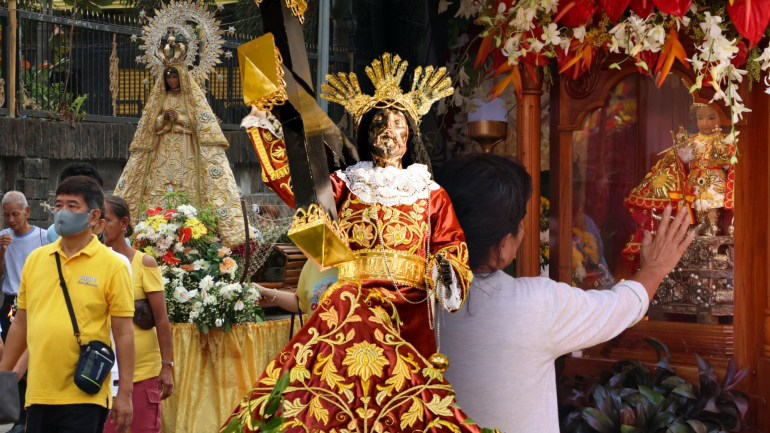
Recent mockery of Catholic devotion—particularly claims that Catholics worship wood or a “burnt god,” referring to the devotion to Black Nazarene in the Philippines—does not arise from a genuine engagement with Catholic teaching, but from a misconception of it.
Those who repeat such accusations are often not arguing against what Catholics believe, but against a caricature formed in ignorance.
Disagreement is legitimate; misrepresentation is not.
Some critics assume that Catholics treat the image itself as God. This is false.
Catholics worship Christ, not an object. Sacred images are representations meant to direct devotion toward the person they signify, not substitutes for God Himself.
The material of an image—wood, paint, or stone—has no divine status in Catholic belief.
This misunderstanding often surfaces in objections to bodily gestures such as bowing or kneeling before images.
Bowing before an image of Christ would be idolatry if Catholics treated the wood or stone as divine. They do not. Images are not regarded as spiritual beings, but as representations that direct devotion toward God, not substitutes for Him. The gesture expresses reverence toward Christ, not belief in the divinity of the object.
Others argue that the very act of creating religious images constitutes idolatry, citing Exodus 20:4–5, which warns against making images of anything “in heaven above” or “on the earth beneath.”
Read in isolation, the passage can appear to prohibit all images.
Read in full, however, the commandment is specific: the prohibition concerns bowing down to and worshipping images as gods.
The warning applies to “those who hate me”—that is, those who replace God with idols.
Read together, Exodus 20:4–5 and Exodus 25:18–20 give Catholics a clear basis for interpretation.
Scripture itself records God commanding Moses to make cherubim—heavenly beings, unmistakably “things in heaven above”—to adorn the Ark of the Covenant.
If the commandment were an absolute ban on representation, this instruction would be incoherent. A commandment cannot be interpreted in a way that makes God disobey Himself.
Taken together, these passages show that the Bible does not reject images; it rejects idolatry.
Catholic devotion to sacred images follows this same distinction—one rooted not in evasion, but in the internal coherence of Scripture itself.
For many Catholics, the difficulty is not belief but articulation. They practice the faith devotionally but not always articulately. They sense that something is right, yet struggle to explain why. When challenged, some retreat into silence—not because their faith is mistaken, but because they lack the language to defend it against caricature.