





Every September, the Church pauses beside a mother whose grief has no equal. Our Lady of Sorrows stands at the foot of a cross the world had already judged a failure. And yet this is the same woman who once sang that the proud would be scattered and the lowly lifted up. The Magnificat and the sorrow are not two different Marys. They are one woman living out the same conviction in two different keys, and that unity has something urgent to say to a world increasingly run by machines that cannot sing or weep at all.
A Song Before She Knew the Cost
When Mary sang her Magnificat, she was young, pregnant, and almost certainly frightened. She sang anyway, about a God who topples the mighty and fills the hungry, about a reversal of every worldly hierarchy. It is easy to read that song as pure triumph. It is harder and more honest to read it as a promise; she would spend the rest of her life paying.
Pope Leo XIV’s encyclical Magnifica humanitas closes with a meditation on that same song. He calls it a song of hope, but hope, in Mary’s life, was never separable from cost. The Magnificat is not a lullaby. It is a declaration that God measures worth by a different scale than the world does, and Mary lived long enough to watch that declaration nearly destroy her.
Sorrow and Song Are Not Enemies
This matters now because we are building systems that measure human worth almost exclusively by the world’s old scale: output, efficiency, predictability, and usefulness. An algorithm does not ask whether a person is loved. It asks whether they are productive, engaged, and monetisable. Leo’s encyclical names this danger plainly: the risk is not that machines will replace us but that we will start measuring ourselves the way machines measure everything and quietly accept that a person’s value can be calculated.
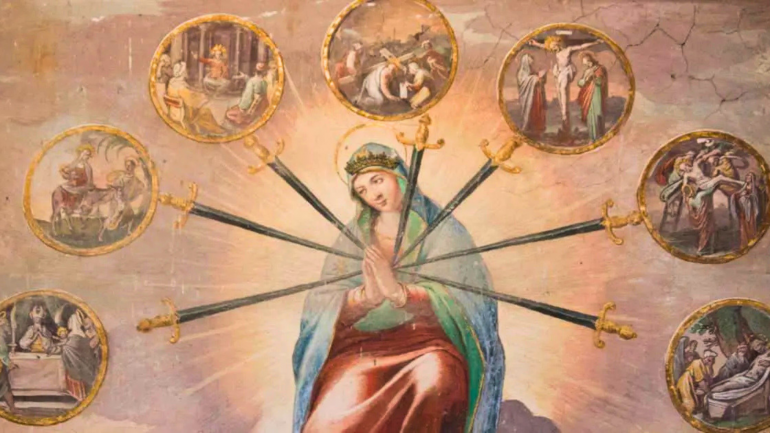
Our Lady of Sorrows refuses that math entirely. At Calvary, by every efficient standard, her son was a catastrophic failure, a condemned man, abandoned by his followers, executed as a criminal. There was no metric on earth that would have called that scene a victory. And yet Mary stood there anyway, not fixing anything, not optimising anything, just present to a suffering that made no sense by the world’s accounting. That presence is itself a theological statement: some things matter precisely because they cannot be justified by usefulness.
What the Machine Cannot Weep For
We live in a moment that is strangely allergic to unproductive sorrow. Grief gets rerouted into apps that track our moods and suggest coping strategies. Loneliness gets outsourced to chatbots designed to feel like companionship without the inconvenience of another person’s actual needs, and without anyone clearly being responsible when that simulation fails. There is real comfort in some of these tools, and there is no reason to pretend otherwise. But there is also a quiet danger in letting anything synthetic stand in for the specific, costly work of accompanying another person through pain.
Mary’s sorrow was never efficient. It did not solve anything. It did not shorten the Passion or spare her son the nails. What it did was refuse to let suffering happen in isolation. That refusal, the sheer stubbornness of staying present when nothing can be fixed, is precisely what no system built on optimisation can replicate, because optimisation exists to eliminate exactly the kind of “wasted” presence Mary offers. A God who becomes flesh and a mother who stands at the cross are both, from an efficiency standpoint, unnecessary. That is the point.
Living Between Compassion and Hope
The task facing anyone trying to live faithfully in this new landscape is not to reject technology outright; the Church has never asked that, and this pontificate certainly has not. The task is to hold onto the two-sided witness of Mary: the woman who sang of a world remade in justice and the woman who wept beside injustice she could not undo. Both postures are necessary. A hope that never grieves becomes naive. A grief that never hopes becomes despair.
Practically, this might mean something as unglamorous as choosing to sit with a struggling friend instead of forwarding them a wellness app. It might mean asking, before adopting some new efficiency, who gets flattened into a data point by it. It might mean simply remembering, when a system tells you that your worth is measurable, that the woman at the foot of the cross would have laughed, sorrowfully, at the very idea.
Our Lady of Sorrows and the Magnificat are not opposites to reconcile. They are the same fidelity, sung in one breath and paid for in the next. In an age tempted to solve suffering out of existence rather than accompany it, she remains a strange, stubborn, necessary witness.


