Caritas Bangladesh's Mymensingh Region held a workshop on June 25 to address human-elephant conflict as part of its Food Security and Livelihood (FSL) Project.
The aim of this program to promoting peaceful coexistence between local communities and wildlife while protecting livelihoods in northern Bangladesh.
The workshop was chaired by Ms. Rosey Rongma, Regional Director of Caritas Mymensingh. Mr. Kazi Mohammad Nurul Karim, Divisional Forest Officer, attended as the chief guest, while Professor Dr. Mohammad Sakhawat Hossain of Sher-e-Bangla Agricultural University delivered the keynote presentation.
Among the distinguished participants were Mr. Showpoun Kumar Paul, Executive Director of Sabalamby Unnayan Samity (SUS); Mr. Gregory Vanderbilt, Country Representative of the Mennonite Central Committee (MCC); Dr. Md. Arefur Rahaman, Food Security Coordinator of MCC; and Mr. Kamal Hossain, Programme Officer of MCC. The session was facilitated by Mr. Dulen Areng.
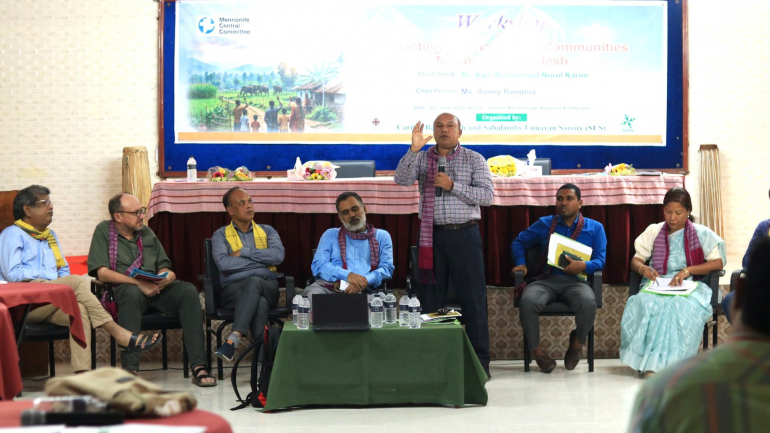
In his keynote address, Professor Hossain presented a historical overview of elephant migration into Bangladesh and highlighted practical approaches to fostering coexistence between humans and elephants. He emphasized the importance of community awareness, habitat conservation, and coordinated action among stakeholders.
Addressing the participants, Mr. Karim stressed the need to respect traditional elephant migration corridors and outlined existing government compensation mechanisms for families affected by human–elephant conflict. He underscored the importance of collaborative efforts among government agencies, development organizations, and local communities to reduce conflict and ensure sustainable livelihoods.
The workshop brought together 31 participants, including 19 men and 12 women, providing a platform for dialogue, knowledge sharing, and the development of effective strategies to mitigate human–elephant conflict in vulnerable areas of northern Bangladesh.