



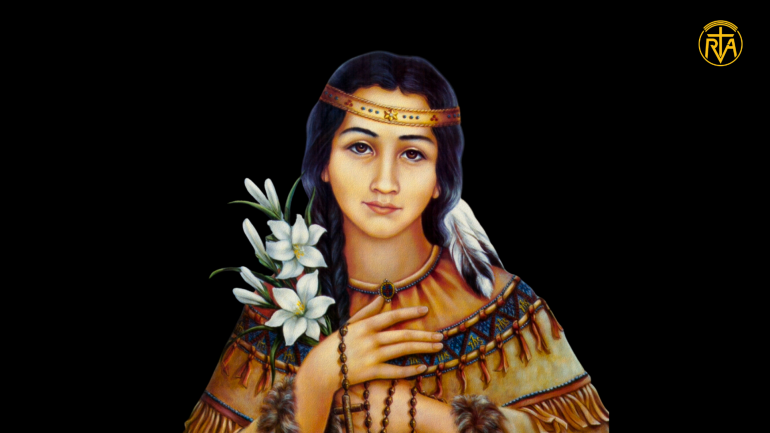
We usually meet the saints at the end of their stories: haloed, composed, and already complete. St. Kateri Tekakwitha stands out, because so much of her story is about someone finding her way forward in the dark, sometimes in a very real sense.
Most of what people remember about her sounds almost too perfect: “Lily of the Mohawks,” the first Native American canonised in 2012, and the scars that witnesses said faded from her face just minutes after she died at twenty-four. These stories are true and beautiful, but they can quietly hide the harder, more human realities underneath. Those are the things that make her story matter to the rest of us.
Let’s start with the trauma because she did. When Kateri was about four, a smallpox epidemic swept through her Mohawk village near what is now Auriesville, New York. It killed her mother, father, and younger brother, leaving her an orphan cared for by her uncle. The disease scarred her face and badly hurt her eyesight. She spent much of her life squinting and often covered her head to shield her eyes from the light. Her name, Tekakwitha, is often translated as "she who bumps into things" or "she who feels her way." Before anything else, she was a grieving, partially blind, and visibly scarred child in a community that had every reason to see her as marked.
Looking at her life through a psychological lens, almost everything that follows seems like post-traumatic growth. It’s not about being untouched by pain, but about slowly building meaning from it. Research on early loss is sobering: losing a parent as a child raises the risk of depression, anxiety, and a deep sense of insecurity. Losing your whole immediate family at once, in one terrible season, is a wound most adults never fully process. Kateri was only four.
What she did with that pain is worth paying attention to. According to the stories we have, she did not become bitter or withdraw from others. Instead, she found direction. When Jesuit missionaries came to her village, the faith she discovered gave her grief a new meaning, a story big enough to include her lost loved ones and a future she could choose. She was baptised at twenty and took the name Kateri after Catherine of Siena.
Next comes a part that many modern readers might overlook, since it can seem like simple piety: she refused to marry. In her community, marriage was not just about feelings but about structure, economic security, social belonging, and the expected path for a young woman. Her refusal came at a real cost. She was mocked, pressured, accused, and sometimes even threatened. Eventually, she walked about two hundred miles north to a Christian mission near Montreal, Kahnawake, where she could live as she believed she was meant to.
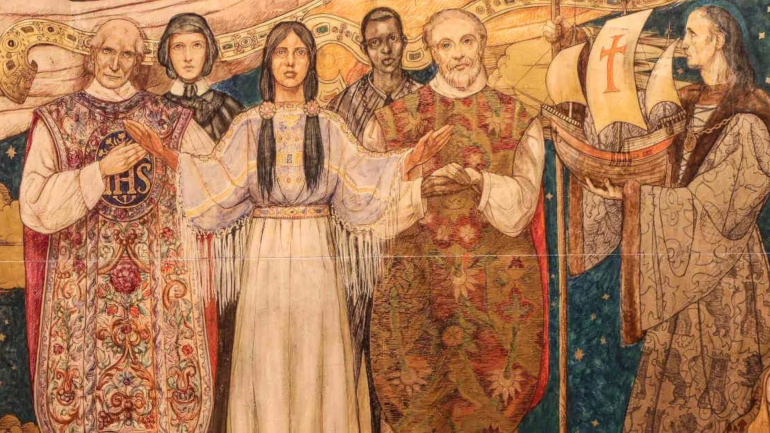
It’s easy to see this only as religious devotion, but it’s also a clear example of autonomy. She was a young woman choosing the self she knew over the one her world expected, and she accepted the social consequences. Self-determination theory would call this the pursuit of an authentically owned life; she would have called it belonging to God. Both are true.
We also need to be honest about the harder parts. Kateri lived during a time when colonial forces were already breaking apart her people, and her strict practices at Kahnawake, fasting, facing the cold, sleeping on thorns, can be troubling to anyone who worries about self-harm. We do her no favours by ignoring this. But in her time, suffering was often seen as a way to show love, and her actions came from a deep desire to give herself completely. We don’t have to copy her methods, but we can take her love seriously.
What makes her quietly modern is the people she stands with now, even without trying. She is a patron for trauma survivors who refuse to be defined only by their wounds, for people with visible differences who learn, often painfully, that a face is not a verdict, for those who are displaced and searching for a place where they can truly be themselves, for young people pressured to live a life they did not choose, and for Indigenous Catholics who hold a faith and a history that are both tangled and tender.
The story of her scars disappearing is a beautiful legend. But the real miracle is simpler: a half-blind orphan kept moving forward and found something true. Most of us are doing the same. She just did it toward the light.