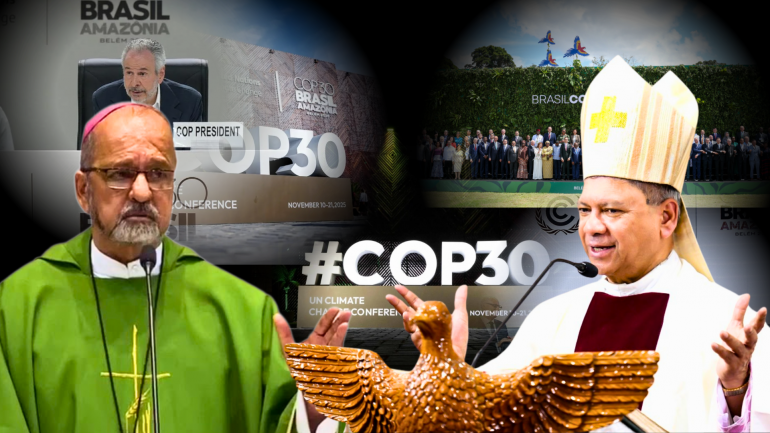
Two key offices of the Federation of Asian Bishops’ Conferences have called for deeper collaboration across faiths to address the climate crisis and promote care for creation, following the outcomes of COP 30.
The joint statement, issued by the FABC Office of Human Development (OHD/CCD) and the Office of Ecumenical and Interreligious Affairs (OEIA), was presented during the FABC Central Committee and Offices meeting held on March 5, 2026, at the Camillian Pastoral Care Centre in Bangkok. The gathering brought together presidents of episcopal conferences across Asia, along with representatives of various FABC offices.
The statement was signed by Bishop Emeritus Allwyn D’Silva, chairman of OHD/CCD, and Archbishop Emeritus Felix Machado, chairman of OEIA.
Reflecting on COP30, held in Belém, Brazil, from November 10 to 21, 2025, the statement acknowledged both significant gains and critical gaps in global climate action. It noted that the Church played a vital role in offering a moral compass, highlighting the lived realities of vulnerable communities, including the poor, indigenous peoples, migrants, and women.
The document emphasized that climate action must move beyond market-driven approaches and instead be rooted in ecological stewardship, justice, and responsibility, especially by wealthier nations with a greater historical role in environmental degradation.
Among the key gains of COP30 were commitments to mobilize $1.3 trillion annually by 2035 for developing countries, the operationalization of the Loss and Damage Fund, and the adoption of global indicators to track climate adaptation. The conference also advanced women’s participation in climate governance and introduced mechanisms for a just transition from fossil fuels.
However, the statement also highlighted major shortcomings, including the failure to reach binding agreements on phasing out fossil fuels and halting deforestation, as well as the persistent gap between current commitments and the 1.5°C global warming target.
In response, the FABC offices called for a renewed and strategic engagement by the Church in Asia. Central to this effort is fostering collaboration with people of other faiths and neighboring religions to raise awareness about the climate crisis and the outcomes of COP30.
The statement outlined ten priority actions for the Asian Church, including promoting data-driven advocacy, strengthening capacity-building at all levels, supporting the leadership of vulnerable communities, and advancing eco-education initiatives. It also emphasized the importance of bold advocacy to ensure climate justice, equitable financing, and accountability from governments and industries.
A key focus is the promotion of interfaith initiatives, particularly through the Season of Creation, as a means to encourage ecological conversion and collective action.
The FABC offices stressed that while the tools to address the climate crisis exist, a lack of political will remains a major obstacle. They urged the Church in Asia to continue leveraging its moral voice, in partnership with others, to ensure that global commitments translate into meaningful action for the most vulnerable.
The joint initiative aims not only to localize global climate outcomes but also to deepen solidarity across religions in safeguarding the common home.
To read the full document: Joint statement OHD and OEIA
Radio Veritas Asia (RVA), a media platform of the Catholic Church, aims to share Christ. RVA started in 1969 as a continental Catholic radio station to serve Asian countries in their respective local language, thus earning the tag “the Voice of Asian Christianity.” Responding to the emerging context, RVA embraced media platforms to connect with the global Asian audience via its 21 language websites and various social media platforms.
Latest News