FABC Vice President Urges National Synodal Teams to Animate, Accompany Local Churches

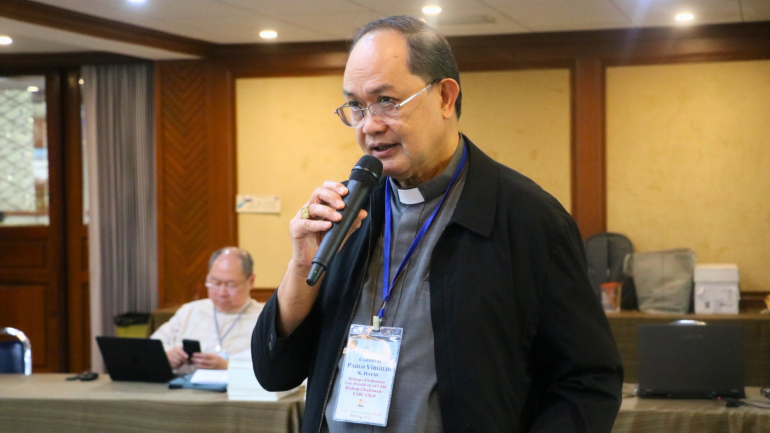
National synodal teams should see themselves not as another layer of authority in the Church, but as facilitators helping bishops, clergy and pastoral communities discover practical ways of living synodality, said Pablo Virgilio Cardinal David, Vice President of the Federation of Asian Bishops’ Conferences (FABC).
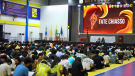
Cardinal David offered the reflection at the conclusion of a table conversation on September 2 during a three-day meeting of national synodal teams at Baan Phu Waan in Bangkok. The discussion, led by Fr. Vimal Tirimanna of Sri Lanka, focused on the question: “What is one concrete thing our national synodal team can do within the next six months to strengthen synodal engagement with our bishops, our clergy and our pastoral councils?”
Cardinal David invited participants to look closely at how the Bangkok meeting itself was organized.
The Commission for Synodality did not have the authority to convene the gathering on its own, he explained. The FABC provided the institutional authority and support, while the commission’s role was to animate the process.
“This is what you are going to do when you go back to your own countries,” Cardinal David told the national teams.
At the national level, teams should help animate diocesan synodal teams, but they cannot do so effectively without the cooperation and support of national bishops’ conferences.
The same principle applies at the diocesan level. Diocesan synodal teams need the support of bishops, while parish-level synodal processes depend on dioceses and existing pastoral structures.
“It’s capacity building on many levels,” Cardinal David said, stressing that the goal is not simply to produce another report, but to nurture a deeper spiritual process in the Church.
He encouraged national teams to help diocesan teams orient parish synodal groups and other ecclesial bodies so that synodality becomes rooted at the grassroots.
Without something happening at the parish and institutional levels, he asked, what can meaningfully be brought into a diocesan ecclesial assembly?
Cardinal David also addressed situations in which a bishop may be reluctant to engage in the synodal process. He urged participants to rely on relationships and appropriate ecclesial structures rather than confrontation.
When a suffragan bishop is uncooperative, for example, the metropolitan archbishop can help facilitate dialogue, he said. But the first step should always be personal conversation.
Referring to Jesus’ teaching on reconciliation, Cardinal David emphasized the importance of speaking directly with a person rather than publicly criticizing or shaming them.
“Don’t post it on Facebook. Don’t shame them,” he said, stressing that patient, personal engagement can open the way to conversion.
He acknowledged that national teams will encounter different pastoral priorities in different countries. Synodality, therefore, should not be treated as something separate from the Church’s other initiatives.
He cited preparations for World Youth Day in Korea as an example. Rather than asking organizers to undertake a separate synodal process, synodal spirituality could be integrated into the event itself.
“You don’t have to separate,” he said. Existing Church activities can be enriched by listening, participation and discernment.
Turning to pastoral councils, he challenged the idea that their role is limited to providing advice that can simply be ignored.
Cardinal David acknowledged that there is no guarantee everyone will immediately embrace synodality. He urged national teams not to label those who resist, but to engage them patiently through respectful, Spirit-led conversation.
Such conversations, he said, can lead to changes in attitude and genuine conversion.
The discussion ultimately pointed national synodal teams toward a practical role: not creating more work for dioceses, but helping them do what they already need to do in a more synodal way.
For Cardinal David, the six-month challenge is therefore not simply to organize another synodal activity, but to strengthen accompaniment from bishops’ conferences to national teams, dioceses, parishes and pastoral councils, so that synodality becomes a lived reality across the Church in Asia.
Radio Veritas Asia (RVA), a media platform of the Catholic Church, aims to share Christ. RVA started in 1969 as a continental Catholic radio station to serve Asian countries in their respective local language, thus earning the tag “the Voice of Asian Christianity.” Responding to the emerging context, RVA embraced media platforms to connect with the global Asian audience via its 21 language websites and various social media platforms.
Latest News