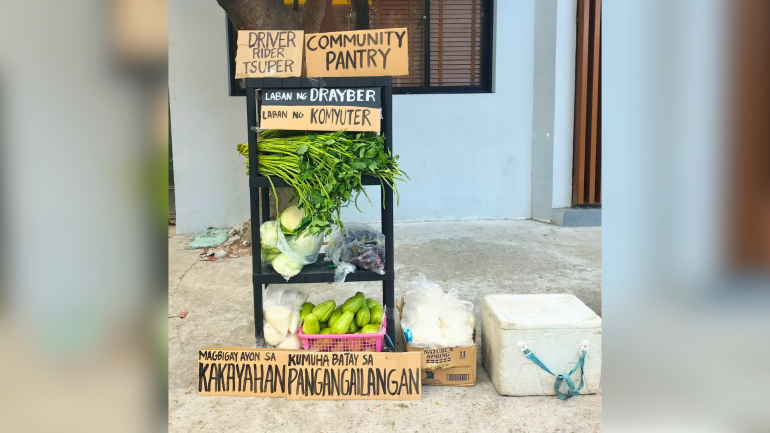
Along a busy roadside in Barangay Biga, Calapan, in the province of Oriental Mindoro, a small wooden table lined with rice, fruits, and basic goods has brought joy and relief to passing drivers and residents, at a time when many Filipino families are tightening their budgets amid rising global uncertainties.
On March 26, stay-at-home mother Ermarie Fortuno set up a modest community pantry in front of her home, guided by the now-familiar call to solidarity: “Give what you can, take what you need.”
“For drivers, farmers, and those in need,” Fortuno declared.
Her initiative comes as many Filipinos face economic pressures, including rising fuel and food prices linked to global tensions that have disrupted oil supply chains and contributed to inflation. In provinces like Oriental Mindoro, where livelihoods often depend on agriculture and daily wage work, these pressures are felt even more sharply.
Despite limited means, Fortuno chose to act.
“Actually, I don’t have a job right now. I’m a stay-at-home mom… it’s really difficult to find work at the moment,” she said. “I was inspired to set up a community pantry in front of our house after seeing it on Patreng Non’s Facebook, she was the one who started it.”
Ana Patricia Non is a Filipino community organizer best known for starting the community pantry movement in the Philippines.
She launched the Maginhawa Community Pantry in Quezon City in April 2021 at the height of the COVID-19 pandemic. Her guiding principle, “give according to one’s ability, take according to one’s need,” inspired similar efforts nationwide, reviving the Filipino spirit of bayanihan.
Bayanihan is a core concept in Filipino culture that represents community spirit, cooperation, and mutual help.
Drawing from what little she had at home, Fortuno began with simple supplies.
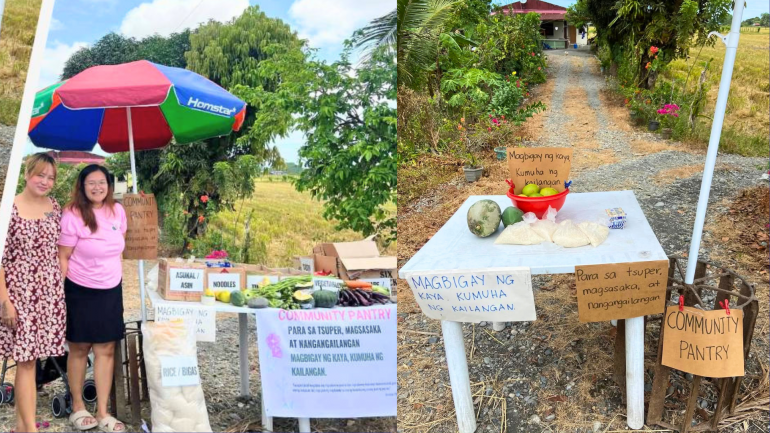
“I realized that if I kept focusing only on scarcity and hardship, nothing would happen in my life. So I checked what we had at home, picked papayas from our yard, and measured out four bags of rice,” she said.
The pantry offers basic items such as rice, freshly picked papaya, lemons, and crackers, simple goods, yet meaningful for those in need.
By its second day, the response has been both encouraging and instructive.
“It's already Day 2. It's going well. The real challenge is making sure people give and take only what is enough,” Fortuno said with a light laugh. “It really needs to be monitored.”
The impact is visible in the reactions of those who stop by.
“You can clearly see the surprise and joy on the faces of the drivers and passersby. They thought we were selling something,” she added.
Fortuno said the pantry will remain open, “as long as there are people who continue to give.”
She also encouraged others to take part in sustaining the effort, by sharing what they can or taking only what they need.
“If you have extra, you can leave it for others. If you are in need, don’t hesitate to take. We are simply practicing bayanihan,” she said.
At a time marked by uncertainty and rising costs, this small roadside pantry stands as a reminder that even modest acts of generosity can sustain both material needs and community spirit.
Radio Veritas Asia (RVA), a media platform of the Catholic Church, aims to share Christ. RVA started in 1969 as a continental Catholic radio station to serve Asian countries in their respective local language, thus earning the tag “the Voice of Asian Christianity.” Responding to the emerging context, RVA embraced media platforms to connect with the global Asian audience via its 21 language websites and various social media platforms.
Latest News