A church-backed labor group has welcomed Pope Leo XIV's newly released encyclical on artificial intelligence while urging stronger protections for workers facing the growing impact of automation and digital technologies.
In a statement issued May 30, the Church People-Workers Solidarity (CWS) praised the encyclical Magnifica Humanitas ("Magnificent Humanity"), describing it as a timely application of Catholic social teaching to the challenges posed by artificial intelligence, automation, and the digital economy.
Signed on May 15, the 135th anniversary of Pope Leo XIII's landmark social encyclical Rerum Novarum, the document warns against what Pope Leo XIV calls a "technocratic paradigm" that concentrates technological power and wealth while reducing people to units of efficiency and profit.
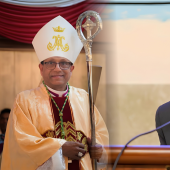
"The economy must serve the worker, never the other way around," said Bishop Alminaza who chairs the group and is bishop of San Carlos, echoing the encyclical's emphasis on the dignity of labor and the primacy of the human person.
The group said technological advances should not be used to justify labor exploitation, mass displacement of workers, union suppression, or the erosion of workers' rights.
"Work is not merely an economic activity; it is participation in God's creative action," he said.
"When technology is used primarily to replace workers in pursuit of greater profit, a new social calamity emerges that strips persons not only of livelihood but also of dignity, purpose, and participation."
The group called on governments, employers, technology companies, educational institutions, and other stakeholders to ensure that innovation serves the common good.
Among its recommendations are retraining and livelihood programs for workers displaced by automation, stronger labor protections in digital industries, ethical regulation of artificial intelligence systems, and safeguards for vulnerable workers in global supply chains.
They also highlighted the often unseen labor behind digital technologies, including data-labeling workers, gig workers, and communities affected by the extraction of minerals used in technological infrastructure.
The group said the Church's social teaching remains relevant in the digital age, insisting that technological progress must be measured not only by innovation and efficiency but also by its impact on human dignity.
"Technology must serve humanity, not replace it," Bishop Alminaza said.
Radio Veritas Asia (RVA), a media platform of the Catholic Church, aims to share Christ. RVA started in 1969 as a continental Catholic radio station to serve Asian countries in their respective local language, thus earning the tag “the Voice of Asian Christianity.” Responding to the emerging context, RVA embraced media platforms to connect with the global Asian audience via its 21 language websites and various social media platforms.
Latest News