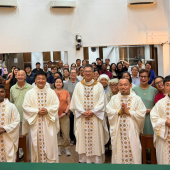



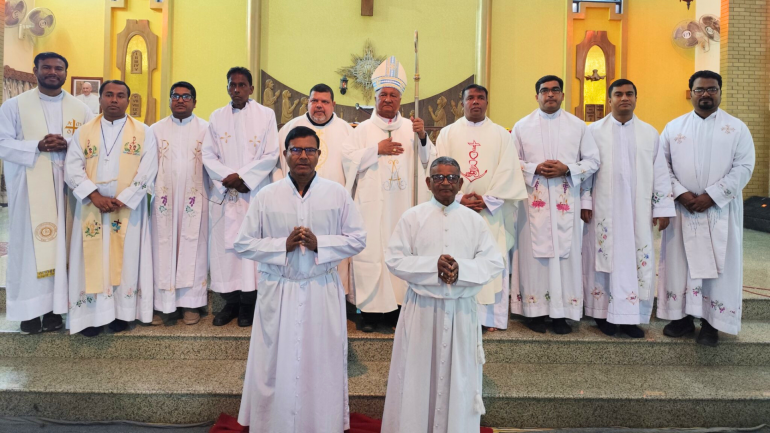
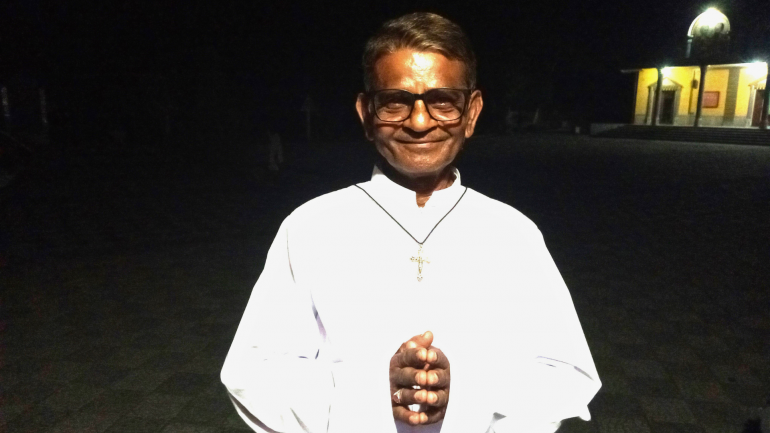
For much of his life, Alexander Corraya carried a quiet regret. As a young man in Bonpara, a predominantly Catholic community in northwestern Bangladesh, he dreamed of becoming a priest. But after completing Grade 10, financial and educational challenges prevented him from pursuing that path.
Today, at 65, the retired chef has discovered another way to serve the Church he has loved all his life.
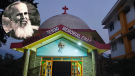
Every morning, Corraya attends Holy Mass at Bonpara Catholic Church in Rajshahi Diocese. Since November 3, 2024, he has also served as an acolyte, assisting priests during liturgical celebrations, a role that has given him a renewed sense of purpose and belonging.
“I could not become a priest, but I always felt sorry that I could not do something directly for the Church,” said Corraya, a father of two. “Since becoming an acolyte, I can actively participate in the Holy Mass and serve God’s people. I am very satisfied.”
His journey began after a Sunday announcement at the parish invited lay Catholics to join newly established ministries as acolytes and lectors. Inspired by the opportunity, Corraya enrolled in a month-long preparation program.
“Our parish priest, Fr. Dilip S. Costa, reminded us that the Holy Mass is the greatest form of worship in the life of a Catholic and that we would be helping in that sacred service,” Corraya recalled.
For him, the invitation was more than an assignment. It was the fulfillment of a long-held desire to contribute meaningfully to the Church.
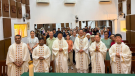
His responsibilities extend beyond serving at the altar on Sundays and major feast days. He assists priests, bishops, and visiting clergy during liturgical celebrations and takes part in funeral services when members of the community die.
But his ministry also reaches into village life.
After spending mornings in prayer and time with his family, Corraya often visits homes in his village and neighboring communities where families gather to pray the Rosary. There, he leads prayers and encourages fellow Catholics in their faith.
“People now show me more respect and affection,” he said. “Whenever there is a prayer gathering, they invite me with great sincerity, and I happily respond.”
His experience reflects a broader movement within the Catholic Church in Bangladesh, where lay Catholics are being encouraged to take on greater responsibilities in parish life.
Over the past two years, many parishes in Rajshahi Diocese have introduced teams of acolytes, lectors, and ushers. Church leaders say the initiative aims to deepen lay participation in worship and strengthen the sense of shared responsibility among Catholics.
The effort resonates strongly in Bangladesh, where Catholics make up a small minority in a predominantly Muslim nation. In many rural parishes, lay leaders have long played a crucial role in maintaining community life, organizing prayer gatherings, catechism programs, and social outreach.
The newly formalized ministries are helping to reinforce that tradition while giving lay men and women visible roles in the liturgy.
“There are 11 acolytes and lectors in our parish now,” Corraya said. “We work together to make the celebration of the Mass more beautiful and meaningful.”
Like many lay ministers, he has faced occasional misunderstandings. Some people jokingly call him “bishop” because of his visible role in church activities.
“I do not mind,” he said with a smile. “Only a few people say that. Most people respect us and appreciate what we do. My family and relatives are very supportive.”
For many parishioners, the growing presence of lay ministers represents more than a practical solution to parish needs. It reflects the Church’s vision of shared mission, where all baptized Catholics are called to participate actively in the life of the faith community.
Community members say the ministries have encouraged greater engagement among ordinary Catholics, many of whom previously saw liturgical service as the responsibility of the clergy alone.
“The Church becomes stronger when lay people feel they belong and have a role to play,” said one parishioner. “Now people see that they, too, can serve.”
For Corraya, the ministry has brought a sense of fulfillment that he once thought was beyond reach.
Although he never wore the collar he once dreamed of, he now stands near the altar at every Mass, serving the community and the Church he loves. In doing so, he has found that a vocation can take unexpected forms and that even a lifelong disappointment can become a path to deeper faith and service.
Radio Veritas Asia (RVA), a media platform of the Catholic Church, aims to share Christ. RVA started in 1969 as a continental Catholic radio station to serve Asian countries in their respective local language, thus earning the tag “the Voice of Asian Christianity.” Responding to the emerging context, RVA embraced media platforms to connect with the global Asian audience via its 21 language websites and various social media platforms.
Latest News