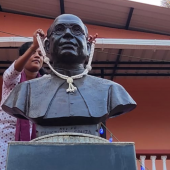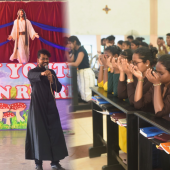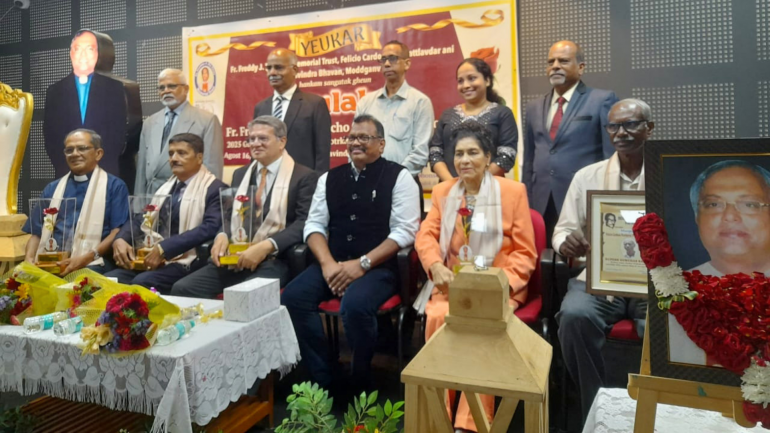
A late Goan Catholic priest who devoted his talents to promoting the Konkani language, literature and cultural heritage has been remembered for using his ministry to inspire Goans to value and preserve their mother tongue.
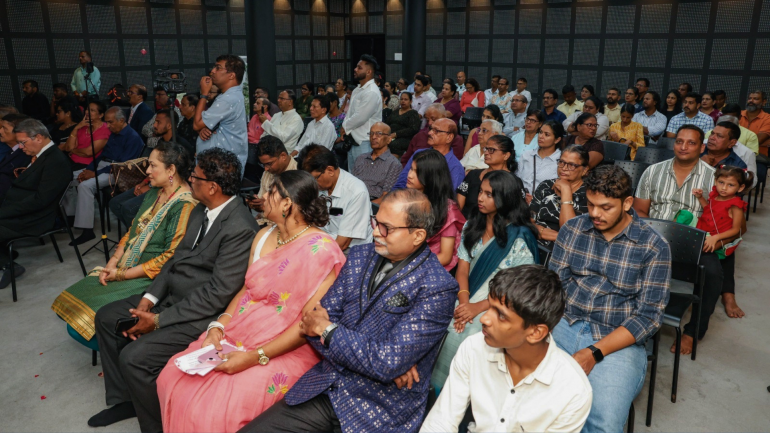
Prof. Remy Dias, a professor of history and research scholar in Goa, paid tribute to Fr. Freddy J. da Costa during the GULAB Awards ceremony at Ravindra Bhavan in Margao in the western Indian state of Goa on August 16. He described the priest as a multifaceted personality whose vocation found expression through pastoral ministry, teaching, theater and writing.
“Fr. Freddy J. da Costa is a multifaceted personality with many achievements. He was a devout Catholic and a priest devoted to his mission as a diocesan priest,” Dias said.
Dias, who had been Fr. Freddy’s student, recalled the priest’s years at Bardez Minor Seminary, where he taught Hindi and Konkani after serving in administrative roles. Citing Jesuit Fr. Moreno de Souza, he said Fr. Freddy’s ministry extended beyond the classroom to “the pulpit, the classroom, and the tiatr stage.”
Fr. Freddy wrote and staged several tiatrs, a popular form of Konkani musical theater, including Niz Mog, Doxea and Ghorabo. Dias particularly highlighted Utt Gõykara (Awake Goans), which was staged across Goa as well as in Mumbai and Gulf countries.
The play and Fr. Freddy’s “pet project,” the Konkani magazine GULAB, reflected his determination to awaken Goans to the importance of their mother tongue, Dias said.
“These initiatives were designed to awaken Goans from a deep slumber of indifference towards Konkani,” he said.
Dias also recalled the beginnings of GULAB and Fr. Freddy’s commitment to serving the language for future generations. The magazine demanded considerable personal and financial sacrifice. Although Fr. Freddy earned a modest salary as a Hindi-Konkani teacher, each issue cost about 15,000 Indian rupees to produce in the 1980s. The project initially attracted few advertisements and faced criticism from some quarters.
Despite discouragement, Fr. Freddy remained committed to the publication. Dias recalled a saying the priest often shared: “A boat is safe on the shore, but it is made for the sea and turbulent waters.”
For Dias, the saying reflected Fr. Freddy’s willingness to move beyond convention and take risks for a cause he believed in.
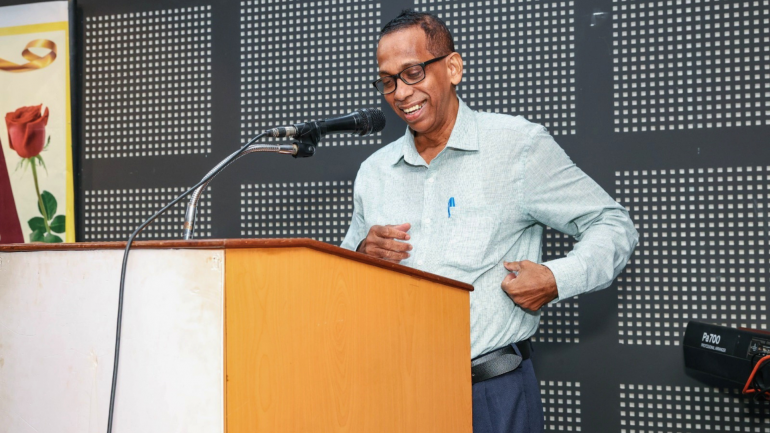
“From what I know of him as my teacher, he was not a man who would follow the beaten path,” Dias said.
Dias called for renewed study of Fr. Freddy’s writings, particularly his editorials, which he said were inspired by the priest’s love for Goa, its people and the Konkani language.
Fr. Freddy’s contribution to Konkani was inseparable from his priestly ministry, Dias said. Through the pulpit, classroom, theater and printed word, he used his gifts to encourage Goans to value their language and cultural heritage.
His legacy, Dias said, is one of faith, courage, creativity and commitment to preserving Konkani for future generations.
Radio Veritas Asia (RVA), a media platform of the Catholic Church, aims to share Christ. RVA started in 1969 as a continental Catholic radio station to serve Asian countries in their respective local language, thus earning the tag “the Voice of Asian Christianity.” Responding to the emerging context, RVA embraced media platforms to connect with the global Asian audience via its 21 language websites and various social media platforms.
Latest News