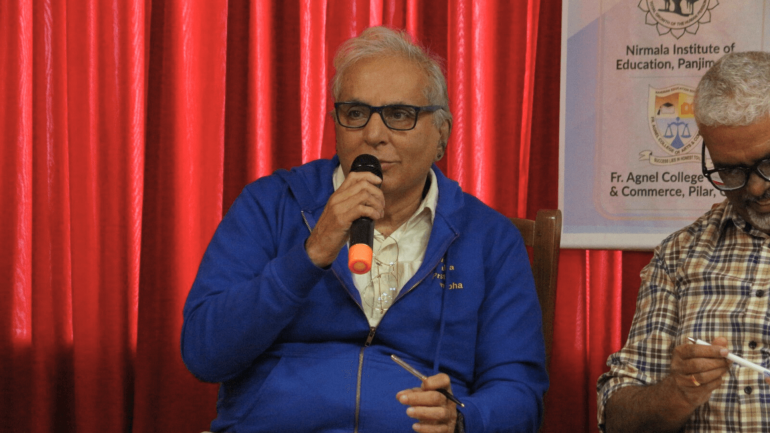
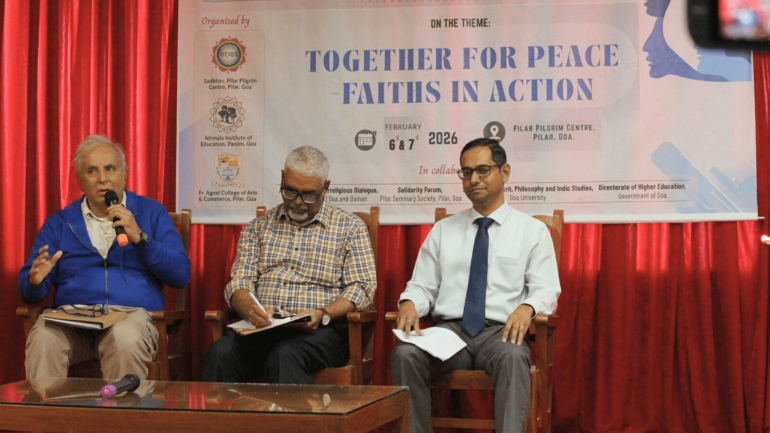
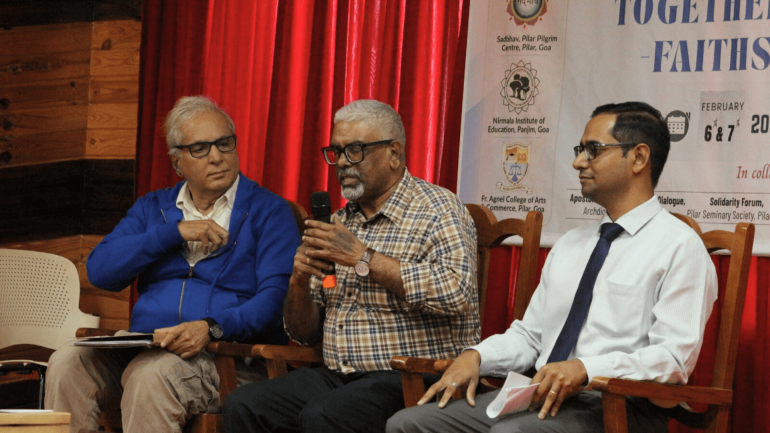
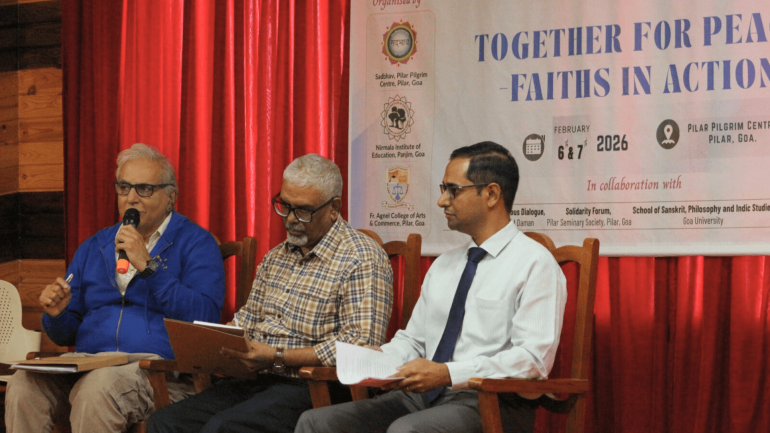
A thought-provoking philosophical paper proposing the Principle of Causality as a unifying foundation for interfaith peace was presented at the 4th edition of the Society of Pilar’s Sadbhav Sammelan 2026, held on February 6–7 at Pilar, Goa. The international interfaith conference was held on the theme “Together for Peace: Faith in Action.”
The paper, titled “Reconciliation of Major Religions through the Principle of Causality: A Philosophical Foundation for Interfaith Peace,” was presented by Aditya Raj Kapoor, who offered a wide-ranging analysis of global conflict, religious division, and the need for a deeper metaphysical basis for interreligious dialogue.
A World Shaped by Human Choice
Setting the global context, Kapoor traced modern violence—from world wars and colonial famines to ideological regimes and contemporary conflicts—arguing that most of the suffering in the last century has been man-made rather than natural.
“Humanity has become its own worst enemy,” he said, noting that war, famine, and displacement often result from ideology divorced from compassion. He observed that religion, once a source of moral cohesion, is frequently misused today as a marker of identity and power, causing exclusion and conflict.
Beyond Tolerance: One Faith, Many Traditions
Kapoor argued that while religions are many, faith at its core is one.
“There are many religions, but only one underlying faith — trust in the moral order of existence,” he said. Quoting the Rig Veda—“Truth is One, the wise call it by many names”—he drew parallels with Abrahamic traditions, showing that all major religions acknowledge a higher order governing life, whether expressed as God’s justice, Dharma, Karma, Hukam, or Divine Will.
Causality: A Common Thread Across Religions
At the heart of the paper was the Principle of Causality—the universal law that every action produces a corresponding effect. Kapoor highlighted its presence in major religions:
-
Hinduism: Karma and Dharma
-
Buddhism: Dependent Origination
-
Christianity: Moral reciprocity (“Whatever a man sows, that shall he also reap” – Gal 6:7)
-
Islam: Divine justice and accountability
-
Judaism: Middah k’neged middah (measure for measure)
-
Sikhism: Hukam, the divine order
“Whether one speaks of Karma or Divine Justice,” Kapoor said, “the rhythm is the same: action and consequence, inseparably linked.”
Causality as a Bridge for Interfaith Dialogue
Kapoor stressed that many interfaith initiatives remain superficial, promoting coexistence without addressing deeper philosophical divisions.
“Tolerance may postpone conflict, but without accountability, it cannot sustain peace,” he said. Grounding dialogue in causality shifts the focus from ideology to shared responsibility, evaluating actions by their consequences.
“If violence produces suffering and compassion produces peace, these are not opinions—they are causal certainties,” he added.
Implications for Peace and Faith
Concluding his presentation, Kapoor warned that peace is no longer optional in an interconnected world.
“Peace is not an ideal to be preached; it is a law to be obeyed,” he said, identifying greed, fear, and ignorance as the timeless roots of conflict. He called for renewed emphasis on character formation, education, and moral accountability, noting that the future of faith lies not in asserting superiority but in recognising the shared causal law that binds humanity together.
The Sammelan is jointly organised by Sadbhav, Pilar; Fr. Agnel College of Commerce and Arts, Pilar; and Nirmala Institute of Education, in collaboration with the Apostolate of Interreligious Dialogue, Archdiocese of Goa and Daman; Solidarity Forum of Pilar Seminary; School of Sanskrit, Philosophy and Indic Studies, Goa University; and the Directorate of Higher Education, Government of Goa.