


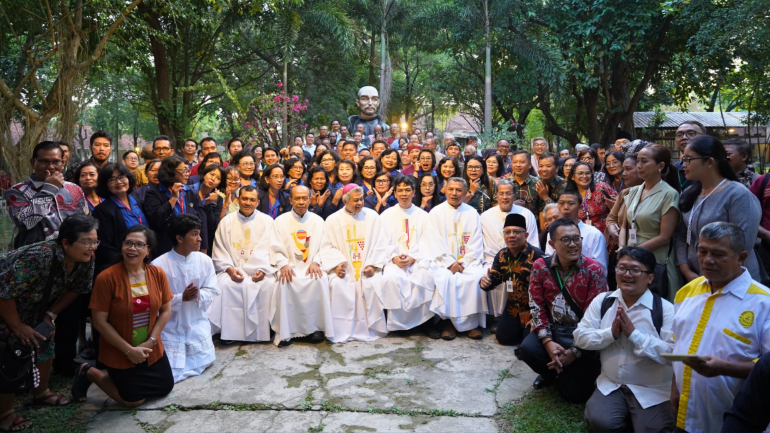
The Indonesian Catholic Community Forum (FMKI) is marking its 28th anniversary on Aug 15, by renewing its commitment to democracy, human rights, social justice and the common good amid growing challenges in the country’s public life.
Founded August 15, 1998, shortly after the fall of President Suharto and the end of Indonesia’s New Order regime, FMKI brought together Catholic activists and public figures from different political parties, organizations and professions to promote dialogue and cooperation.
The forum emerged from a concern that Catholics involved in public life were often pursuing similar goals but working separately.
“We are all working, but we are not working together,” said Christ Nugroho, recalling one of the reflections that helped shape FMKI’s founding.
The organization’s founding vision remains centered on bonum commune, or the common good, as a basis for Catholic engagement in Indonesian society.
Call to strengthen democracy
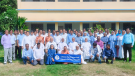
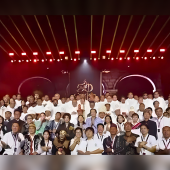
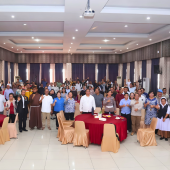
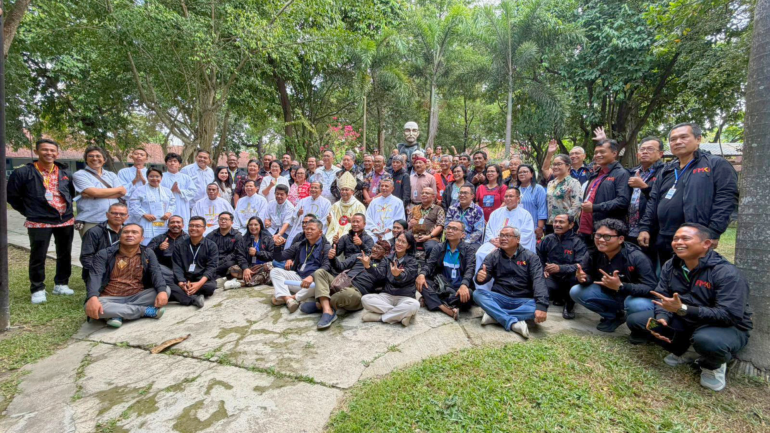
The commitment was reaffirmed at FMKI’s 13th National Meeting, held June 4-6 in Klaten, Central Java. The meeting brought together representatives from across Indonesia under the theme, “FMKI Rises and Moves: Safeguarding a Democracy Rooted in Pancasila Values.”
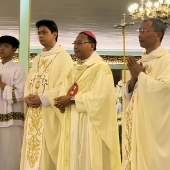
The gathering was attended by Bishop Antonius Subianto Bunjamin, OSC, president of the Indonesian Bishops’ Conference (KWI); Archbishop Robertus Rubiyatmoko of Semarang; representatives of the Ministry of Religious Affairs; and Fr. Hans Jeharut, executive secretary of the KWI Commission for the Laity.
A key outcome was a Moral Appeal calling for greater respect for the rule of law, human rights, social justice and human dignity.
The appeal raised concerns about what FMKI described as weakening checks and balances in government, including the declining oversight role of the House of Representatives, challenges to meritocracy and the growing involvement of the military in civilian affairs.
The forum also expressed concern about laws passed with limited public participation, the independence of law enforcement institutions and provisions of Indonesia’s Electronic Information and Transactions Law that it said could restrict critical voices.
FMKI called for stronger protection of vulnerable communities, including victims of human trafficking, indigenous peoples and communities affected by natural-resource exploitation.
Environment and Papua
Environmental degradation and agrarian conflicts were also highlighted, particularly deforestation and overlapping permits affecting forests and indigenous territories in several regions.
FMKI called for stronger environmental safeguards and legislation protecting indigenous peoples.
On Papua, the forum urged greater emphasis on dialogue and human rights, warning that an excessive reliance on security measures could make peaceful conflict resolution more difficult.
The Moral Appeal also addressed religious intolerance, inequality in education, the welfare of non-permanent teachers and the potential impact of technological development on human values.
FMKI issued 16 recommendations, including strengthening parliamentary oversight, maintaining a clear separation between military and civilian functions, reforming law enforcement, reviewing the Electronic Information and Transactions Law, improving protection for trafficking victims and increasing public participation in the legislative process.
It also called for evaluating National Strategic Projects, strengthening environmental protection, improving the welfare of teachers and education workers, and addressing economic inequality.
FMKI described the appeal not simply as criticism of the government but as correctio fraterna, or fraternal correction, rooted in concern and moral responsibility.
A mission shaped by Indonesia’s transition
FMKI was established during a critical period in Indonesia’s history, as the country moved from decades of authoritarian rule toward the Reform era and prepared for the 1999 general election.
Twenty-eight years later, its founders’ call for Catholics to overcome political and organizational differences remains central to the forum’s mission.
“The founding vision remains relevant as FMKI responds to increasingly complex challenges facing Indonesian society,” Nugroho said.
The forum’s anniversary comes as Indonesia’s Catholic community continues to engage questions of democracy, human rights, social justice, environmental protection and the dignity of vulnerable communities.
For FMKI, the experience of the past 28 years reinforces a simple principle: differences in political affiliation or profession need not prevent Catholics from working together for the common good, the Church and the nation
Radio Veritas Asia (RVA), a media platform of the Catholic Church, aims to share Christ. RVA started in 1969 as a continental Catholic radio station to serve Asian countries in their respective local language, thus earning the tag “the Voice of Asian Christianity.” Responding to the emerging context, RVA embraced media platforms to connect with the global Asian audience via its 21 language websites and various social media platforms.
Latest News