Indonesian Ursuline Schools Celebrate 170 Years of Education, Raise Scholarship Funds

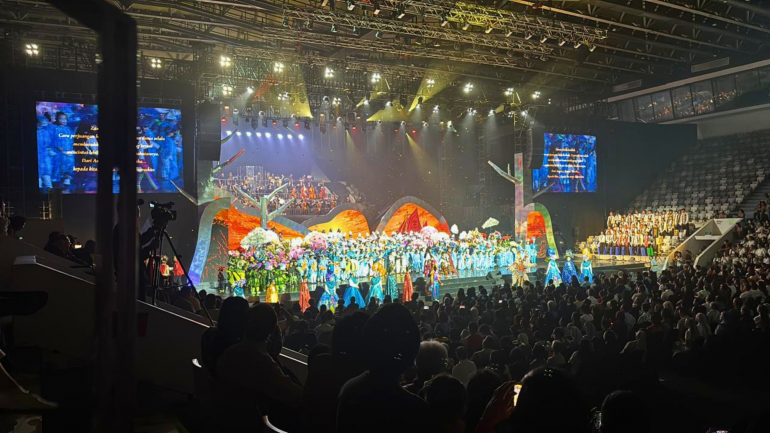
Around 520 students from five Ursuline schools in Jakarta and Banten Province, Indonesia, presented a large-scale musical drama about a young Catholic national heroine as part of celebrations marking 170 years of Ursuline education in the country.
The musical, “Pearl of the East: The Flame of Martha Christina Tiahahu’s Struggle,” was performed at Istora Senayan in Central Jakarta on September 10–11 during the 170th Anniversary of Ursuline Education in Indonesia Festival.
Held under the theme “Strong in Love,” the festival celebrated the Ursuline Sisters’ 170-year contribution to education in Indonesia while raising funds for scholarships for children from underprivileged families.
The students, from kindergarten through senior high school, came from St. Maria, St. Ursula Jakarta, St. Theresia, St. Vincentius and St. Ursula BSD schools.
The musical tells the story of Martha Christina Tiahahu, a young Catholic national heroine from Maluku Province in eastern Indonesia who fought against colonial rule.
Director and creative art director Rama Soeprapto said the story was chosen because Tiahahu’s struggle, particularly as a young woman from eastern Indonesia, has rarely been portrayed through the performing arts.
“History is not only meant to be read, but to be brought to life,” Rama said.
He said the performance helped students understand Tiahahu’s courage, sacrifice and determination to defend her people.
Festival organizing committee chairman Anton Sumardi said the production strengthened cooperation among the five Ursuline schools. He also noted a connection between the educational mission of St. Angela Merici, founder of the Ursulines, and the courage of Tiahahu, who began fighting for her people while still a teenager.
The festival also featured an education and university exhibition, educational competitions, parenting seminars, student performances and a bazaar involving small businesses and food vendors.
Proceeds will support the Ursuline Scholarship Foundation (USF), which provides educational assistance to children from underprivileged families. During the 2025–26 academic year, USF awarded 8,095 scholarships in more than 25 cities across Indonesia and Timor-Leste. Of 919 applications received that year, 709 students received assistance.
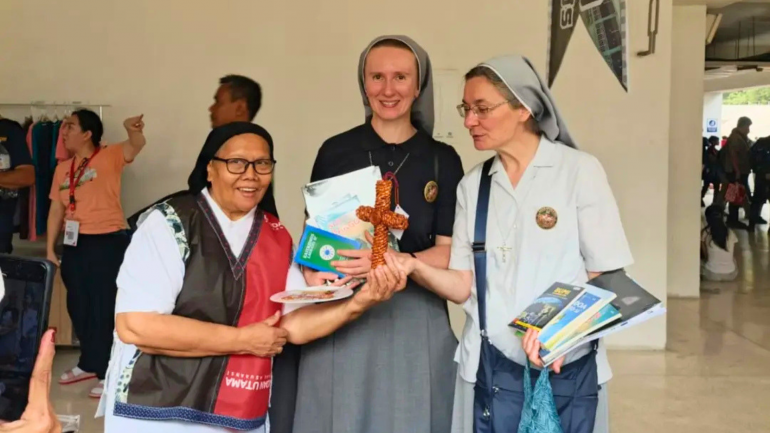
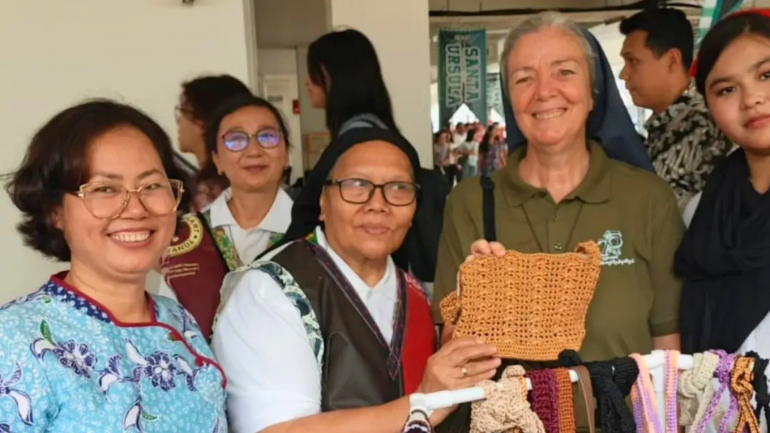
Sr. Moekti Gondosasmito, OSU, vice chairwoman of the Satya Bhakti Foundation, said the anniversary was both an expression of gratitude and an opportunity to share with those in need.
“170 years is not a short journey. This Education Festival is an expression of gratitude for the presence of the Ursulines in Indonesia,” she said.
The Ursuline mission in Indonesia began on February 7, 1856, when seven Ursuline Sisters arrived in Batavia, now Jakarta, after a 140-day sea voyage from Europe. They came at the invitation of Bishop Msgr. P.M. Vrancken, Apostolic Vicar of Batavia, who was concerned about limited access to education, particularly for girls.
Four days after their arrival, Sr. Emmanuel Haris became ill and died. The six remaining Sisters continued their mission, laying the foundation for Ursuline education in Indonesia.
The Sisters established their first convent and school in Noordwijk. In 1859, they opened a second convent and school in Weltevreden, which later developed into Santa Ursula School in Central Jakarta.
From these beginnings, Ursuline education spread to Jakarta, Bandung, Bogor, Surabaya, Malang, Flores in East Nusa Tenggara Province and East Kalimantan, including areas near Indonesia’s new capital, Nusantara.
Guided by “Serviam, I will serve,” rooted in the charism of St. Angela Merici, Ursuline education seeks to form young people in faith, character, compassion and service alongside academic excellence.
After 170 years, the celebration renewed the Ursulines’ commitment to educating and serving future generations, particularly those with fewer opportunities.
Radio Veritas Asia (RVA), a media platform of the Catholic Church, aims to share Christ. RVA started in 1969 as a continental Catholic radio station to serve Asian countries in their respective local language, thus earning the tag “the Voice of Asian Christianity.” Responding to the emerging context, RVA embraced media platforms to connect with the global Asian audience via its 21 language websites and various social media platforms.
Latest News