


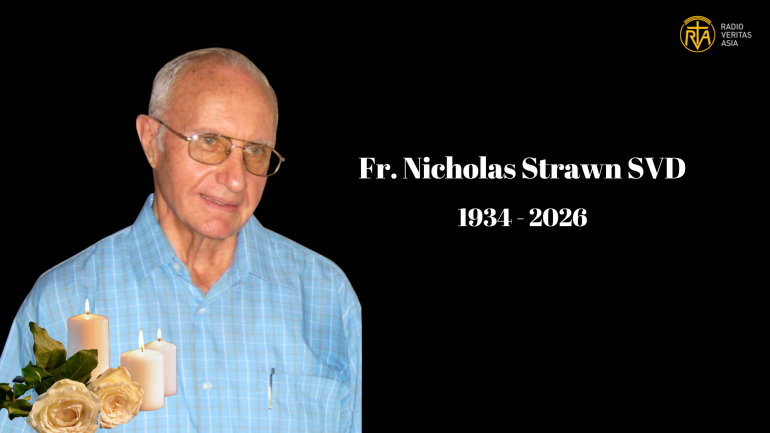
Fr. Nicholas Strawn, SVD, an American-born missionary whose more than 60 years of priestly ministry transformed him into one of the most beloved figures on Indonesia's Lembata Island, died on August 4 at Bukit Lewoleba Hospital in East Nusa Tenggara Province. He was 91.
The Society of the Divine Word (SVD) missionary passed away just weeks before his 92nd birthday on September 24.
Known affectionately as "Fr. Niko," he spent nearly his entire missionary life serving the people of Lembata, where his warm smile, humble lifestyle, and close bond with local communities earned him a reputation as "the smiling priest."
Born in Cedar Rapids, Iowa, on September 24, 1934, Fr. Nicholas Strawn arrived in Indonesia in late 1963 as a young SVD missionary. His introduction to the country was dramatic: the ship carrying him to Flores Island, KM Stella Maris, caught fire during the voyage, destroying all of his personal belongings and missionary supplies.
Undeterred, Fr. Nicholas Strawn began his first pastoral assignment in February 1964 as parish priest of Lerek, where he served for 24 years. He later spent another 17 years at St. Joseph Parish in Boto. Across more than six decades of missionary work in Indonesia, became known not only for preaching the Gospel but also for sharing the daily lives of the people he served.
Local residents affectionately called him "Konok," a nickname inspired by his habit of sitting with villagers, sharing conversations over a glass of tuak, the traditional palm wine, as a sign of friendship and fraternity.
His body is lying in state at Bukit Lewoleba Hospital. On August 5, it will be transferred to St. Mary of Banneux Parish in Lewoleba, where a Requiem Mass will be celebrated before his burial.
In a March 1, 2023, interview with Radio Veritas Asia (RVA) at the hospital compound in Lewoleba, Fr. Nicholas Strawn spoke candidly about the country that had become his home.
"Every morning, I say to God, I'm happy. Please let me stay here. I am happy living here," he said.
For Fr. Nicholas Strawn, Indonesia had long ceased to be simply a mission assignment. It had become the place where he belonged.
Asked whether he missed the United States, he reflected that much had changed in his homeland. Most of his immediate family had died, while the relatives who remained lived far away.
"Now I feel that I am at home here. I don't need to move anywhere else. I thank God that He still gives me good health," he said.
He embraced a simple lifestyle, often receiving visits from parishioners who brought fruit, peanuts, and other daily necessities. He regarded these gestures as signs of the deep affection that united him with the people of Lembata.
Fr. Nicholas Strawn also expressed gratitude for the progress he had witnessed in Indonesia over the decades, particularly improvements in healthcare on Lembata, where malaria had once posed a major threat. Even in old age, he remained thankful that he could still walk and continue his daily routine.
"I simply thank God every day. When God calls me home, that is God's business," he said.
Reflecting on the future of the Church, Fr. Nicholas Strawn said he was encouraged to see new generations of SVD missionaries serving around the world, believing the missionary spirit would continue to flourish.
His final message during the RVA interview reflected the simplicity that marked his life: "I'm happy that you came to visit me so we could share the story of why I came to Indonesia and why I have remained here."
That story became the defining witness of his vocation. Though he arrived from the United States as a missionary, Fr. Nicholas Strawn spent more than six decades becoming part of the life of the Indonesian Church, leaving behind a legacy of faithful service, humility, and enduring love for the people he called his own.
Radio Veritas Asia (RVA), a media platform of the Catholic Church, aims to share Christ. RVA started in 1969 as a continental Catholic radio station to serve Asian countries in their respective local language, thus earning the tag “the Voice of Asian Christianity.” Responding to the emerging context, RVA embraced media platforms to connect with the global Asian audience via its 21 language websites and various social media platforms.
Latest News