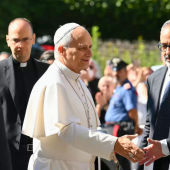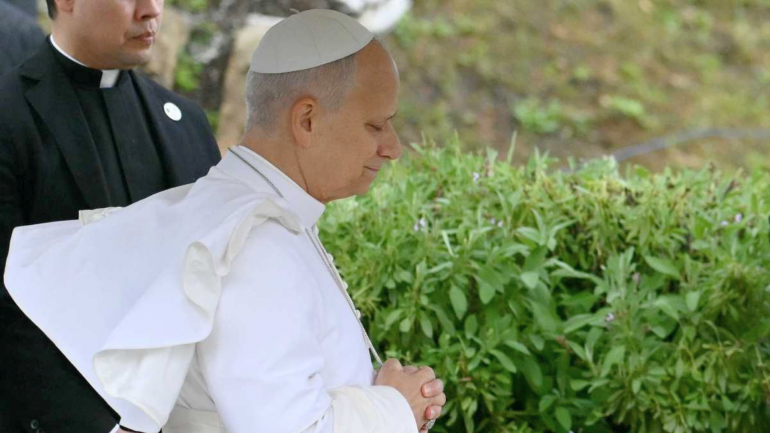
Retracing the footsteps of Augustine of Hippo, Pope Leo XIV visited the ancient site of Hippo Regius on April 14, during the second day of his apostolic journey to Algeria, according to Vatican News.
Located in present-day Annaba, Hippo Regius was once a major coastal and economic center of the Roman Empire. St. Augustine served as its bishop from 396 until his death in 430, when the city was under siege by the Vandals.
Today, significant remains of the ancient city are preserved, including a paved forum, theater, market, baths, and mosaics. Early Christian structures also endure, notably the Basilica Pacis, where Augustine exercised his ministry, and a baptistery, offering a glimpse into the life of the early Church in North Africa.
Under cloudy skies, the Pope was welcomed at the archaeological site before pausing in prayer among the ruins closely associated with his spiritual predecessor. He laid a wreath of flowers and planted an olive tree as a symbol of peace. A choir from Annaba’s music institute performed hymns inspired by the writings of St. Augustine, reflecting themes of fraternity and reconciliation.
From the site, the Basilica of St. Augustine could be seen on a nearby hill, where the Pope celebrated Mass later.
According to Vatican News, Pope Leo XIV noted that although this marks the first papal visit to Algeria, he had previously visited Annaba in 2004 and 2013 “as a spiritual son of Saint Augustine.” He expressed gratitude for what he described as “the mysterious plan of divine providence” that brought him back as the Successor of Peter.
Speaking earlier during his flight from Rome to Algiers, the Pope highlighted the enduring relevance of St. Augustine, describing him as “a very important bridge in interreligious dialogue” and a figure deeply loved in his homeland.
“Having the opportunity to visit the places associated with the life of St. Augustine… is truly a blessing for me personally,” he said, as quoted by Vatican News. “I believe it is also a blessing for the Church and for the world, because we must always seek bridges to build peace and reconciliation.”
The visit underscores the historical and spiritual significance of North Africa in the development of early Christianity, as well as the Pope’s emphasis on dialogue and unity in today’s world.
Radio Veritas Asia (RVA), a media platform of the Catholic Church, aims to share Christ. RVA started in 1969 as a continental Catholic radio station to serve Asian countries in their respective local language, thus earning the tag “the Voice of Asian Christianity.” Responding to the emerging context, RVA embraced media platforms to connect with the global Asian audience via its 21 language websites and various social media platforms.
Latest News