January 6 marks the 41st death anniversary of Fr. Mary Bastian, the courageous priest and martyr who gave his life at Pesalai Church in Vankalai, Mannar, Sri Lanka. His death, now more than four decades ago, remains a powerful symbol of steadfast faith, prophetic witness, and unwavering solidarity with the oppressed.
Born in a Decisive Year
Mary Bastian Manuel was born on December 11, 1948, in Thandikkulam, Vavuniya, to S. V. Manuelpillai and Mary Theresa Manuelpillai. That year was pivotal in Sri Lankan history, the British transferred power to local rulers, setting the stage for decades of political tension, ethnic marginalization, and violence. In the years that followed, thousands lost their lives due to greed, nationalism, and oppression, foreshadowing the struggles Fr. Bastian would confront in his lifetime.
Born into a relatively affluent family, Bastian received his early education in leading schools in Jaffna and Kandy. He pursued theological studies in seminaries across India and Sri Lanka. Even as a seminarian, he demonstrated a deep respect for human dignity, quietly opposing rules that dehumanized others and eroded the ethical formation of young priests.
Easing the Suffering of the People
Ordained a priest in 1975, Fr. Bastian began his ministry at Mannar Cathedral and later served at the Murunkan orphanage and Madhu Shrine, before being assigned to Manippai Church in 1977. Here, he extended himself beyond parish boundaries, reaching out to marginalized villages.
Unlike many who depended on foreign aid, Bastian believed in community-driven solutions. With the labor of villagers and youth, through projects such as Passion Plays, he built a small chapel. To him, the true Church was not a structure but a living community that rebuilt the lives of the poor.
He distributed schoolbooks, clothing, and created opportunities for employment, keeping the presbytery open to all. Those who sought help were given whatever he had. When resources ran dry, he wrote personal notes to his parents, asking them to assist those in need.
Understanding the Fire of Youth
When Mannar became a separate diocese from Jaffna in 1981, Bastian chose to remain in the poorer, more challenging region. He was appointed Parish Priest of Pesalai Church while also serving as diocesan director for youth apostolate.
Fr. Bastian saw firsthand the anger and frustration of young people, often fueled by poverty, unemployment, and lack of education. Nationalist pressures gradually pulled youth into militancy. Recognizing the danger, Bastian appealed to bishops and priests in the South, urging them to advocate for justice and the protection of Northern communities. His prophetic voice sought to prevent the mass destruction of lives that eventually followed.

Welcoming Refugees with Compassion
After the July 1983 pogrom, thousands of Tamil-speaking and Indian-origin people fled plantations, seeking refuge in Mannar. Fr. Bastian regarded their plight as a direct call from Christ. Regardless of ethnic distinctions, he saw the suffering of these refugees as the suffering of God Himself.
He organized villagers to build shelters using coconut fronds, tree branches, and timber. Even amid the exhaustion and risk of violence, he personally labored alongside the destitute, enduring beatings without complaint. In doing so, Fr. Bastian became a bridge of solidarity, compassion, and protection for those whom the world had abandoned.
A Prophetic Voice Amid Silence
Fr. Bastian tirelessly reached out to Sinhalese friends in the South, communicating the truth about the North:
“Friends, let us not remain silent; let us do something. In the North, we are simply waiting until our turn comes to be killed.”
He consistently stood with the vulnerable, challenging military orders and defending innocent youths from arbitrary arrests. His loyalty was to justice, faith, and the poor, not to power or government. To the army, however, this devotion marked him as a threat.
He also confronted injustice within his own community. He opposed Tamil businessmen distributing illicit alcohol, insisting on legal action. In retaliation, false accusations were spread linking him to armed militant groups, a common tactic to silence advocates of life and justice.
Despite the constant threats, Bastian never sought martyrdom. He pleaded for life, justice, and peace, especially appealing to people in the South to choose life over violence.
The Massacre of December 1984
On December 4, 1984, the Sri Lankan army carried out a massacre along Murunkan Road and across Northern and Eastern districts, killing around 200 people, mostly unarmed young men and boys. Many victims were refugees who had recently fled plantations. Bodies were burned, buried without inquiry, or sent to hospitals without proper records.
In the aftermath, Fr. Bastian, Bishop Thomas Soundaranayagam, Fr. Xavier Croos, Dr. Navamalar Kanagaratnam, and Methodist minister Rev. George M. Jeyarajasingham acted as Good Samaritans, collecting bodies, comforting survivors, and caring for the wounded. Fr. Bastian traveled 15–20 km from Pesalai to Murunkan, gathering dismembered bodies and arranging burials, a silent protest against atrocity.

Martyrdom on January 6, 1985
In the early hours of January 6, 1985, soldiers attacked the presbytery of Pesalai Church. Fr. Bastian cried out, “Please! Please!” and later, “Mother!”, before being shot. Eight others in the church premises were also killed, and his body was taken by the army.
Eyewitness Mrs. Livinda Sashidaran Croos recounted: “Around midnight, we heard gunfire across the village. My family and I stayed hidden in the church, terrified. At one point, we saw Fr. Bastian lying on the ground, bleeding. The army took his body along with the other corpses. Then we emerged, crying, to gather near the church.”
After his death, the government falsely claimed he had fled to Tamil Nadu, effectively erasing him a second time. Soldiers illegally searched the Holy Family Convent, compounding the indignities. Amnesty International later confirmed:
“Amnesty International has received no evidence to support speculation that Fr. Bastian is alive in India… there is credible testimony that he was shot dead in his presbytery by the army and that his body was removed from the scene.”
Legacy of Courage and Faith
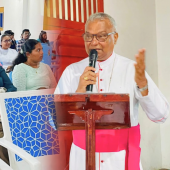
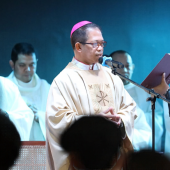
On the 40th anniversary of his death, southern priests held a memorial service in Colombo, demanding accountability from the government. In Mannar, Fr. Mary Bastian is honored as a saint by the people. A statue commemorates him, and many children are named Bastian in his memory. Some even call him “the Óscar Romero of Mannar.”
Fr. Mary Bastian’s life exemplifies the prophetic call of a Christian disciple: to stand with the oppressed, speak truth to power, and protect life at all costs. He witnessed the suffering of his people, acted with courage, and ultimately gave his life in witness. His story continues to inspire priests, youth, and communities across Sri Lanka and beyond, reminding all that faith without action is incomplete, and that even in a land marked by death, one life lived for God and humanity can shine as a beacon of hope.
Radio Veritas Asia (RVA), a media platform of the Catholic Church, aims to share Christ. RVA started in 1969 as a continental Catholic radio station to serve Asian countries in their respective local language, thus earning the tag “the Voice of Asian Christianity.” Responding to the emerging context, RVA embraced media platforms to connect with the global Asian audience via its 21 language websites and various social media platforms.
Latest News