

Seoul Peace Forum Urges Human Control over AI Weapons, Dialogue for Korean Peninsula

The Catholic Church must ensure that human conscience and responsibility remain central to decisions involving artificial intelligence (AI) and warfare, speakers said at a peace forum in Seoul, South Korea, on November 13.
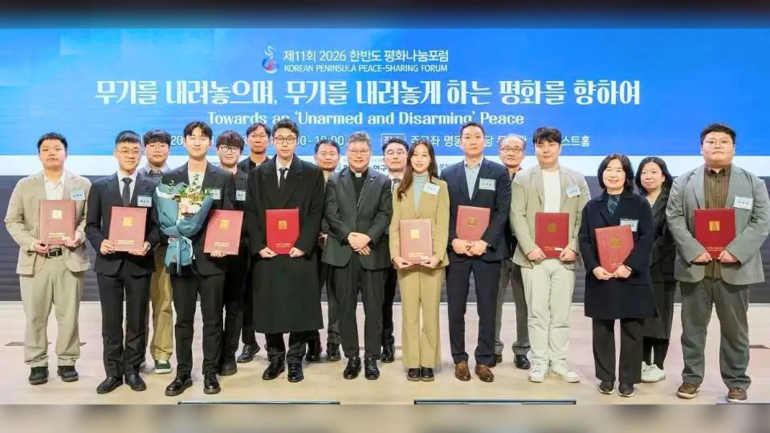
About 200 participants attended the 11th Korean Peninsula Peace-Sharing Forum 2026 at Coste Hall, Myeongdong Cathedral, organized by the Archdiocese of Seoul’s Korea Reconciliation Committee and its Institute for Peace-Sharing.
The forum’s theme, “Towards an ‘Unarmed and Disarming’ Peace,” drew inspiration from Pope Leo XIV’s message for the 2026 World Day of Peace.
Archbishop Peter Soon-taick Chung, O.C.D., Archbishop of Seoul and Apostolic Administrator of Pyongyang, who chairs the committee, said the world was experiencing simultaneous crises, including the climate emergency, the war in Ukraine, conflicts in the Middle East, and tensions between North and South Korea.
He expressed concern over North Korea’s rejection of dialogue and growing military activities, warning that the Church must raise its voice in response to threats to peace.
Recalling Pope Leo’s October 5 appeal to Korean priests and religious in Rome, Chung emphasized the responsibility to become people of reconciliation on a peninsula still wounded by division.
Alessio Pecorario, founder and CEO of the Domus Communis Foundation, said artificial intelligence was accelerating warfare through surveillance, targeting, and strategic decision-making, potentially weakening human judgment and accountability.
He proposed safeguards, including meaningful human control over lethal and nuclear decisions, and called for a “Seoul Commitment” to establish responsible practices.
“Peace cannot be automated,” he said.
Greg M. Reichberg, research professor at the Peace Research Institute Oslo, examined Pope Leo’s criticism of the traditional just-war theory, arguing that the Pope opposed using self-defense as justification for any war rather than rejecting the right to self-defense itself.
Father Antonio Dong-Won Cho of the Catholic University of Korea said machines operate within programmed parameters, while human beings make decisions and remain accountable to conscience.
“Laying down our weapons begins with refusing to hand our judgment and responsibility over to machines,” he said.
Professor Jaeun Choi of Kwangwoon University urged the Church to form the consciences of engineers developing AI, while Jong Jin Lee of Seoul National University called for legally binding international regulations on autonomous weapons.
In a second session, researchers examined peacebuilding experiences in Vietnam, Cuba, and Northern Ireland.
Speakers highlighted the Holy See’s diplomatic engagement, the importance of maintaining communication channels, and the role of religious communities in facilitating reconciliation.
Father Hyunwoo Doh of the Diocese of Uijeongbu said the Korean Church should address hostility toward North Korea within South Korean society.
Professor Soomin Seo of Sogang University encouraged modest people-to-people exchanges, emphasizing the need to “talk less, act more.”
The forum also recognized 11 winners of the Institute for Peace-Sharing’s inaugural peace research competition for young people and researchers.
The competition attracted 84 applicants in 68 teams, including participants from Italy and the United States. Winning presentations explored restorative justice and expressions of reunification among Korean students in Japan.
Chung encouraged young participants to become “torches” rekindling hope for peaceful reunification and coexistence.
The annual forum will return during World Youth Day Seoul 2027, bringing young people together to discuss peace on the Korean Peninsula and beyond.
The Korea Reconciliation Committee was established in 1995 by Cardinal Stephen Kim Sou-hwan to promote reconciliation and peace on the Korean Peninsula. It has organized the forum annually since 2016.
Radio Veritas Asia (RVA), a media platform of the Catholic Church, aims to share Christ. RVA started in 1969 as a continental Catholic radio station to serve Asian countries in their respective local language, thus earning the tag “the Voice of Asian Christianity.” Responding to the emerging context, RVA embraced media platforms to connect with the global Asian audience via its 21 language websites and various social media platforms.
Latest News