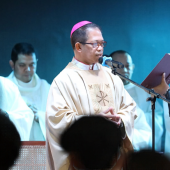
Sri Lanka: Mannar Bishop Calls for Action on Long-Term Environmental and Ethnic Issues

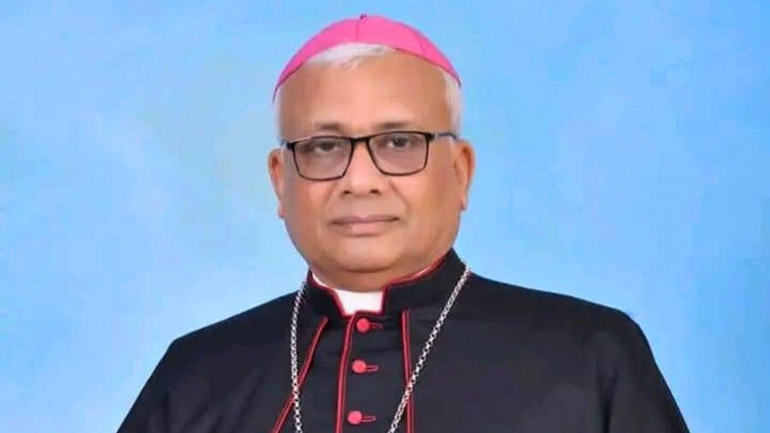
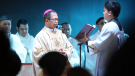
Beyond recovery from the recent floods, Sri Lanka must also confront its long-standing environmental and ethnic challenges, said Bishop Gnanapragasam Anthonypillai, placing the disaster within a broader national context.
In a recent pastoral letter, the Sri Lankan prelate noted that the Diocese of Mannar itself suffered loss of life and displacement due to the floods. He emphasized the urgent need to extend compassion and solidarity to those affected, calling on the faithful to make the Advent theme, “God is with us” a lived reality.
However, the bishop went beyond the immediate crisis to address deeper and long-term concerns affecting communities both within and outside his diocese. In particular, he raised strong concerns about environmentally sensitive development projects, including wind power installations and sand (Kaniya soil) mining on Mannar Island.
Referring to these projects, Bishop Gnanapragasam said: “The plans to establish wind power projects and excavate fertile soil in the Diocese of Mannar pose serious challenges. The government had granted permission for 14 additional wind turbines, in addition to the 30 already installed on Mannar Island. However, the government has now given a firm assurance that no further wind turbines will be erected in the future. With this assurance, the continuous protests of the people of Mannar have come to an end.”
He also spoke about assurances regarding sand mining:
“The government has promised that the excavation of Kaniya soil will not take place anywhere on Mannar Island. It has further assured that a Cabinet decision will be implemented to prevent companies involved in Kaniya soil excavation from operating in Mannar. We hope the government will faithfully honor this promise made to the people.”
While acknowledging certain positive steps taken by the new government, the bishop urged authorities to address unresolved political and human-rights concerns, particularly those affecting the Tamil community.
“The new government, which came to power with a strong mandate, deserves appreciation for its efforts to eradicate corruption, control drug abuse, and stabilize the economy. However, it is deeply regrettable that constructive measures have not yet been taken regarding issues such as land acquisition affecting Tamils, the release of political prisoners, an independent international investigation into human-rights violations during the final phase of the war, and a lasting political solution for the Tamil people.”
In this context, Bishop Gnanapragasam appealed to Tamil political parties and civil society organizations to work together:
“I request Tamil political parties and organizations committed to Tamil welfare to unite and continue working together to secure the rights of the Tamil people.”
The bishop’s letter stands out for addressing not only the country’s immediate disaster response but also its deep-rooted environmental, social, and ethnic challenges, highlighting the prophetic role of pastoral leadership in calling both Church and State to justice, accountability, and compassion.
Radio Veritas Asia (RVA), a media platform of the Catholic Church, aims to share Christ. RVA started in 1969 as a continental Catholic radio station to serve Asian countries in their respective local language, thus earning the tag “the Voice of Asian Christianity.” Responding to the emerging context, RVA embraced media platforms to connect with the global Asian audience via its 21 language websites and various social media platforms.
Latest News