Sri Lanka Mourns Latha Walpola, Catholic Singer Behind the Beloved “Namo Mariyani,” Dies at 91

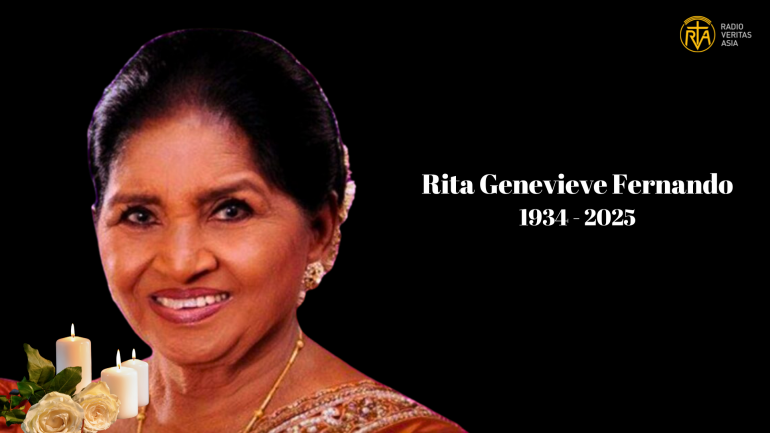
Rita Genevieve Fernando, professionally known as Latha Walpola, a name etched forever in the hearts of Sinhalese music lovers, passed away on December 27 at the age of 91. Gifted with extraordinary talent and rare vocal brilliance, she leaves behind an indelible legacy in Sri Lanka’s musical and cultural history.
Early Life and “Divine” Beginnings
Born on November 11, 1934, in Bambalapitiya, Colombo, to devout Catholic parents Joseph Fernando and Elizabeth Muriel, Rita was one of five children. Her baptismal name, Rita Genevieve (also known as Rita Janet), carried profound meaning: “Rita,” derived from Margarita, signifies a “pearl” or “child of light,” while “Genevieve” means “divine gift.”
True to her name, she became a pearl of Sinhalese music and a divine gift to the arts. Her musical journey began almost at birth, nurtured by hymns sung during daily family prayers. As a child, she joined the choir of St. Anthony’s Church, Mount Lavinia, marking her first formal training in music.
Blessings at the Shrine of Our Lady of Madhu
A defining moment in her early life occurred during a family pilgrimage to the Shrine of Our Lady of Madhu. While staying in traditional pilgrim huts, the family sang hymns each evening. Drawn by young Rita’s pure and ethereal voice, passersby would stop to listen. Elders, deeply moved, offered blessings, convinced her talent was a gift from God.
At just 12 years old, Rita joined the Radio Ceylon Choir. In 1947, at the age of 13, she recorded her first solo song, “Kandulu Denethin Wahena,” written by Sarath Wimalaweera and composed by Vincent de Alwis. This marked the beginning of an extraordinary career spanning nearly eight decades, during which she recorded more than 6,500 songs.
Tradition: A Blessing and a Barrier
While her Catholic upbringing shaped her musical foundation, the conservative traditions of the time posed challenges. Her father, a strict traditionalist, believed that travelling for singing engagements was inappropriate for a young Christian girl. He insisted she return home by 6:00 p.m. for the Angelus prayer, restrictions that even caused her to miss her first opportunity to sing for a film.
At one point, he sought the help of school nuns to dissuade her from pursuing music. The intervention of the renowned priest-poet Fr. Marcelline Jayakody eventually helped ease family tensions. Despite severe opposition, including an incident where her father burned household items in protest of her travelling to India for recordings, Rita found unwavering support in her mother, a convent-educated teacher who quietly nurtured her daughter’s extraordinary gift.
A Prayer Answered
Latha Walpola often reflected on the biblical verse, “Ask and it shall be given to you.” As a teenager, she accompanied her elder sister to All Saints’ Church, Borella. While her sister met her suitor under parental supervision, Rita spent the time in prayer, asking God for one simple gift: a beautiful new voice. She would later say that her prayer was answered beyond anything she could have imagined.
In 1959, she married celebrated singer Dharmadasa Walpola, after which she became known as Latha Walpola. Her chosen name echoed comparisons with India’s legendary Lata Mangeshkar, earning her similar reverence in Sri Lanka.
An Unrivalled Cinematic Legacy
The story of Sinhalese cinema music is incomplete without Latha Walpola. Although she missed an opportunity to sing for the film Sujatha, she made her playback debut in 1953 with “Habata Mage” in the film Eda Re.
She became a key figure in the landmark musical transformation of 1956, when Dr. Lester James Peries’ Rekawa broke away from Indian cinematic influences. Latha’s voice gave life to the iconic “Sigiri Ladakage Mal Wattiye,” written by Fr. Marcelline Jayakody and composed by Sunil Santha. Over her career, she lent her voice to nearly 600 films.
The Enduring “Namo Mariyani” Legacy
Beyond cinema, Latha Walpola uniquely bridged faith and culture. Her rendition of “Namo Mariyani” the Hail Mary, became an immortal hymn cherished by Catholics and Buddhists alike and remains a cornerstone of Sri Lankan Christmas carols.
Recorded in 1947 under the prestigious Columbia label, “Namo Mariyani” was her very first solo recording. Lyrics by Kalidasa Kurukulasuriya, set to music by Erwin Fonseka, created a masterpiece that has withstood the passage of time.
Remarkably, this hymn became the defining work of her life. Until her final years, it remained the song she performed most frequently, re-recorded most often, and saw widely covered by other artists. Many believe its enduring resonance was a special blessing that accompanied her throughout her life.
Her devotion to sacred music continued well into her later years. In 2011, she released a special CD titled “Divine Jesus” (Dewman Jesu), reaffirming her identity as an artist who seamlessly united secular excellence with spiritual devotion.
A Voice That Lives On
Honoured with every major state award bestowed upon Sri Lankan artists, Latha Walpola was affectionately hailed as the “Queen of Sinhalese Song” and the “Nightingale of Sri Lanka.”
Though she has departed from this world, her voice remains timeless, an enduring treasure that continues to inspire generations and resonate across Sri Lanka’s cultural and spiritual landscape.
Radio Veritas Asia (RVA), a media platform of the Catholic Church, aims to share Christ. RVA started in 1969 as a continental Catholic radio station to serve Asian countries in their respective local language, thus earning the tag “the Voice of Asian Christianity.” Responding to the emerging context, RVA embraced media platforms to connect with the global Asian audience via its 21 language websites and various social media platforms.
Latest News