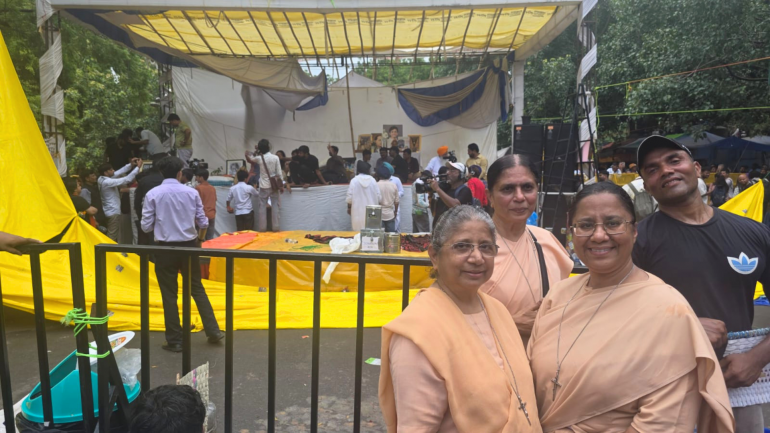
As thousands of students gathered at Jantar Mantar, the designated site for public demonstrations in India's capital, to protest alleged irregularities in the National Eligibility-cum-Entrance Test (NEET), Sr. Nirmalini AC, Superior General of the Congregation of the Apostolic Carmel, chose to stand alongside them rather than remain a distant observer.
Accompanied by two Apostolic Carmel sisters, she visited the protest site to express the Catholic Church's solidarity with students whose hopes of pursuing medical careers had been shaken by the examination controversy.
NEET is India's nationwide entrance examination for medical and dental programs. Taken annually by more than two million students, it is one of the country's most competitive examinations and largely determines admission to government and private medical colleges. Allegations of question paper leaks and examination malpractice triggered widespread protests, raising concerns about fairness and transparency in the country's higher education system.
The controversy led to the cancellation of the examination and sparked demonstrations across India. Reports of students experiencing severe emotional distress, including some deaths by suicide, intensified public concern. The protests eventually culminated in the resignation of Union Education Minister Dharmendra Pradhan on July 25, 2026.
For Sr. Nirmalini, accompanying the students was a natural expression of the Church's mission.
"Being in Delhi for many years, I have always been involved with social issues," she said. "Whether it was the Kandhamal violence, the Lokpal movement, or other public concerns, we participated to express our solidarity. We wanted the young to know that we stand with them."
Her visit reflected what she described as the Church's responsibility to listen to young people rather than remain detached from their struggles.
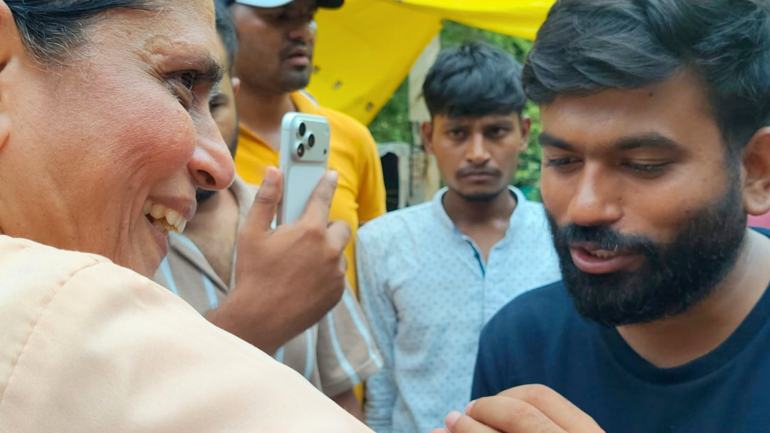
During the visit, she met student leader Abhijeet Dipke, head of the Cockroach Janata Party, whose determination impressed her.
"My encounter with Abhijeet Dipke was inspiring. I saw in him a young, daring, bold, and courageous India," she said.
Drawing on her experience as a former school principal, Sr. Nirmalini said she understood the immense pressure students face while preparing for highly competitive entrance examinations.
"Students preparing for competitive exams go through tremendous pressure. It is also a huge financial burden on parents. After all this, when they have to face system failures and corruption, it is but natural to feel anger," she said.
She believes the crisis offers the Church and educational institutions an opportunity to engage more deeply with young people.
"It is a good call, in the spirit of synodality, to listen to the voices of the youth," she said. "We need to enter into dialogue and make them part of the decision-making process."
Calling on Catholic educational institutions to lead by example, she urged a review of existing educational policies and greater attention to students' emotional well-being.
"I definitely feel the Catholic Church must be a trendsetter. It is time we review our policies and systems and make them more student-friendly. We also need to offer ongoing counseling, not only before examinations but also after the results, so that students can cope with disappointment," she said.
Inspired by Pope Francis' vision of a Church that accompanies people in their daily lives, Sr. Nirmalini described her visit as a practical expression of Christian discipleship.
"Pope Francis was a leader who walked the talk, and I am inspired by him," she said. "A follower of Jesus is called to stand with the vulnerable. The young are not just our future; they are our present. Leaders have to be available to listen."
To students discouraged by uncertainty and repeated setbacks, she offered a message of hope.
"It is difficult to tell students simply to let go, but I want to say to them: 'You are not alone.' We are here to offer support. There is always something for each one. It will unfold, but they have to remain strong."
She concluded with a prayer for India's youth.
"Believe in God, believe in yourself, and you will always find a way. Do not lose heart, but pick up the threads and walk even more resolutely, because life is full of challenges."
Radio Veritas Asia (RVA), a media platform of the Catholic Church, aims to share Christ. RVA started in 1969 as a continental Catholic radio station to serve Asian countries in their respective local language, thus earning the tag “the Voice of Asian Christianity.” Responding to the emerging context, RVA embraced media platforms to connect with the global Asian audience via its 21 language websites and various social media platforms.
Latest News