Synod Canon Law Commission Proposes Changes to Strengthen Lay Participation and Synodal Bodies

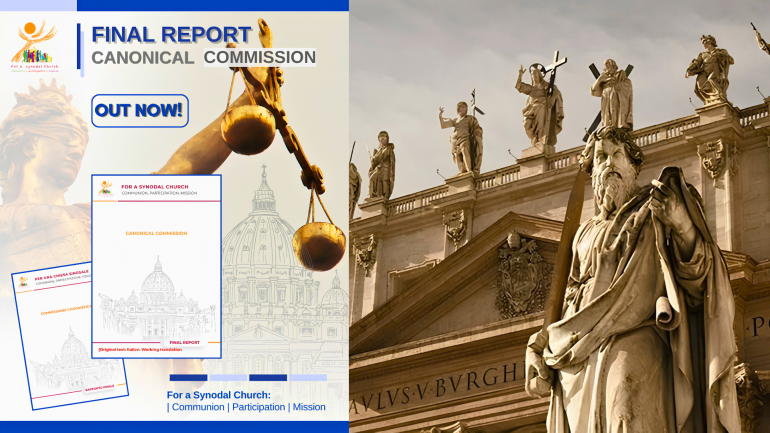
The final report of the Synod of Bishops’ Canon Law Commission proposes amendments to the Code of Canon Law of the Latin Church, including provisions concerning lay participation, Episcopal Conferences and participatory bodies.
Vatican News reported on September 30 that the report was published by the General Secretariat of the Synod following the commission’s work based on the 2021–24 synodal process and the two General Assemblies held in October 2023 and October 2024.
The commission identified three time horizons. The short-term proposals concern amendments to current legislation. The medium term could involve new or revised instructions with the competent Vatican Dicasteries, while the long term envisages a comprehensive revision of both the Latin and Eastern Codes of Canon Law. The present report concerns only the Latin Code.
Among the short-term proposals are amendments concerning the capacity of lay people, both men and women, to exercise offices, responsibilities and ministries for which they are qualified and competent, including in ecclesial governance. The report also proposes revisions concerning particular councils and Episcopal Conferences, as well as participatory bodies.
The commission examined provisions of the 2024 Synod Final Document concerning the equal dignity of the faithful and the juridical implications of lay participation. It considered revisions to Canons 145, 204, 208, 212, 228, 230, 275, 476, 483, 749, 1112, 1421 and 1425.
According to the report, existing canon law already provides instruments for lay people to share responsibility alongside pastors, but these are not always implemented and may require stronger normative affirmation.
The proposals also address particular councils and Episcopal Conferences. They include allowing all members of the People of God to participate in a particular council in a proportion equal to ex officio members, and removing the limitation “only” from their consultative vote. The report also proposes that councils be held every 10 years and introduces a presumption of validity for council acts if the Holy See does not respond within one year.
The final section concerns participatory bodies and what the Synod’s Final Document calls “missionary transformation.” These bodies are described as serving the proclamation of the Gospel and the life of the People of God, rather than functioning merely as organizational structures.
The report stresses that synodality does not remove the decision-making competence of the bishop, the College of Bishops or the Pope. Instead, it seeks to incorporate the contribution of the People of God into ecclesial discernment and decision-making.
Amendments are proposed to Canons 127, 399, 461, 463, 466, 473, 493, 495, 500, 511, 512, 514, 536 and 537. A new norm concerning accountability is also proposed.
Radio Veritas Asia (RVA), a media platform of the Catholic Church, aims to share Christ. RVA started in 1969 as a continental Catholic radio station to serve Asian countries in their respective local language, thus earning the tag “the Voice of Asian Christianity.” Responding to the emerging context, RVA embraced media platforms to connect with the global Asian audience via its 21 language websites and various social media platforms.
Latest News