Two Years after Istiqlal Declaration, Indonesian Faith Leaders Call for Action on Peace and Care for Creation

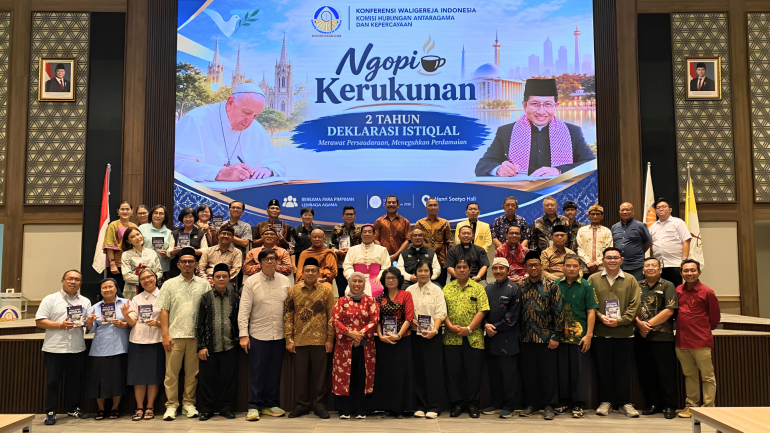
Two years after Pope Francis and Grand Imam Nasaruddin Umar signed the Istiqlal Declaration in Jakarta, Indonesian interfaith leaders have called for its commitments to brotherhood, peace and care for creation to be translated into concrete action.
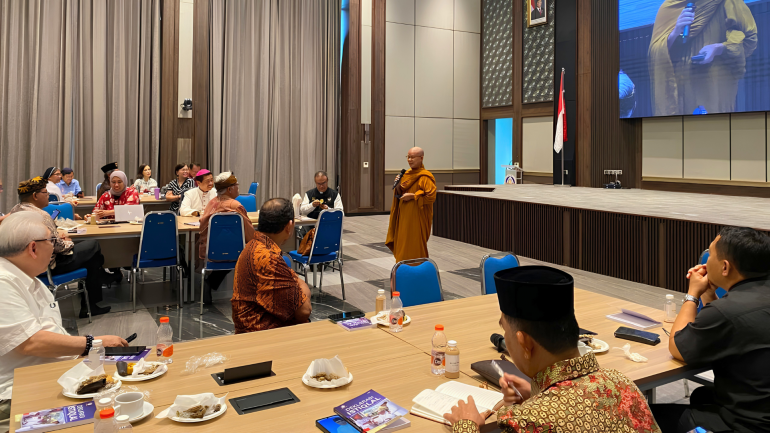
The call came during a “Coffee Afternoon of Friendship, Two Years of the Istiqlal Declaration: Nurturing Brotherhood, Strengthening Peace” gathering at the office of the Indonesian Bishops’ Conference (KWI) in Jakarta on September 28.
The Istiqlal Declaration was signed on September 5, 2024, by Pope Francis and Nasaruddin Umar, grand imam of Istiqlal Mosque in Jakarta, during the Pope’s visit to Indonesia. The declaration expressed shared concern about global challenges including dehumanization and climate change and called for greater interreligious cooperation.
Bishop Christophorus Tri Harsono, chairman of the Commission for Interreligious Affairs of KWI and Bishop of Purwokerto, Central Java, said the passage of two years has not removed the need to work for greater fraternity.
“There are still people who are intolerant, and many things remain out of line,” he said. “But this is precisely a process that must continue so that brotherhood and peace can become more meaningful.”
He said the declaration should be understood not simply as a document but as an ongoing journey requiring encounters, trust and acceptance of differences.
“In the past, having coffee together among people of different religions might have been difficult. Now it has become something normal,” Bishop Christophorus said. “But our meetings should not be merely formalities.”
Fr. Aloys Budi Purnomo, secretary of the Commission for Interreligious Affairs of KWI and moderator of the gathering, invited participants to consider how the declaration could become a continuing movement rather than remain a ceremonial commitment.
Hening Purwati Parlan, deputy chairperson of the Environmental Council of the Muhammadiyah Central Executive Board and deputy chairperson of the Environmental and Disaster Management Institute of Aisyiyah, connected interfaith cooperation with the environmental crisis.
She described changes she has witnessed in Central Java, where a drainage ditch that once held water has become dry and a river where she bathed as a child now carries very little water.
“In the past, after it rained, we could hear the frogs, but now there are none,” she said.
Hening acknowledged that religious communities already respond to environmental and humanitarian crises through disaster assistance, tree planting, reforestation and other initiatives. But she said such efforts need to address the causes of environmental destruction.
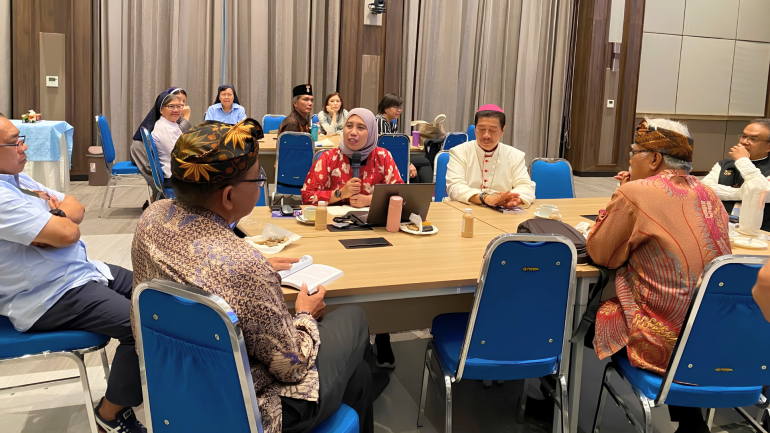
“When the earth is wounded, we cannot simply apply medicine. We must look at the root causes of the wound,” she said.
She proposed action at three levels: strengthening awareness and solidarity within communities, engaging policymakers through evidence-based advocacy, and encouraging religious leaders to speak clearly about the ethical responsibility to protect the earth.
Bhante Dhammasubho Mahathera, who offered the final reflection, linked dehumanization with the need for a deeper understanding of humanity’s relationship with other people and the natural world.
He highlighted the Buddhist greeting Sabbe Satta Bhavantu Sukhitatta, “May all beings be happy,” as an expression of respect for all living beings.
“All beings in the air, in the water, on the land, in the mountains and in the trees; those with legs and those without legs, may all beings be happy,” he said.
He also highlighted the environmental significance of the Bodhi tree, under which Siddhartha Gautama is traditionally believed to have attained enlightenment.
The gathering concluded by returning to the central challenge of the Istiqlal Declaration: ensuring that interfaith friendship moves beyond formal encounters toward concrete action that strengthens human dignity, peace and care for the common home.
Radio Veritas Asia (RVA), a media platform of the Catholic Church, aims to share Christ. RVA started in 1969 as a continental Catholic radio station to serve Asian countries in their respective local language, thus earning the tag “the Voice of Asian Christianity.” Responding to the emerging context, RVA embraced media platforms to connect with the global Asian audience via its 21 language websites and various social media platforms.
Latest News