

Vietnamese Camillian Priest Ministers to Children Living With HIV, Sees Communication as Life Witness

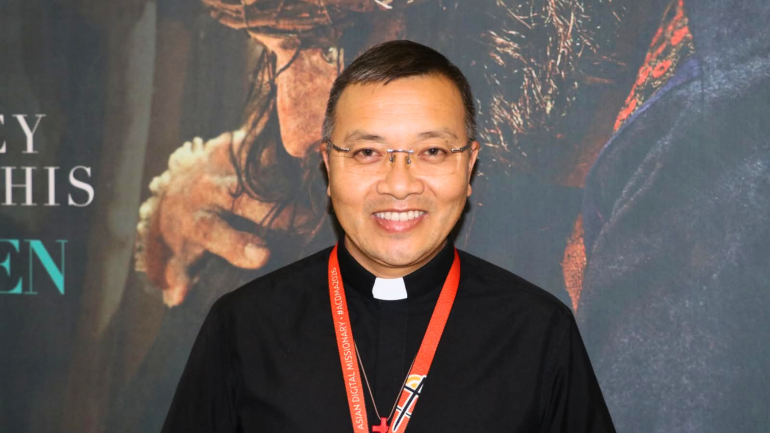
For Fr. John Toai, communication begins not with gaining followers but with giving himself to people through concrete encounters.
The Vietnamese Camillian priest, who has spent years accompanying children living with HIV and AIDS, says his ministry of care, counseling and pastoral service has shaped how he communicates the Catholic faith in the digital world.
“I always work under the Diocese,” he said in an exclusive interview with Radio Veritas Asia on the sidelines of the First Asian Catholic Digital Missionary Assembly in Quezon City, Philippines.
“I don’t have to worry about people following me. That’s not my problem. My problem is to deliver a message.”
A member of the Order of the Ministers of the Infirm, commonly known as the Camillians, Fr. John is director of the House of Hope, a center in Ho Chi Minh City, southern Vietnam for children living with HIV who have been orphaned or abandoned. He founded the center in 2005 after years of encounters with people affected by HIV and AIDS in India, Thailand and Vietnam.
During a year as a caregiver at Snehadan in Karnataka, India, and while undertaking public health training at St. John Medical College in Bangalore, he had his first experience caring for people living with HIV.
After returning to Vietnam in 2003, he was invited by the archdiocese of Ho Chi Minh City, then a cardinal, to assist in pastoral care for people living with HIV. At the time, many people affected by HIV faced stigma and discrimination, while children whose parents had died of AIDS were sometimes abandoned. Fr. John began with a small shelter for five or six children. Over the years, it grew into the House of Hope, which has cared for hundreds of children.
The center now houses about 100 children, including around 80 living with HIV and about 20 who are HIV-free but were also abandoned or otherwise in need of care.
The House of Hope provides food, accommodation, education and medicine without charge. Some children who arrived as infants or young children are now adults studying at universities, working or raising families.
His ministry has also led Fr. John into advocacy. He has worked with Caritas Internationalis and Vatican-related initiatives to promote access to medicines suitable for children living with HIV, particularly in developing countries.
His communication ministry became more visible during the COVID-19 pandemic. While Camillian religious members with health-care backgrounds were serving patients, Fr. John was invited by the Archdiocese of Ho Chi Minh City’s communication office to speak online.
He began sharing homilies, reflections on healing and psychology, and responses to questions about faith and personal crises through the archdiocese’s YouTube channel.
He said his growing online presence was not something he deliberately sought.

“Slowly, maybe by accident, I became known,” he said.
Rather than creating an independent platform around himself, Fr. John continues to work through the archdiocese’s communication channels.
“We work as a team,” he said. “I do my role, and I’m happy with that. And leave the rest of it to God.”
His Vietnamese-language broadcasts allow him to address people within their own cultural and linguistic context, but he sees communication as inseparable from the life behind the message.
His years accompanying people affected by HIV, cancer and other forms of suffering, as well as his experiences in India, Thailand, Vietnam and Liberia during the Ebola crisis, have given him experiences from which he can speak.
For Fr. John, that lived experience is particularly important at a time when artificial intelligence and content creation make it increasingly easy to produce material without personal involvement.
“Unless we have a concrete encounter, then our world will be empty, very shallow,” he said.
He warned that communicators can risk simply creating, copying and republishing material while lacking the experiences that give their messages depth.
By contrast, genuine encounters allow people to receive from others and then share what they have learned.
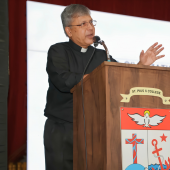
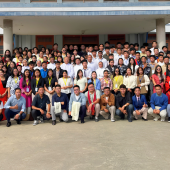
Representing the Catholic Bishops’ Conference of Vietnam at the First Asian Catholic Digital Missionary Assembly, Fr. John joined more than 100 Catholic digital missionaries, communicators and content creators from across Asia.
The September 10–13 gathering at the Radio Veritas Asia campus in Quezon City is organized by the Federation of Asian Bishops’ Conferences Office of Social Communication and Radio Veritas Asia, in partnership with the Vatican Dicastery for Communication through the Fully Present Network.
For Fr. John, the assembly’s call to digital mission ultimately points back to the same principle that has guided his ministry: communication is not merely about speaking to people, but about encountering them, serving them and giving something of oneself.
In the digital world, his witness suggests, the credibility of the message begins with the life of the messenger.
Radio Veritas Asia (RVA), a media platform of the Catholic Church, aims to share Christ. RVA started in 1969 as a continental Catholic radio station to serve Asian countries in their respective local language, thus earning the tag “the Voice of Asian Christianity.” Responding to the emerging context, RVA embraced media platforms to connect with the global Asian audience via its 21 language websites and various social media platforms.
Latest News