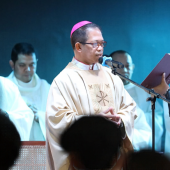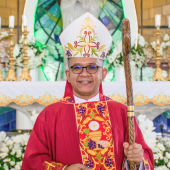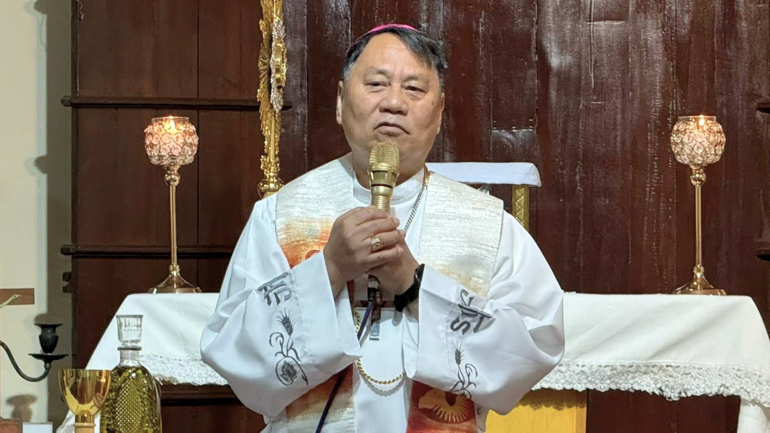
A Catholic bishop in the northern Philippines has called for dialogue, scientific assessment, and stronger protection for coastal communities as concerns grow over a proposed ₱330-billion (US$5.7 billion) offshore wind energy project in Ilocos Norte province.
In a statement issued on July 29, Bishop Renato Mayugba of Laoag urged government authorities, project developers, scientists, and local communities to work together to ensure that the transition to renewable energy respects both people and the environment.
"We call for dialogue, scientific study, and development that prioritizes genuine human ecology over corporate greed," Bishop Mayugba said.
The proposed BuhaWind offshore wind project would install wind turbines in the coastal waters of Pasuquin, Burgos, Bangui, and Pagudpud, municipalities in Ilocos Norte on the northwestern tip of Luzon, the Philippines' largest island. The area is known for pioneering wind energy development in the country.
According to the Diocese of Laoag, the project's proposed 50-meter no-sail zones could affect more than 6,500 municipal fisherfolk, raising concerns over the livelihoods of families who depend on coastal fishing.
Bishop Mayugba also pointed to potential environmental impacts, saying the construction of underwater foundations and noise generated during offshore operations could disrupt the fragile marine ecosystem of Bangui Bay.
The bishop stressed that the diocese does not oppose renewable energy or economic development but supports projects that are just, inclusive, and environmentally responsible.
"We are not anti-development. We are for just and inclusive development," he said. "We do not speak in opposition. We speak in solidarity with our fisherfolk, coastal communities, and future generations."
He added that the Church supports clean energy but insists that it must not come at the expense of vulnerable communities.
"We are not against clean and renewable energy. What we uphold is that true ecological conversion demands that the pursuit of green energy must not come at the expense of the poor and the destruction of our local environment," he said.
Echoing the Church's teaching on care for creation, Bishop Mayugba described the province's natural resources as "a sacred trust" that should serve the common good rather than private interests.
"The land, wind, and seas of Ilocos Norte are a sacred trust," he said.
The Diocese of Laoag said it favors cooperation rather than confrontation, calling for continued engagement among government agencies, project developers, scientists, and affected communities. It said the project should be evaluated through scientific evidence, meaningful public consultation, and moral responsibility.
Concluding his appeal, Bishop Mayugba reaffirmed the Church's commitment to protecting both people and the environment.
"We will defend our waters, we will protect our poor, and we will preserve our future," he said.
Radio Veritas Asia (RVA), a media platform of the Catholic Church, aims to share Christ. RVA started in 1969 as a continental Catholic radio station to serve Asian countries in their respective local language, thus earning the tag “the Voice of Asian Christianity.” Responding to the emerging context, RVA embraced media platforms to connect with the global Asian audience via its 21 language websites and various social media platforms.
Latest News