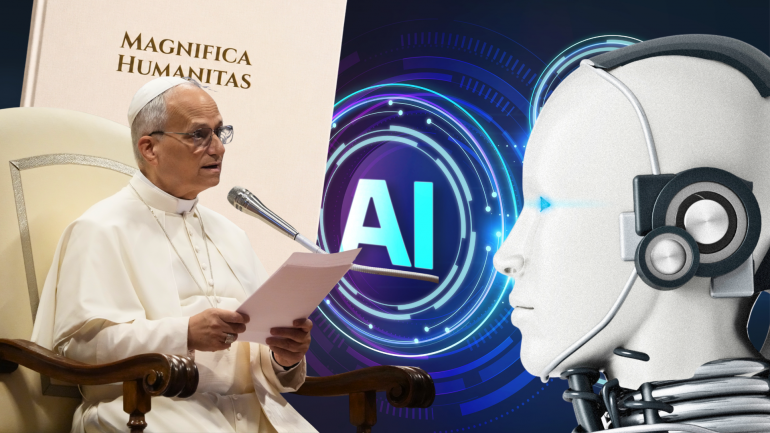
Artificial intelligence is increasingly shaping contemporary society, influencing communication, work, education, and even religious reflection. Its rapid development raises questions that the Church cannot ignore. In this context, Pope Leo’s recent encyclical Magnifica Humanitas examines the ethical and anthropological implications of AI and its impact on human dignity.
The document emphasizes a clear distinction between human beings and artificial systems. As noted in section 99, AI systems “do not undergo experiences, do not possess a body, do not feel joy or pain, do not mature through relationships and do not know from within what love, work, friendship or responsibility mean.” While they may simulate language, reasoning, or empathy, they do not possess consciousness, moral responsibility, or interior life. Their responses are generated through statistical modeling based on data, not through lived experience or moral judgment.
This distinction is central to the Church’s concern. AI can imitate human expression, but it does not participate in the human condition. It does not grow in wisdom through suffering, relationships, or ethical decision-making. The encyclical stresses that this difference must remain foundational in evaluating both the use and development of emerging technologies.
Fr. Philip Larrey, professor of philosophy at Boston College and a Vatican consultant on artificial intelligence, describes the encyclical as a framework for ethical discernment in this field. He notes that Pope Leo places the human person at the center of technological development and outlines principles intended to guide responsible innovation. According to Larrey, the document invites deeper reflection on how AI should serve humanity rather than define it.
Similar concerns are raised within the scientific and technological community. Chris Olah, co-founder of the AI company Anthropic, has observed that research into large language models reveals complex internal structures that sometimes resemble patterns associated with human cognition. However, he cautions that these findings remain difficult to interpret and require continued study and discernment. His reflections highlight both the sophistication and the uncertainty surrounding current AI systems.
Developments in artificial intelligence are also extending into new applications that intersect with faith contexts, including theological research tools and experimental platforms that seek to engage religious data and texts. While such systems can provide rapid access to information, they also raise questions about interpretation, authority, and the role of human judgment in religious understanding.
The encyclical further emphasizes the uniqueness of human embodiment. It draws a clear distinction between mechanical systems and human existence. Machines may perform tasks efficiently, but they do not experience vulnerability, moral responsibility, or the consequences of ethical choices. Human life, by contrast, is defined by interiority, conscience, reflection, and the capacity for moral growth.
Within this framework, AI may assist in generating content or processing information, but it cannot replace the human capacity for meaning-making. It can produce text or analysis, but it does not experience understanding, joy, or faith.
This distinction has broader implications for how individuals relate to technology. The speed and efficiency of AI-generated responses contrast with the slower, more reflective processes associated with spiritual life and religious practice. In Catholic tradition, prayer, discernment, and intercession involve patience and trust rather than immediate outcomes.
The reflection extends to the role of saints in Catholic spirituality. Saints are not viewed as information systems but as witnesses to faith who intercede through prayer. While AI systems provide immediate responses based on data processing, spiritual life often involves waiting, discernment, and openness to time and mystery. The contrast highlights differing understandings of knowledge, response, and presence.
A key concern raised in this context is the expectation of immediacy. Technological systems provide instant answers, while spiritual traditions emphasize patience and trust in divine timing. This difference can shape how individuals approach both technology and faith, particularly in moments of uncertainty.
The encyclical also draws attention to the moral responsibility of individuals in an increasingly complex world. It encourages a focus on ethical action within one’s immediate context rather than an attempt to control global systems or outcomes beyond human capacity.
In this spirit, Pope Leo cites a reflection attributed to Gandalf in J.R.R. Tolkien’s writings, which emphasizes faithfulness in one’s own time and responsibilities rather than control over broader forces: “It is not our part to master all the tides of the world, but to do what is in us for the succor of those years wherein we are set.”
This perspective offers a framework for responding to rapid technological change. Rather than being overwhelmed by global developments, individuals are called to attend to their immediate responsibilities, family, relationships, work, and ethical conduct, while striving to act with integrity and care.
In this light, technological advancement is not rejected but situated within a broader moral horizon. The challenge is not only to develop new systems but to ensure that human dignity, responsibility, and spiritual depth remain central.
The encyclical ultimately calls for discernment in an age of rapid transformation. It invites reflection on what it means to be human in a world increasingly shaped by artificial intelligence and urges a renewed commitment to ethical awareness, patience, and responsibility.