




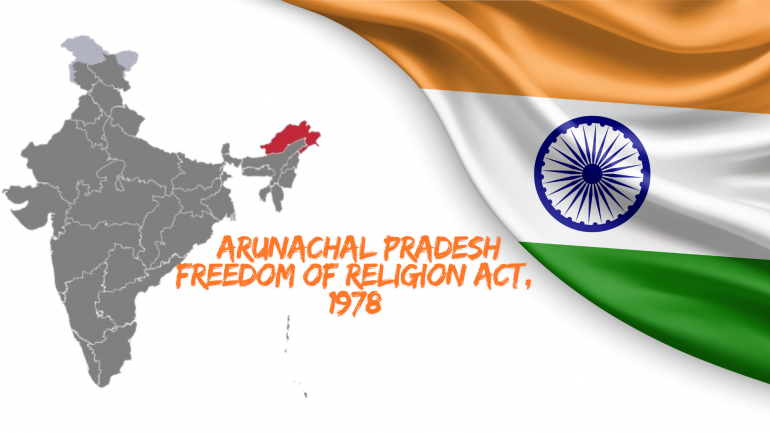
In every society, there comes a moment when laws must be re-examined, not out of rebellion, but out of responsibility. For Arunachal Pradesh in northeast India, that moment has arrived in relation to the Arunachal Pradesh Freedom of Religion Act, 1978 (APFRA). This is not merely a legal discussion. It is a question of conscience and of the kind of society we aspire to be, one rooted in trust and freedom, or one guided by suspicion and control. The time has come to engage in a serious, thoughtful, and compassionate reconsideration of APFRA 1978.
Understanding the Origins of APFRA
To fairly evaluate APFRA, we must first understand the circumstances in which it was created. The late 1970s were a period of transition in Arunachal Pradesh, with concerns about preserving indigenous cultures, traditions, and social harmony. The arrival of different religious influences was viewed by some as a potential threat to these delicate social structures. It was within this context that APFRA was enacted.
Its stated objective was to prevent religious conversions through force, fraud, or inducement. On the surface, this appears reasonable, as no society should tolerate coercion or deception in matters of faith. However, the intention behind a law and its long-term impact are not always the same. What may begin as protection can, over time, evolve into restriction, especially when it concerns something as deeply personal as belief.
The Constitutional Promise of Freedom
India’s Constitution stands as a moral and legal compass for the nation. Under Article 25, every citizen is guaranteed the freedom to profess, practice, and propagate religion. This is a fundamental right. The framers of the Constitution understood that belief cannot be imposed or restricted without undermining human dignity. Faith is a matter of conviction, not regulation.
While reasonable restrictions are permitted in the interest of public order, morality, and health, they must be precise and proportionate. The concern with APFRA is that it risks crossing this line. Instead of narrowly targeting coercion, it creates a broader framework that may affect even voluntary expressions of faith.
The Problem of Ambiguity
One of the key issues with APFRA lies in its language. Terms such as “inducement” and “allurement” are vague and open to interpretation. This lack of clarity can lead to inconsistent application. For example, when religious organizations provide education, healthcare, or humanitarian aid, are these acts service or inducement?
Such ambiguity creates uncertainty. It may discourage legitimate charitable and spiritual activities for fear of legal consequences.
The Question of Personal Autonomy
At the heart of this debate lies personal autonomy. The decision to embrace or change one’s religion is among the most intimate human choices. It involves reflection, conscience, and lived experience. When the state enters this space through procedural scrutiny, ethical concerns arise.
Can belief be subject to approval? Can conscience be regulated? In a free society, the answer must be no.
Changing Times, Changing Realities
More than four decades have passed since APFRA was enacted. India has changed significantly, as has Arunachal Pradesh. There is greater awareness of rights, education, and constitutional values. Society today is more connected and informed. Laws must evolve with these realities. A law that does not adapt risks becoming outdated and counterproductive.
Do We Need APFRA Today?
This question must be asked honestly. Existing Indian laws already address coercion, fraud, and undue influence. If such offenses occur, they can be dealt with under general criminal provisions. This raises the question of whether a separate law like APFRA is necessary. If its concerns are already covered elsewhere, its continued existence may be redundant and potentially problematic.
Beyond legal arguments, laws affect real lives. They shape perceptions, relationships, and trust. When people feel their beliefs are monitored, it creates fear. When communities feel targeted, it creates exclusion. This is not the spirit of democracy, which must empower rather than constrain.
A Call for Dialogue, Not Division
The issue of APFRA should be approached through calm and inclusive dialogue. Concerns about culture, harmony, and freedom must all be considered. The goal is not to create winners and losers, but to find a just and balanced path forward.
If concerns persist, they must be addressed through fair and constitutional means, by strengthening existing laws against coercion, promoting education, encouraging interfaith dialogue, and building trust among communities. These approaches focus on solutions rather than restrictions.
Why Repeal Matters
Repealing APFRA is not about removing protection but restoring balance. It is about ensuring that laws do not overreach into personal freedoms and aligning legislation with constitutional values. It is about building a society where trust replaces suspicion. Repeal does not mean absence of law, it means better law.
Ultimately, this is not only a legal question but a moral one. Do we trust individuals to make their own choices? Do we believe in freedom of conscience? Do we value unity over division? If the answer is yes, then the direction becomes clear.
This is a clarion call, not of protest, but of reflection and responsibility. APFRA served a purpose in its time, but times have changed, and so must our laws. Let us move towards a future where freedom is respected, diversity is celebrated, and laws empower rather than restrict. The repeal of APFRA is not just a legal step, it is a step towards a more just, inclusive, and free society.