



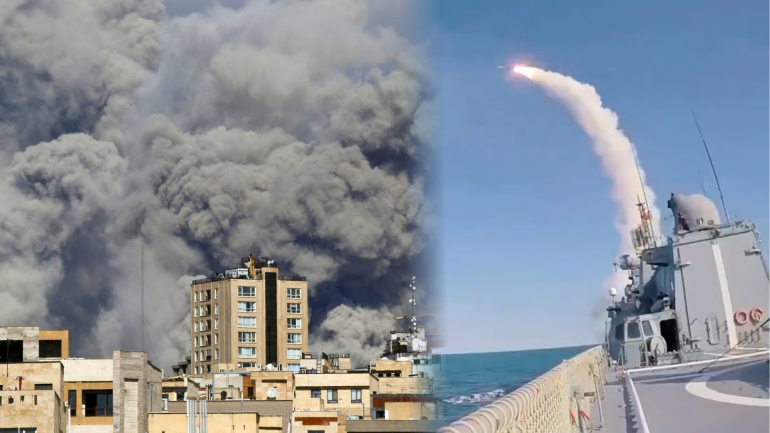
As missile exchanges intensify across the Middle East, Catholic communities in Iran and the Gulf are adjusting to a new climate of uncertainty. For Iran’s small minority and the region’s large expatriate congregations, the conflict has sharpened concerns over security, public expression and long-term stability.
Catholics in Iran belong largely to Armenian and Chaldean communities, with a small Latin-rite presence centered around parishes such as the Cathedral of the Consolata and St. Joseph’s Cathedral in Tehran. Altogether, Catholics number about 21,000 across Latin, Armenian and Chaldean rites in a country of nearly 87 million people. Recognized by the state but closely monitored, they practice their faith within clearly defined limits.
Periods of war or heightened geopolitical strain increase that vulnerability.
Church leaders in Iran have kept public remarks measured. Homilies avoid political language that could be interpreted as alignment with foreign powers, particularly in a context where Western influence is viewed with suspicion. In such an environment, restraint is often seen as necessary to safeguard communities and maintain space for worship.
At the Vatican on March 1, 2026, Pope Leo XIV called for “reasonable, authentic and responsible dialogue” amid mounting tensions in the Middle East, warning that “stability and peace are not built with mutual threats.” The Holy See reiterated its appeal for diplomacy and avoided endorsing any political actor.
The escalation followed coordinated U.S. and Israeli strikes on Iranian targets, described by Washington and Jerusalem as defensive actions linked to concerns over Iran’s nuclear and missile programs.
Across the Persian Gulf, Catholic communities operate under different political systems but face related anxieties. In Bahrain, Qatar, Kuwait, and the United Arab Emirates, churches serve large expatriate populations. In Qatar, Catholics are estimated at about 350,000; in Kuwait, between 350,000 and 400,000; and in the UAE, close to one million, largely migrants from the Philippines, India, and other Asian countries.
In Bahrain, home to the U.S. Navy’s Fifth Fleet, thousands attend the Cathedral of Our Lady of Arabia. Qatar’s Our Lady of the Rosary Church ministers to one of the region’s largest expatriate congregations, while Kuwait’s Holy Family Cathedral serves a predominantly migrant faithful in a country hosting significant U.S. military facilities.
These churches function openly but within established restrictions. Public evangelization is limited, political commentary is discouraged, and their continued operation depends on government approval and regional stability.
In recent days, Catholics in Qatar and the United Arab Emirates reported seeing missile interceptions and distant impacts in the sky. While daily routines have largely continued, parishioners described heightened alertness and close attention to developments.
For Catholics in Iran, the conflict reinforces the need for caution in public life. For expatriate communities in the Gulf, it underscores how quickly regional tensions can affect countries hosting foreign military assets. In both contexts, the war has tightened the boundaries within which these communities practice their faith, even as churches remain open and liturgies continue.