


Reflection Date: September 22, 2026 | Tuesday of the Twenty-fifth Week in Ordinary Time
Daily Readings: Proverbs 21:1-6, 10-13; Luke 8:19-21
Children of God:
In many Filipino communities, especially in the Visayas and parts of Mindanao, the mananabtan, or the community prayer leader in simple English, has long been a familiar figure who leads people in prayers and novenas.
The word is connected with sabat, the Cebuano practice of responding or repeating after the prayer leader, which explains the responsorial character of the prayer.
The mananabtan often becomes especially visible during wakes, novenas, fiestas, and other moments when a community gathers to pray.
In the traditional Filipino setting, this person does more than simply recite prayers because he or she helps gather people, organize the prayer, and keep the community praying together.
The practice has also been passed down through generations, often through observation, constant practice, and learning from older prayer leaders rather than through formal schooling.
I remember how the voice of a mananabtan could become almost part of the soundscape of a Filipino village, leading one response after another while families and neighbors gathered together.
For many people, especially during times of death and mourning, the mananabtan becomes part of the community's way of accompanying a family through grief and prayer.
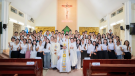
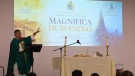
That is why I am happy to see that, as reported by the Davao Catholic Herald, formation is now being made available for mananabtan, because a tradition that has long been transmitted informally can also be strengthened by intentional formation.
The formation of new mananabtan is not simply about preserving an old practice but about preparing people who can continue helping Filipino communities pray, gather, and live their faith together.
In the gospel story of Jesus, His mother and relatives came looking for Him while a crowd surrounded Him.
Someone told Him that they were outside and wanted to see Him.
Jesus responded by saying, “My mother and my brothers are those who hear the word of God and act on it” (Luke 8:21).
Of course, Jesus did not reject His family or deny the importance of family relationships.
Instead, He expanded the meaning of family by pointing to something deeper: people become part of His family when they listen to God's word and put it into practice.
The people gathered around Jesus were not merely spectators.
They were invited to become a community shaped by what they heard and lived.
So, what are our inspirations for today?
First, a community becomes stronger when someone takes responsibility for bringing people together.
The mananabtan traditionally stands in front of a group and leads the prayers, but the deeper role is not simply having a loud or recognizable voice.
It is helping people pray together.
One person begins, others respond, and eventually the whole community becomes one praying voice.
That is also what Jesus was doing when people gathered around Him.
He was not simply collecting listeners.
He was forming a community of people who could hear God's word and act upon it.
The real measure of a community is not only how many people are present but whether those people are becoming connected by something greater than themselves.
This challenges us to look at our own communities.
In our families, parishes, workplaces, schools, and neighborhoods, someone always needs to take the first step to gather people.
Sometimes that person is a priest, sometimes a parent, sometimes a catechist, sometimes a youth leader, and sometimes simply an ordinary person who says, “Let us pray together.”
A community becomes stronger when someone takes responsibility for bringing people together.
Second, what we say in prayer should be seen in the way we live.
Jesus defined His true family not simply by their relationship to Him but by their response to God's word. “My mother and my brothers are those who hear the word of God and act on it” (Luke 8:21).
Listening was important, but acting was equally important.
This is also an important reminder for anyone who leads prayer.
Prayer is not finished when the final “Amen” is spoken.
It continues when we forgive, serve, accompany someone who is grieving, help a neighbor, care for the poor, and choose what is right.
What we say in prayer should be seen in the way we live
As we reflect, we ask ourselves: Am I helping bring people together in my family, parish, workplace, or community, or am I simply waiting for someone else to take the first step?
When I pray, do my words lead me to concrete actions toward other people? What responsibility can I take today to help keep the faith alive in the community where God has placed me?
Children of God:
The Gospel reminds us that prayer becomes all the more meaningful when people hear God's word and act on it.
This means that every community needs people who are willing to gather, lead, teach, accompany, and serve.
The community needs someone who helps people find their voice together before God and then carry that prayer into everyday life.
Every time someone gathers people to pray, a community is being formed.
Every time that prayer becomes an act of love, the Gospel becomes visible.
Radio Veritas Asia (RVA), a media platform of the Catholic Church, aims to share Christ. RVA started in 1969 as a continental Catholic radio station to serve Asian countries in their respective local language, thus earning the tag “the Voice of Asian Christianity.” Responding to the emerging context, RVA embraced media platforms to connect with the global Asian audience via its 21 language websites and various social media platforms.
Latest News