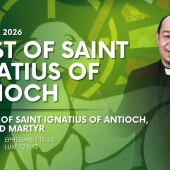
Reflection Date: September 19, 2026 | Saturday of the Twenty-fourth Week in Ordinary Time
Saint Januarius, Bishop and Martyr
Daily Readings: 1 Corinthians 15:35-37, 42-49; Luke 8:4-15
Children of God:
One of the histories of Christianity that I admire in Asia is that of Korea.
Christianity in Korea began in a remarkably unusual way because the first seeds of the faith were planted not by foreign missionaries but by Korean lay intellectuals who encountered Christian writings.
In the eighteenth century, Korean scholars who participated in diplomatic missions to China came across Catholic books and ideas and became curious about the Christian faith.
Some of them studied these writings seriously, discussed them among themselves, and eventually began practicing what they learned.
One of the important early figures was Yi Seung-hun, who traveled to Beijing, received baptism, and returned to Korea with Christian books and a new determination to share the faith.
He and other lay believers began teaching their countrymen even before foreign priests could regularly enter Korea.
Small Christian communities gradually formed in different places, sustained by ordinary people who prayed, learned, baptized when possible, and shared the teachings of Christianity with their families and friends.
The movement eventually attracted the attention of the Joseon authorities, who viewed Catholicism as a threat to traditional social structures and religious practices.
Persecutions followed, and many of the early Korean Christians were imprisoned, tortured, or executed, yet the faith continued to spread.
Foreign missionaries eventually entered Korea secretly, and priests such as the French missionaries of the nineteenth century helped strengthen a Church that Korean laypeople had already begun to build.
Saint Andrew Kim Taegon later became the first Korean-born Catholic priest and one of the most famous martyrs of the Korean Church.
From those small beginnings, Christianity grew into a significant community in Korea, and the Korean Church eventually produced thousands of clergy, religious, missionaries, and lay leaders who continued to carry the faith far beyond its original beginnings.
What makes the Korean story remarkable is that the seed was already growing before the people who could formally cultivate it arrived.
The first believers did not wait for perfect circumstances, impressive buildings, or a large organization before sharing what they discovered.
They simply received the seed, allowed it to take root in their lives, and passed it on.
In the gospel story of Luke, Jesus described a farmer who scattered seed across different kinds of ground.
Some seed was lost, some began growing but did not survive, and some fell on good soil and produced an abundant harvest.
Jesus explained that the seed represented the word of God and that its fruitfulness depended on what happened after the seed was received.
So, what are our inspirations for today?
First, a small beginning can become something much bigger when people take it seriously.
We often underestimate small beginnings because we want immediate results.
We want the first video to go viral, the first project to become successful, the first meeting to solve everything, or the first effort to produce a visible achievement.
When nothing dramatic happens, we sometimes conclude that our effort is useless.
But many important things in life begin quietly.
A child learns one word at a time, a friendship begins with one conversation, a community starts with a few committed people, and a mission grows because somebody takes the initiative.
A small beginning can become something much bigger when people take it seriously.
Second, the seed grows when it is given a place to take root.
Jesus described different kinds of soil because receiving a message is not the same as allowing that message to transform our lives.
Some seed disappeared quickly, some grew only briefly, and some produced a harvest because it found good soil.
We receive many seeds every day: advice from someone who loves us, a lesson from experience, an inspiring story, a word of encouragement, an uncomfortable truth, or an invitation to change.
The question is not simply how much information enters our minds but what we allow to take root in our hearts.
A good message can produce little fruit if we listen today and forget it tomorrow.
The seed grows when it is given a place to take root.
As we reflect, we ask ourselves: What good seed is already being planted in my life that I need to take more seriously?
What prevents good ideas, lessons, or invitations from taking deeper root in me? What can I do today to allow something good that I have received to produce fruit in my life and in the lives of others?
Children of God:
Jesus reminds us that the seed already carries the possibility of growth, but it needs good soil and patient care.
Today, let us not underestimate the small things we are doing simply because we cannot yet see their results.
Let us also ask whether the good seeds we receive are truly taking root in us.
And like those early Korean Christians, may we become people who receive what is good, live it faithfully, and quietly pass it on to others.
Radio Veritas Asia (RVA), a media platform of the Catholic Church, aims to share Christ. RVA started in 1969 as a continental Catholic radio station to serve Asian countries in their respective local language, thus earning the tag “the Voice of Asian Christianity.” Responding to the emerging context, RVA embraced media platforms to connect with the global Asian audience via its 21 language websites and various social media platforms.
Latest News