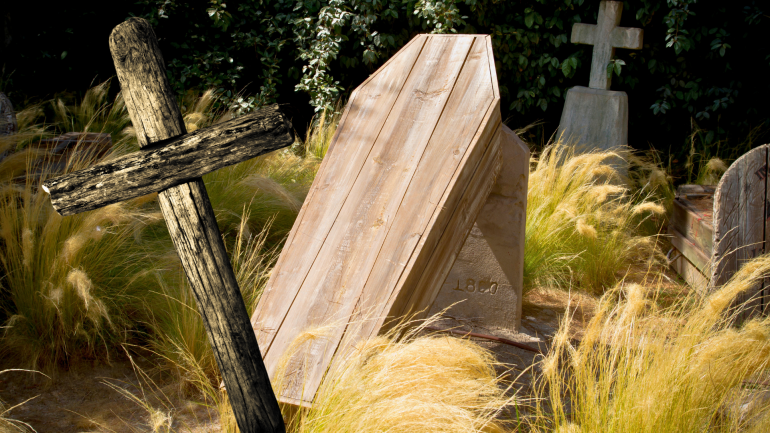
I once lay inside a coffin and listened to my friends describe my life as if I had already left it.
This was not a nightmare. It was a retreat exercise during my novitiate, deliberately arranged, entirely voluntary. Each of us took a turn. We climbed in, closed our eyes, and listened while our brothers spoke about us in the past tense: what we had given, what we had withheld, what kind of space we had made for others, or failed to make. When my turn came, I heard things that were kind, things that were accurate in ways I wished they weren’t, and one observation that I have never quite shaken, not because it was cruel, but because it was simply, plainly true.
One companion stayed in the coffin the entire afternoon. Nobody asked him to leave.
I have thought about that image many times since. A young man choosing to stay inside his own death, not from despair, but from some deep need to let the truth settle before he climbed back out into ordinary life. I found it quietly frightening.
We are not as comfortable with honesty as we think.
Good Friday is supposed to be the most honest day in the Christian calendar. A man was executed. Friends scattered. Everything he said apparently ended in silence and failure. No softening, no recovery, not yet. Just the cross and what it cost.
But we have had two thousand years to tidy it up, and we have used them well. The cross has become jewelry. The story has become ritual. The brutality, the political maneuvering, the crowd psychology, the particular cowardice of people who knew better and stayed quiet, has been smoothed into something we can observe from a comfortable distance without it asking us very much at all.
That bothers me more the older I get.
Because the forces that killed Jesus were not unusual. They were ordinary. Pilate was not a monster; he was a pragmatist protecting his position. The religious authorities were not villains twirling cloaks; they were institutional men afraid of disruption. The crowd was not uniquely cruel; crowds rarely are. They were people doing what people do when fear and tribalism take over, following the loudest voice, rationalizing what they could not stop, and looking away from what they did not want to see.
We do all of this, regularly, often without noticing.
What the Coffin and the Cross Share
The retreat exercise worked because it removed the usual escape routes. You could not change the subject, check your phone, or reframe the story more favorably. You simply had to lie there and listen to an account of your life that you had not written and could not edit.
The cross does something structurally similar. It holds up a moment that cannot be redecorated. A person who spent his life moving toward the excluded and the wounded ended up being killed for it, not by extraordinary evil, but by the completely ordinary machinery of self-interest, institutional anxiety, and crowd silence. That is not a comfortable story. It is not meant to be.
What unsettles me most about Good Friday is not the suffering, terrible as it was, but the recognizability of everything surrounding it. I know the voice that says this situation is more complicated than it looks. I know the instinct to protect what we have built rather than risk it for something true. I know what it feels like to stay quiet in a room where someone needed me to speak.
I suspect most people do.
Living While There Is Still Time to Change
My companion in the coffin was working something out that afternoon. I think he had heard something about himself that needed more than a few minutes to absorb, not a condemnation, but an invitation to become more fully what he was already capable of being.
That is what Good Friday offers, underneath all the solemnity, not guilt as a destination, but honesty as a doorway.
The question is not whether we have failed, most of us carry the knowledge of our failures quietly and constantly. The question is whether we are willing to climb back out of the coffin and actually do something differently, whether the story of Jesus’ life and death lands on us as history or as something that has a claim on how we spend tomorrow.
The cross does not offer easy comfort. But it does offer company, the company of someone who looked at the full cost of love and chose it anyway, not in a single heroic moment, but across years of small, consistent, quietly radical choices.
Most of our lives will be decided in those smaller moments, in what we say or don’t say, in whom we stay near when staying is inconvenient, in whether we let difficult truths settle or climb out too quickly into the noise.
My friend stayed in that coffin all afternoon.
I have always thought he understood something the rest of us were still working up the courage to face.