



One figure returns to our thoughts every Holy Week with unsettling persistence - not Peter in his denial, nor Judas in his betrayal, but Pontius Pilate, the man who tried, and failed, to do the right thing.
There is something deeply human about Pilate. He is not driven by hatred. He does not appear ideologically opposed to Jesus. In fact, the Gospels present him as a reluctant participant in a drama he neither fully understands nor entirely controls. “I find no basis for a charge against him,” Pilate declares. Not once, but repeatedly. And yet, Jesus is crucified.
So the question lingers: if Pilate knew Jesus was innocent, how then do we judge his role? Was he guilty - or merely weak?
A Governor Caught Between Truth and Power
To understand Pilate is to understand the world he governed. Roman rule depended not only on military strength but on maintaining order in volatile provinces.
Pilate’s primary responsibility in Judea was simple: keep the peace.
When Jesus is brought before him, Pilate quickly realises this is no ordinary criminal case. The accusations are religious, not political. Jesus speaks of a kingdom - but not one that threatens Rome.
Pilate does not rush to condemn Jesus. On the contrary, he appears to search for a way out.
He sends Jesus to Herod. He invokes the Passover custom of releasing a prisoner. He even orders Jesus to be scourged - perhaps hoping that a brutal punishment short of death would appease the crowd.
And then, in the midst of this tense and public trial, a message arrives from his wife.
“Have nothing to do with that innocent man,” she tells him, “for I have suffered a great deal today in a dream because of him.”
Pilate, already convinced of Jesus’ innocence, now finds that conviction echoed within his own household.
These are not the actions of a man eager for blood. They are the actions of a man trying to avoid making a costly decision.
But justice, by its very nature, demands decision. And delay, in such moments, becomes its own form of complicity.
When the Crowd Finds Its Voice
The crowd, stirred by the chief priests, grows louder, more insistent. “Crucify him!” they shout. And then comes the line that likely sealed Jesus’ fate: “If you release this man, you are no friend of Caesar.”
In that moment, the trial ceases to be about Jesus.
It becomes about Pilate.
His loyalty is questioned. His position is threatened. A report to Rome - suggesting leniency towards a man claiming kingship - could end his career, if not worse. Pilate calculates.
And like many before and after him, he chooses self-preservation over justice.
The Futility of Washed Hands
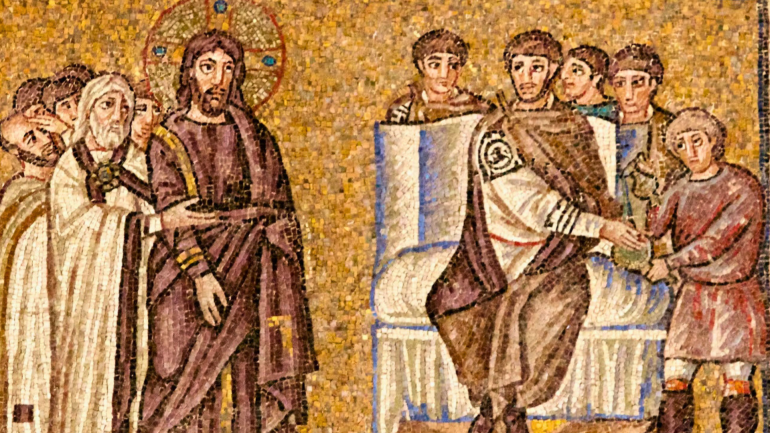
The image is unforgettable. Pilate takes water, washes his hands before the crowd, and declares himself innocent of Jesus’ blood.
It is an empty gesture.
Because authority cannot be symbolically surrendered. Pilate had the power to release Jesus. He had publicly acknowledged His innocence. The machinery of execution moved not without his consent, but because of it.
History and faith have never accepted Pilate’s claim of innocence.
The Creed itself ensures that his name is remembered: “suffered under Pontius Pilate.”
The Sin of Knowing - and Not Acting
Pilate’s guilt is not the guilt of ignorance. It is the guilt of knowing - and still yielding.
There is something almost more troubling about that. A man who does evil out of conviction can at least be confronted at the level of belief. But a man who recognises the good and fails to act on it reveals a deeper fracture - the collapse of moral courage.
Pilate stands as a warning to all who hold power, whether political, institutional, or even personal.
Because the temptation he faced is not unique to Roman governors. It is present wherever truth becomes inconvenient, wherever justice threatens stability, wherever doing the right thing comes at a personal cost.
A Holy Week Question
Holy Week does not invite us merely to judge Pilate. It invites us to examine ourselves.
It is easy to condemn the crowd. Easier still to distance ourselves from the betrayal of Judas. But Pilate unsettles us because he is neither wholly villain nor wholly victim.
He is, in many ways, us - when we see clearly, yet act cautiously; when we speak of justice, yet retreat from its demands.
The tragedy of Pilate is not that he failed to recognise the truth standing before him.
It is that he recognised it - and still let it be crucified.
Long after the water has dried from his hands, the question remains - quiet, insistent, and deeply personal: When truth stands before us, will we have the courage to stand with it?