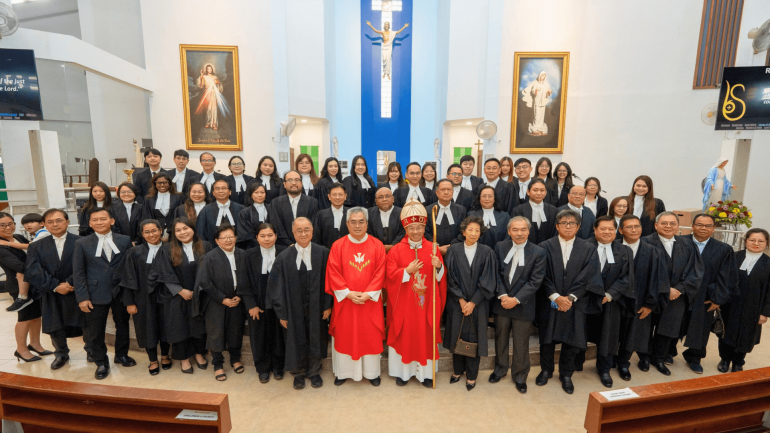
Once a year, the law does something unusual. It stops. It listens. And, in a church filled with the colour of fire and blood, it prays.
The Red Mass is one of the Catholic Church’s most understated yet profound traditions — a solemn liturgy offered not for the sick, the poor, or the grieving, but for those entrusted with something far more abstract and dangerous: justice.
Judges, lawyers, lawmakers, law lecturers, and law students gather not as adversaries or advocates, but as human beings conscious of the weight they carry. In a profession defined by arguments and outcomes, the Red Mass asks a different question: “How do we decide rightly?”
A Medieval Beginning with Modern Relevance
The tradition reaches back to 13th-century Europe, when Church and civic life were deeply intertwined. The first recorded Red Mass was celebrated in 1245 at Notre-Dame Cathedral in Paris, and it later took root in England and across the continent.
Its name comes from the striking red vestments worn by the clergy — a colour chosen deliberately. Red evokes the fire of the Holy Spirit, invoked at Pentecost, and the blood of martyrs who suffered for truth and conscience. From the beginning, the Mass carried a quiet warning: justice is never morally neutral, and it often comes at a cost.
Centuries later, the tradition crossed the Atlantic. In 1928, St Andrew’s Church in New York City hosted the first Red Mass in the United States. Since then, it has become an annual fixture in many cities, marking the opening of the judicial year.
Perhaps the most high-profile celebration today takes place in Washington, D.C., at the Cathedral of St Matthew the Apostle, where members of the U.S. Supreme Court, legislators, and senior officials sit beneath the same red canopy — robed not in authority, but in humility.
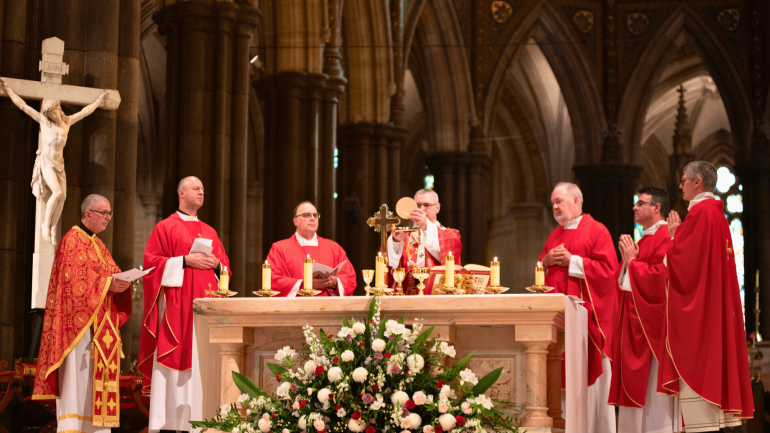
Law Under the Gaze of the Spirit
At its heart, the Red Mass is a prayer of invocation.
The Holy Spirit is called upon to grant wisdom, understanding, counsel, fortitude, knowledge, piety, and fear of the Lord — virtues drawn from Scripture and painfully relevant to legal life. These are not abstract ideals. They are antidotes to real temptations: arrogance, expediency, political pressure, careerism, and the slow dulling of conscience.
The liturgy reminds participants that law is more than procedure, precedent, or power. It is a moral act. Every ruling, every sentence, every piece of legislation touches lives — often the most vulnerable ones.
In a world where legality is frequently mistaken for morality, the Red Mass insists that the two must remain in conversation.
A Countercultural Pause
What makes the Red Mass remarkable is not its grandeur, but its restraint.
There are no verdicts delivered, no speeches about reform, no applause. Instead, there is silence. Scripture. Prayer. And the unsettling suggestion that even the most learned jurist needs guidance beyond themselves.
For law students, it is a quiet initiation into the gravity of their future vocation. For seasoned judges, it can be a moment of reckoning — a reminder that justice is not merely about being correct, but about being right.
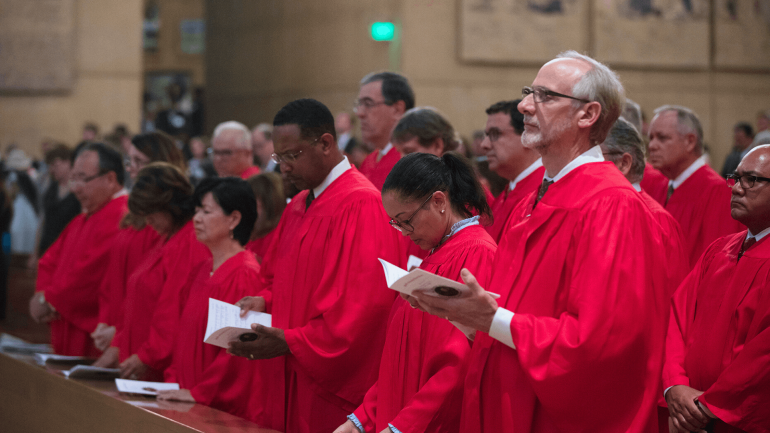
Fire, Blood, and Responsibility
The colour red dominates the liturgy for a reason. It symbolises fire — the Spirit’s energy that illuminates, challenges, and sometimes burns away comfortable certainties. It also symbolises blood — the price paid by those who refused to separate law from conscience, truth from convenience.
In that sense, the Red Mass is not a celebration of the legal profession’s power, but a sober acknowledgement of its responsibility.
Once the Mass ends, the participants return to courtrooms, chambers, classrooms, and parliament halls. The arguments resume. The files pile up. The pressures return.
But for a moment each year, the law remembers that justice, at its deepest level, is not just something we enforce.
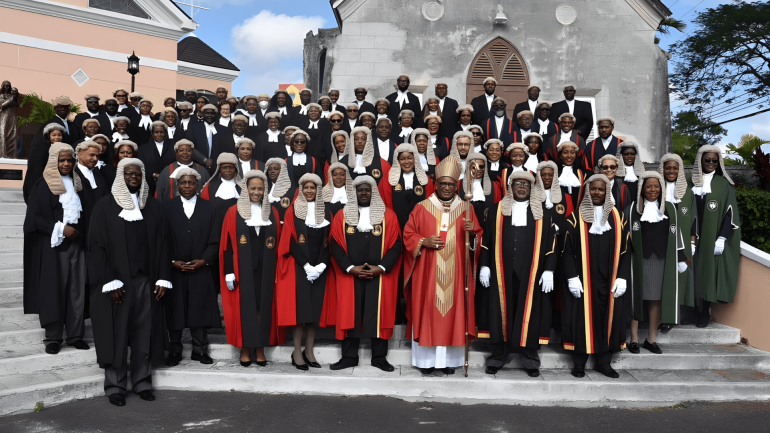
Red Mass in Malaysia and Singapore
Recently, Catholics in Malaysia and Singapore marked the start of the legal year with the Red Mass, gathering members of the legal fraternity to place their vocation before God.
In Sarawak, the Mass at Kuching’s Blessed Sacrament Church was presided over by Archbishop Simon Poh, who urged judges and lawyers to see justice not merely as legal correctness but as moral responsibility, calling them to “uphold the common good, protect the vulnerable and maintain integrity in a polarised society,” where justice is fair treatment, mercy is compassionate forgiveness, and faithfulness is loyal commitment to God and community.
In Singapore, the Red Mass at St Joseph’s Church (Victoria Street) was celebrated by Fr Colin Tan SJ, who acknowledged the moral dilemmas legal professionals face and reminded them of their human limitations, encouraging them to remain open to God’s guidance — which may come in unexpected ways — and to live their vocation with competence, commitment and compassion, especially in service of those who rely on the law for protection.
When the red vestments are folded away, and courtrooms reopen, the Red Mass leaves behind no rulings and no resolutions — only a question that lingers long after the incense fades: how will justice be exercised when conscience, power and human frailty meet?
In asking that question, the Church quietly reminds the law that justice, at its deepest, is not only enforced — it is answered for.