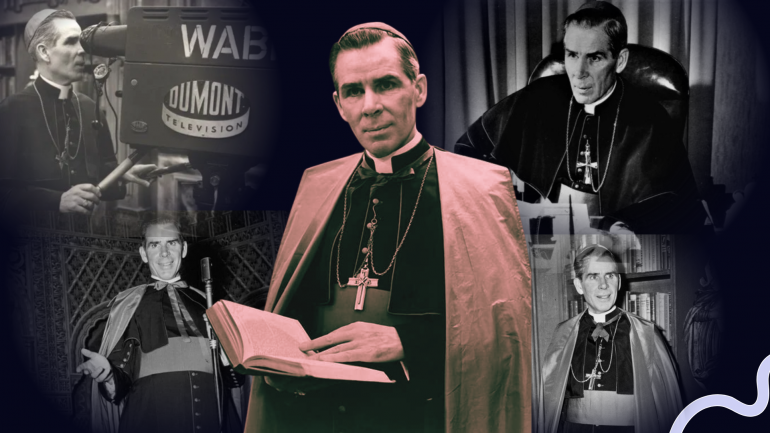
During most of my early years, long before I ever imagined a career in journalism, I devoured anything I could find by Archbishop Fulton J. Sheen. He was everywhere in my reading: his columns in regional Catholic newspapers, radio broadcasts, and eventually the early television programs that made him famous. For a young Malaysian like me, growing up in the 60s and 70s in a world where Catholic voices were often quiet, Sheen’s voice was striking.
Sheen was not only a theologian and archbishop - he was also a prolific writer and media pioneer. He authored over 60 books and two syndicated newspaper columns that ran for nearly 20 years, bringing moral and philosophical reflection into the public sphere.
On television, his Emmy-winning series “Life Is Worth Living” and the radio program “The Catholic Hour” made him one of the first religious figures to reach mass audiences through modern media.
What struck me most was how he could take big, complex ideas and make them clear for anyone listening - a lesson I strive to bring into my journalism.
I remember the first time I read one of his columns. The words struck me not because they were theologically fanciful, they were not - but because they made sense. He wrote as if speaking directly to me. The truth, he seemed to say, is not reserved for scholars or theologians. It belongs to anyone willing to listen, to anyone awake to the stirrings of conscience and the quiet movements of life.
He took heavy concepts and rendered them in ways anyone could understand. Each lesson was a story, an analogy, or a gentle nudge to see meaning in ordinary moments.
For me, these were lessons in seeing the human story in every encounter, a Sheen-inspired approach that has shaped my career as a journalist.
Clarity, Humour, and Human Insight
Sheen’s voice was marked by clarity and an understated humour. I remember reading a line where he likened sin to “taking a sip from the poisoned cup of pleasure.” The imagery was vivid, almost cinematic, and yet delivered with a gentleness that invited reflection rather than fear. That same humour surfaced in the way he engaged people.
During one of his talks, a baby began to cry, and the mother quietly stood up to leave. Sheen paused and said, “Madam, your baby is not bothering me.” Without missing a beat, she replied, “But you are.”
It was a disarming exchange - revealing not just his wit, but his ease with people and his willingness to be part of the moment rather than above it.
This combination of insight and warmth shaped the journalist I became. Like Sheen, I learned to focus on the person at the heart of every story. Through reading his columns, I also discovered how to quickly place a human face into a story - to identify the detail, gesture, or word that makes it feel immediate and real, allowing the reader to recognise something of their own life within it.
Whether profiling Sarawak’s Ring Ladies, chronicling the struggles of working families, or exploring community resilience in urban and rural settings, I strive to illuminate lives, struggles, and moments of grace in a way that is vivid, relatable, and unmistakably human.
Faith, Culture, and Interfaith Storytelling
Sheen’s awareness of culture resonates deeply in my reporting. Growing up in Malaysia, I quickly realised that culture and human behaviour are inseparable; to understand one is to understand the other. His example guided me as I navigated stories involving diverse communities, languages, and traditions. Life cannot be understood in isolation; it is lived and shared, sometimes with or in tension with the world around us.
In my coverage of communities - whether rural villagers preserving traditions, urban families juggling work and care responsibilities, or grassroots volunteers helping neighbours in need - I try to reflect that same principle. Grace, patience, and human connection often speak louder than doctrine.
Sheen also influenced how I approach human-interest narratives. I am always drawn to the individual within the larger story: a nurse quietly caring for patients, a factory worker supporting a colleague through a family crisis, or a young professional navigating life and career challenges with integrity and curiosity. Each story, no matter how local or ordinary, is a window into human resilience, compassion, and dignity - something Sheen’s writings constantly reminded me to seek.
Seeing God in Ordinary Lives
Sheen’s beatification this September is a reminder of the enduring power of a voice that combines intellect, care, and humour. For me, it also prompts reflection on the ways his approach has shaped my work: clarity without condescension, observation grounded in empathy, and storytelling that honours the humanity of its subjects.
Looking back, I realise that Sheen’s influence is subtle but pervasive.
He showed me that meaning and goodness are not confined to formal settings; they are in human relationships, acts of generosity, small gestures of courage, and everyday kindness. From Vietnam to Malaysia, from Sarawak to Penang, every story I write carries echoes of his lessons: observe, listen deeply, and recognise the grace in ordinary lives.