

Crisis as Doorway: Archbishop Poh Invites Asian Church to See Crisis as Opportunity

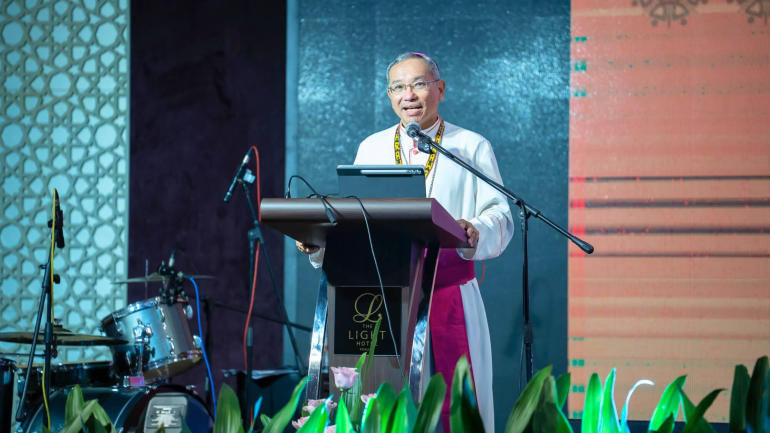
Crisis must be understood not merely as danger but as a doorway through which the Church can grow, Archbishop Simon Poh of Kuching said, urging Asian Catholics to confront modern challenges with confidence and hope.
Delivering the keynote address, “Journeying Together as Peoples of Asia,” on November 28, the second day of the Great Pilgrimage of Hope in Penang, Archbishop Poh, President of the Catholic Bishops’ Conference of Malaysia and Chairman-designate of the FABC Office of Evangelization, reflected on the Chinese word 危机 (wéi jī). While 危 conveys danger, 机 points to a hidden turning point, an opportunity waiting to unfold.
“In every crisis, there is both DANGER and OPPORTUNITY,” he said.
Archbishop Poh emphasized that a crisis is not an interruption but an invitation. It is the moment when God opens a path we may not immediately see. “In every struggle,” he said, “God plants the seed of something new.”
Church in Asia: A History of Trial and Quiet Resilience
The archbishop’s exposition of wéi jī becomes a reflection on the remarkable resilience with which Asian Catholics have survived and grown through centuries of hardship.
Across Asia, the Church has always been small in number yet deep in witness. Its greatest periods of growth occurred not in comfort but in times marked by persecution, political instability, and cultural suspicion.
– In Japan and Korea, hidden Christian communities preserved the faith for generations.
– In India and Sri Lanka, Catholics endured colonisation, civil conflict, and ethnic tensions.
– The Philippines weathered dictatorship and political upheaval.
– In Malaysia, Myanmar, Vietnam, and Timor-Leste, missionaries built schools, hospitals, and pastoral centres amid epidemics, migration, and scarcity.
This was a faith shaped by endurance, parents teaching prayers in secret, catechists walking to remote villages, and priests and religious surviving war, displacement, and poverty.
Time and again, what looked like setbacks became seeds of renewal, the very pattern captured in wéi jī, where danger and hidden possibility stand side by side.
Malaysia’s Journey: Growth on Uneven Ground
The Church in Malaysia mirrors this wider Asian pattern: growth through adversity.
Wartime displacement, rural-to-urban migration, ethnic sensitivities, and demographic shifts have often made Catholic life challenging. Yet each difficulty inspired new responses, youth movements, migrant ministry, outreach to indigenous communities in Sabah and Sarawak, and the emergence of strong lay leadership.
Faith in Malaysia, and throughout much of Asia, has grown on uneven ground. It has survived, and even flourished, because believers refused to give up, reflecting Archbishop Poh’s interpretation of the Chinese character for crisis.
Modern Crises: Challenges and Hidden Possibilities
Archbishop Poh noted that today’s crises, though less dramatic than those of previous centuries, are equally demanding.
Among them are:
• Young people drifting away from parish life
• Declining vocations, especially in mission territories
• Falling birth rates in many parts of developed Asia
• Unemployment, inequality, and limited access to education and healthcare
• Rural–urban migration and the impact of climate change
• Families strained by economic pressure, mobility, and fragmentation
• Digital distractions reducing time for prayer and community
• Environmental crises affecting indigenous and coastal populations
• Rising secular attitudes and cultural fatigue
• Restrictions on evangelisation in many Asian countries
• Discrimination or pressure faced by minority Christian communities
Each of these challenges embodies the dual meaning of wéi jī, danger paired with the possibility of renewal.
“Every hurdle contains a door,” he said. “Every crisis has a pivot where God can turn what seems like decline into growth and transformation.”
When Proclamation Becomes Impossible
Archbishop Poh reminded the faithful of the Church’s missionary identity, quoting Pope Francis’ Evangelii Gaudium (49):
“I prefer a Church which is bruised, hurting and dirty because it has been out on the streets, rather than a Church unhealthy from being confined and clinging to its own security.”
In many parts of Asia where open proclamation of faith is forbidden, the danger posed by such restrictions is real, yet, as Archbishop Poh stressed, so too is the opportunity. These situations call Christians to live the Gospel through actions more than words, to demonstrate Christ’s love through compassion, justice, and respect for human dignity.
Even when explicit preaching is not possible, the Church continues to proclaim Jesus by telling His story, as Ecclesia in Asia reminds us, keeping the Gospel alive through witness, community, and everyday acts of faith.
“In Asia, we must learn to witness and ‘whisper’ the Gospel to one another,” he said, not through silence, but through lives shaped by personal encounters with Christ.
Crisis as a Doorway to Renewal
Linking the Asian understanding of wéi jī to the Church’s mission today, Archbishop Poh called on the faithful to face modern crises with hope and creativity. Just as earlier generations met persecution, displacement, and poverty with courage and patience, today’s Christians must approach their trials with the same resilient spirit.
“As long as faith remains alive,” he said, “every crisis can become a turning point. And every turning point can become a doorway through which the Church grows.”