On February 11, the Church celebrates the Memorial of Our Lady of Lourdes, a feast that recalls one of the most beloved Marian apparitions in modern history and invites the faithful to reflect on prayer, healing, and God’s tender mercy.
Lourdes, France, was once a quiet and remote country town. Today, it is one of the world’s most visited pilgrimage shrines, drawing millions each year. In 1858, in a cave called Massabielle, the Blessed Virgin Mary appeared eighteen times—from February 11 to July 16—to a 14-year-old girl named Bernadette Soubirous.
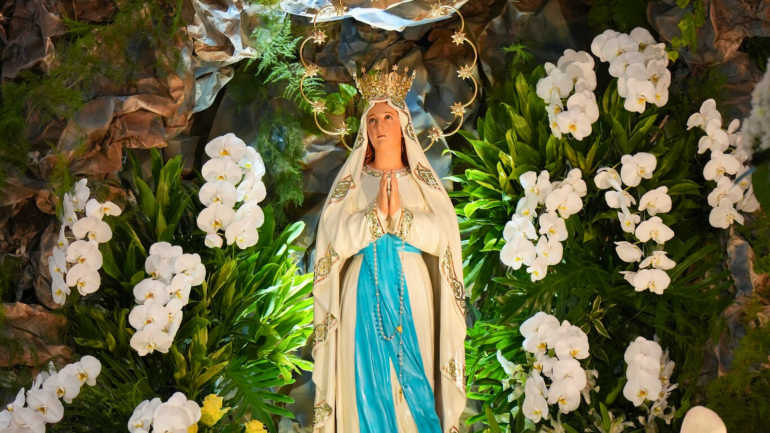
Bernadette, the daughter of a poor flour miller, came from a humble yet deeply God-fearing family. Though they lived with very little, they were generous in helping others. On that first day, February 11, Bernadette was gathering firewood with two younger companions along the banks of the River Gave. While waiting for her friends, her attention was drawn to the rustling of bushes near a shallow grotto. There she saw a beautiful Lady dressed in white, wearing a blue sash, with a yellow rose on each foot and a rosary hanging from her arm.
This first apparition at Lourdes—now more than a century and a half ago—has since become a profound sign of God’s mercy and healing for countless pilgrims.
At the first vision, no words were spoken. The Lady seemed simply to invite Bernadette to pray. The young girl knelt, took out her rosary, and began to recite it. The Lady passed the beads through her fingers, though her lips did not move. In the early apparitions, there was silence—only prayer, a gentle bow of the head, and a benevolent smile. In this, Mary reminded the world of the primacy and importance of prayer in the Christian life.
Her humility and maternal love put Bernadette at ease before entrusting her with a mission that would touch the world.
During the fourth apparition, the Lady finally spoke: “I do not promise to make you happy in this world, but in the next.” As news spread, increasing crowds accompanied Bernadette to the grotto. Her obedience, simplicity, and steadfast faith stirred spiritual renewal among the people.
Yet Bernadette and her family also endured suspicion, interrogation, and persecution from civil authorities. At times, she was even prevented from visiting the grotto. False visionaries arose with sensational claims, but Bernadette’s testimony remained simple, calm, and consistent. She spoke without exaggeration or emotion, describing only what she had seen and heard.
Mary’s promise indeed proved true. Bernadette entered religious life and lived humbly and quietly. She was canonized in 1933, and her body remains incorrupt to this day—a silent witness to her sanctity. Just as Mary stood by Jesus in His Passion, she continues to stand by us in our suffering.
On February 25, 1858, during one of the apparitions, Mary directed Bernadette to a spot near the grotto and said, “Go and drink at the spring, and wash yourself in it.” At first, only muddy water appeared. But after several attempts, clear water began to flow. Within days, a steady spring emerged—one that continues to flow today.
Though Our Lady never explicitly promised bodily cures, Lourdes has become a sanctuary of spiritual and physical healing. Millions testify to graces received there. The healings recorded over the years are signs not only of miraculous intervention but of God’s compassion for those afflicted in body and mind.
In subsequent apparitions, Mary called for prayer, penance, and sorrow for sin. On March 25, the Feast of the Annunciation, Bernadette finally asked, “Madam, would you please tell me who you are?” The Lady replied, “I am the Immaculate Conception.”
This declaration affirmed the dogma proclaimed just four years earlier in 1854—that Mary, by a singular grace of God, was preserved from original sin from the moment of her conception. In revealing herself this way to an uneducated village girl, Mary confirmed a profound theological truth with heavenly simplicity.
The words of St. Bernard beautifully echo this mystery: “A woman is given for a woman—a wise woman for a foolish one, a humble woman for a proud one. This woman does not offer you the fruit of death, but the food of life.” In Mary, humanity sees restored dignity, obedience, and holiness.
The Memorial of Our Lady of Lourdes is also observed as the World Day of the Sick. For 2026, the theme is: “The compassion of the Samaritan: loving by bearing the pain of the other.” The message of Lourdes harmonizes deeply with this call. St. Bernadette herself endured illness and suffering with quiet love, offering her pain in union with Christ.
At Lourdes, pilgrims experience faith lived in action—volunteers pushing wheelchairs, assisting the sick, praying together, and bearing one another’s burdens. It is a sanctuary where compassion becomes visible.
On this February 11, as the Church honors Our Lady of Lourdes, we are reminded that Mary leads us to prayer, to repentance, and to trust in God’s healing grace. We pray to Mary and we pray with Mary. She accompanies us so that we may experience—for ourselves and for others—the abundant life that only Jesus can give.