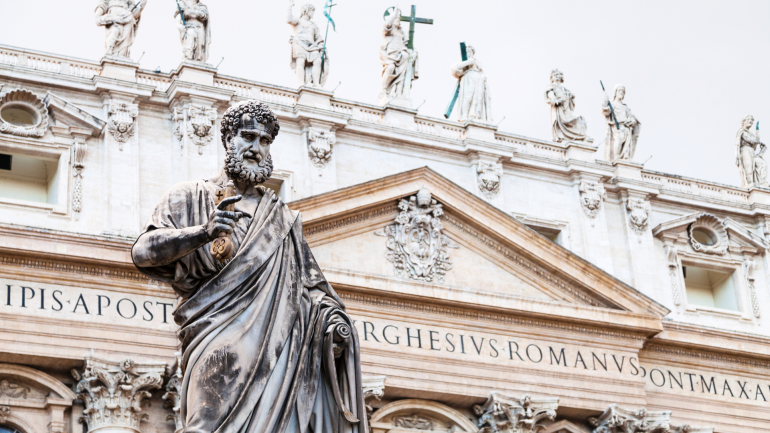
It has been 400 years since the dedication of St. Peter’s Basilica in Rome.
To mark the anniversary, the Vatican has launched a series of special initiatives. Improvements have been made to facilitate easier entry for visitors. Areas once closed to the public have been reopened, access to the terrace has been expanded, and a new pilgrimage route tracing the path of Saints Peter and Paul through Rome has been introduced. The commemorative programs began on February 20 and will conclude on November 18 with a Holy Mass presided over by Pope Leo XIV.
Yet beyond the events and celebrations, one simple phrase stands at the heart of this anniversary: “Peter Is Here.”
“Peter Is Here” — The Real Place, the Real Man
On November 18, 1626, the present Basilica was solemnly dedicated, replacing the fourth-century church built by Emperor Constantine. That earlier structure had stood for nearly 1,200 years over what Christians believed to be the tomb of the Apostle Peter.
Beneath the high altar of the Basilica, under the Altar of the Confession and close to the tomb, an ancient Greek graffito reads: “Pétros ení” — “Peter is here.” These are not symbolic words. They point to a real grave and a real man.
For centuries, the precise location of Peter’s tomb remained uncertain. It was only in the twentieth century, through careful excavations beneath the Basilica, that greater clarity emerged. Among the discoveries was the simple inscription, likely scratched by an early Christian pilgrim, perhaps in secrecy during times of persecution.
Archaeologist Margherita Guarducci studied the site and its inscriptions with patience and rigor. With the support of Pope Paul VI, her research helped confirm that the Basilica indeed stands over Peter’s tomb and remains. It is remarkable to think that from a small fragment of graffiti came renewed certainty. From that hidden marking arose confidence that this vast and magnificent church rests on the bones of a fisherman from Galilee.
Peter Is Like Us
In the book "Pietro – Un uomo nel vento" (Peter – A Man in the Wind), Italian actor, writer, and director Roberto Benigni reflects on Peter’s humanity. He writes: “Peter is just like us… he gets angry, acts on impulse, makes mistakes, misunderstands, cries, laughs, falls asleep, suffers, rejoices, and allows himself to be moved.”
This insight captures the heart of Peter’s story. He is not a distant statue of holiness. He is fragile and impulsive. He is afraid. He denies Jesus at the most critical moment. He falters when he is expected to stand firm. And yet, he remains.
All of us, at some point, discover our own weakness. We fail, sometimes when it matters most. As the book observes, “the most important things in life are not learned and are not taught: they are encountered.” Peter’s encounter with the Risen Christ transforms him.
The Question That Matters
After the Resurrection, Jesus does not ask Peter to justify his failure. Instead, He asks a different question: “Do you love me?”
That Gospel question echoes through history. It is not, “Have you never failed?” but, “Do you love me?” This is why Peter’s story resonates especially during Lent. Lent mirrors his journey: he fails, he weeps, he waits, he is forgiven, and he is sent again.
Italian journalist Andrea Monda writes: “We need to recover memory in order to rediscover ourselves, to rediscover our fragile — and yet great — beauty. Mysteriously capable of regenerating itself. Like Peter’s story. Peter’s story is our own. Our forgotten, betrayed, denied story. But in the end, rediscovered.”
This is the deeper meaning of the 400th anniversary. It is not merely about commemorating a historical date. As Cardinal Mauro Gambetti, Archpriest of St. Peter’s Basilica and President of the Fabbrica di San Pietro, has explained, it is about “bringing back to the heart” what gives life and hope.
One enduring tradition recounts Peter fleeing Rome during persecution. On the Appian Way, he encounters a figure carrying a cross. Recognizing Jesus, he asks, “Domine, quo vadis?” — “Lord, where are you going?” Jesus replies, “I am going to Rome to be crucified again.” Peter understands. If he abandons his mission, Christ will suffer again in his place. He turns back. The wind that once carried him from Galilee now leads him toward Rome — toward witness, martyrdom, and love.
A Lenten Message in the Jubilee Year
Four centuries after its dedication, St. Peter’s Basilica continues to welcome pilgrims from around the world. Beneath its marble and gold lie the remains of a man who once trembled in fear but later stood firm in faith.
The message is both simple and profound: God builds His Church not on perfect people, but on forgiven hearts.
In this Lenten season, the words beneath the altar speak again: “Peter is here.”
Peter is here wherever someone falls and rises again.
Peter is here wherever someone weeps and begins anew.
Peter is here wherever someone, despite weakness, can still say:
“Lord, you know that I love you.”