



(The RVA Central Office in Quezon City, Philippines, has been blessed by visits from three saints of the Catholic Church, St. Paul VI, St. John Paul II, and St. Teresa of Calcutta. Their presence remains a lasting inspiration for RVA’s mission to proclaim the Gospel across Asia. As we prepare to rename our chapel the Three Saints Chapel in their honor, RVA launches a special series reflecting on their lives, their contribution to the Church’s mission in Asia, and their memorable visits to our broadcast center. Their witness continues to guide our work of faith and communication. – Editor)
For more than five decades, Radio Veritas Asia (RVA) has stood as the “Voice of Asian Christianity,” proclaiming the Gospel across cultures, languages, and borders.
From its humble beginnings in shortwave broadcasting to its dynamic presence in today’s digital landscape, RVA has remained faithful to one mission: to bring Christ to the peoples of Asia.
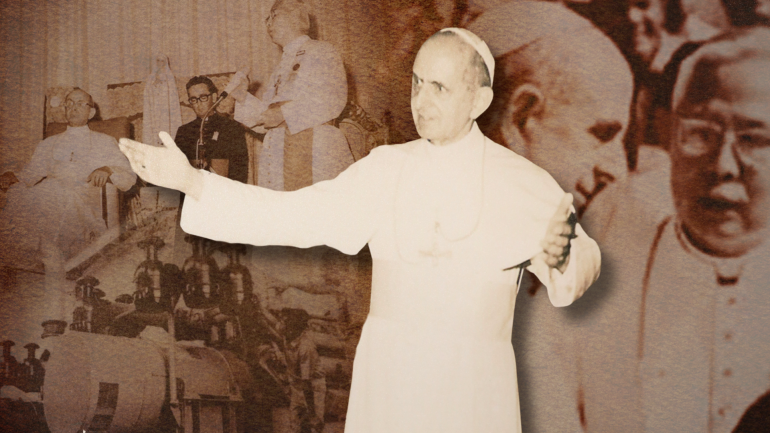
That mission was powerfully affirmed on November 29, 1970, when Pope Paul VI, now St. Paul VI, visited the RVA studios in Fairview, Quezon City.
It was the first time a Pope had set foot on Philippine soil. Significantly, among the many moments of that historic journey, he chose to stand before the microphones of Radio Veritas Asia.
His visit was more than ceremonial. It was a prophetic gesture. In blessing the studios and addressing the continent through the airwaves, St. Paul VI affirmed that modern communication is not merely a tool of convenience but a providential instrument for evangelization.
He saw in radio a missionary frontier, capable of crossing boundaries, reaching the isolated, and carrying the Gospel to the “countless millions” of Asia.
A Prophet of Modern Communication
As the Pope who guided the Church to the completion of the Second Vatican Council, Paul VI understood deeply that the Church must read the “signs of the times.”
The Council’s Decree on Social Communications, Inter Mirifica, described modern media as “gifts of God” to be used responsibly for the good of humanity. For Paul VI, this teaching was not theoretical; it was pastoral and urgent.
Long before the digital age, he grasped that the Gospel could not remain confined within stone walls if it were to reach the “countless millions” of Asia. Radio possessed a unique missionary power: it could cross mountains and seas, enter homes silently, comfort the isolated, and strengthen the persecuted.
Standing before the microphones of RVA, the Pope embodied the words of the Apostle Paul:
“Woe to me if I do not preach the Gospel!” (1 Cor. 9:16).
He did not speak only to those gathered in the studio. He spoke to a continent.
Affirming Asia’s Missionary Voice
At the time of the papal visit, RVA was still a young project, born from the dream of the Federation of Asian Bishops' Conferences (FABC).
The Asian bishops envisioned a communication network that would serve the diverse peoples of Asia, many of whom lived as religious minorities and often lacked access to consistent pastoral care.
By visiting the station, Paul VI offered more than encouragement; he gave validation. His presence signaled that Asia was not a distant periphery of the Church, but a vibrant and essential heart of the global Catholic community.
Evangelization through the airwaves was not secondary; it was integral to the Church’s mission.
Blessing the “Microphones of Truth”
During his visit, the Pope blessed the studios and technical equipment. To some, these were mere machines of steel and wire. To him, they were instruments of grace, “microphones of truth” destined to carry light across Asia.
He prayed that the broadcasts would bring clarity amid confusion, hope amid suffering, and unity amid division. Asia then, as now, was navigating profound social, political, and economic challenges.
The Pope’s blessing transformed transmitters into tools of mission, sanctifying the work of broadcasters, journalists, communicators, technicians, writers, and missionaries who would turn soundwaves into seeds of faith.

A Golden Chalice, A Eucharistic Heart
In a deeply symbolic gesture, Paul VI presented RVA with a golden chalice. This gift was more than ceremonial; it was theological. It reminded the station that all authentic Christian communication flows from the Eucharist, the supreme act of communion between God and humanity.
The chalice became a sign that broadcasting is not simply information-sharing; it is participation in the Church’s life.
In a sense, RVA’s mission is a “liturgy on the airwaves,” nourishing spiritually hungry hearts across borders and cultures. Every program, every reflection, every news report must be rooted in the same love that flows from the altar.
The Voice of the Voiceless
True to its name, Veritas, “Truth”, RVA was called not only to proclaim doctrine but to uphold human dignity. During his visit, the Pope spoke of the “human development” of the poor and the “thirst for a nobler life” among the masses.
This vision would later shape RVA’s historic role in promoting justice, peace, and democracy during times of crisis. The truth carried on its frequencies was not abstract; it was incarnate, concerned with both the salvation of souls and the transformation of society.
In this way, Paul VI anticipated what he would later articulate in Evangelii Nuntiandi: that the Church would feel guilty before the Lord if she failed to use the powerful means of social communication placed at her disposal for evangelization.
The Prophetic Echo Lives On
Today, Radio Veritas Asia has journeyed far beyond its original shortwave frequencies into the vast digital continent, embracing websites, social media, podcasts, and livestreams. Yet its mission remains unchanged: to proclaim Jesus Christ faithfully and creatively to the peoples of Asia.
The spirit of Paul VI continues to guide that mission. His 1970 visit demonstrated that the Church does not stand apart from modern progress; she engages it, purifies it, and places it at the service of the Gospel. For him, communication was not simply about technology; it was about communion. It was about reaching hearts.
When St. Paul VI stood before the microphones of RVA, he affirmed a truth that still resonates today: the airwaves themselves are missionary territory. Every broadcast can be a proclamation. Every program can be an encounter. Every message can become a bridge between God and His people.
More than five decades later, Radio Veritas Asia continues to echo the vision of that prophetic Pope - to be
a voice for the voiceless,
a companion to the searching,
a defender of truth and dignity,
and a herald of hope for all of Asia.