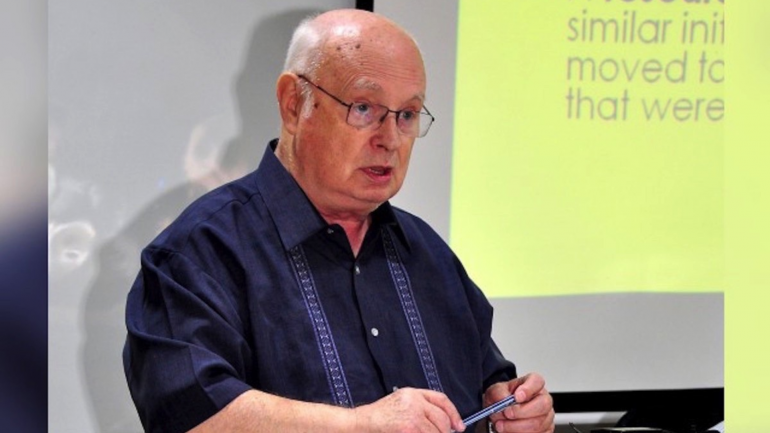
January 13, 2026, marks the fifth anniversary of the death of Fr. Franz-Josef Eilers, SVD, a priest, scholar, and missionary whose work transformed the Church’s approach to communication. A pioneer in human and social communication, Fr. Eilers helped shape the Church’s vision first articulated in the Second Vatican Council’s Inter Mirifica (1963). He served as Executive Secretary of the FABC Office of Social Communication and as Consultor to the Pontifical Council for Social Communications, while his books became essential references in missiology, intercultural communication, and communication theology across Asia.
On this anniversary, two fellow SVD missionaries and a Filipino lay journalist reflect on the profound personal and ecclesial impact of Fr. Eilers’ life and work.
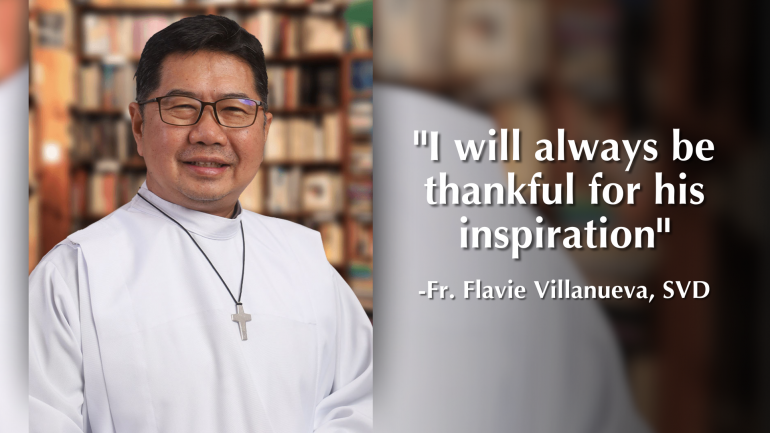
Finding Time to be with God
Always find time, a minimum of 30 minutes a day, to be with your God, to be with Jesus, and never compromise it. Let this experience, this encounter of Jesus, flow and follow you throughout the day.
These are the words of Franz Josef Eilers to me when he was still alive. As early as 2000, he taught this to me. And I am very grateful to say that this has shaped the priesthood, the missionary, and the person that I am today.
For this, I will always be thankful for his guidance, for his inspiration, and for being my spiritual father. He is an image and strived to be an image of St. Arnold Jansen. And from that very experience of his, he passed it on to me and to his spiritual children.
Fr. Franz Josef is my spiritual father, and I will always be indebted, grateful, and resolve to follow his guidance. Wherever you may be, which I believe near the divine word in heaven, please intercede for us and shower some hopes and smiles down from heaven. To all of you, thank you, and may the divine word move us to be his witnesses of the word in today's wounded world.
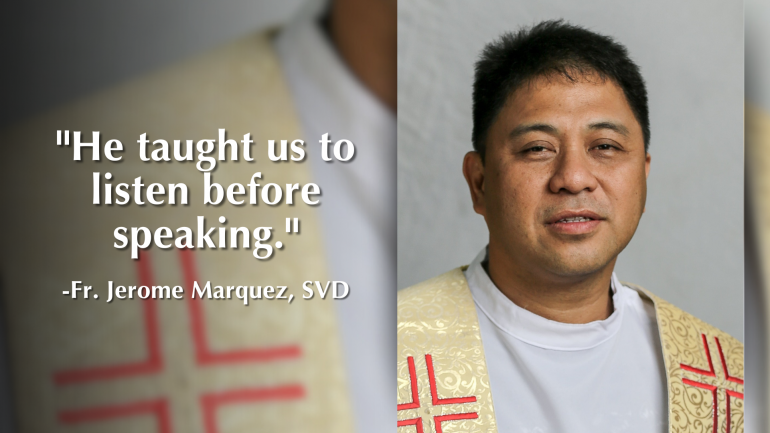
Communication as True Encounter across Cultures
Today we pause to remember a man whose voice shaped how the Church communicates and whose life witnessed on how we come closer to Christ and serve His people. Today we remember Fr. Franz Josef Eillers, SVD, one of the pioneers of Church communication, but for me above all a professor, a spiritual director, and a missionary of the Divine Word.
I first encountered Fr. Eilers as my professor at the Divine Word Seminary of Theology, where he taught missiology and communication. We were not only studying theories, we were being prepared for a life of mission.
In his book Communicating Between Cultures, he taught us to listen before speaking, to respect people's stories and symbols, and to see communication as true encounter across cultures. But he led us even deeper.
Fr. Eilers taught us that communication is not just a tool of the Church, it belongs to the Church's social doctrine itself. For him, the Church is faithful to her mission only when her way of communicating reflects God's own way of relating, truthful, theological, participatory, and life-giving, very synodal. A Church that speaks without listening, decides without dialogue, or protects itself without transparency fails not only in communication but in its moral and social mission.
That is why he reminded us again and again that communication is not optional to mission, it is mission itself. Beyond the seminary, Fr. Eilers taught in many other universities, both in Rome and across Asia.
Whatever he taught, he carried the same conviction: that mission, communication, and prayer are inseparable. Beyond the classroom, Fr. Eilers was also my spiritual director for some years. He always emphasized that the heart of missionary life is a personal relationship with Christ rooted in faithful and disciplined prayer.
On a deeply personal note, he was also the first SVD priest to visit my family when I was still a young seminarian. It was a simple visit, but it revealed who he truly was, a pastor who believed that communication begins with presence.
Two days before he died, I noticed that he was not in the chapel for the early morning Mass. Concerned, I asked the rector to check on him. He was found in his room, still alive but unwell.
I went to see him, and that became our last conversation. We spoke simply about his health, about seeing his doctor, and in a quiet, almost playful way, we even joked a little about death, not in fear but in the calm trust of someone ready to entrust everything to God.
Fr. Eilers also played a decisive role in shaping Church's vision of social communication in Asia through his work with the Federation of Asian Bishops Conference. From his office at the Catholic Trade in Manila, he supported communication initiatives and publications across the continent and worked closely with Radio Veritas Asia. I remember clearly his concern when discussions arose about ending shortwave broadcasting.
He was deeply troubled by what he called the early demise of shortwave. For him, this was not about technology but about people, especially the poor, the remote, and those without stable internet access. He believed that mission must always ask who will be left unheard, and he insisted that communication must always reach those at the margins first.
Fr. Eilers taught us how to communicate, but more importantly, how to communicate Christ with truth, with listening, with participation, and with prayer.
Thank you, Fr. Franz Josef Eillers, SVD. Your mission lives on in us.
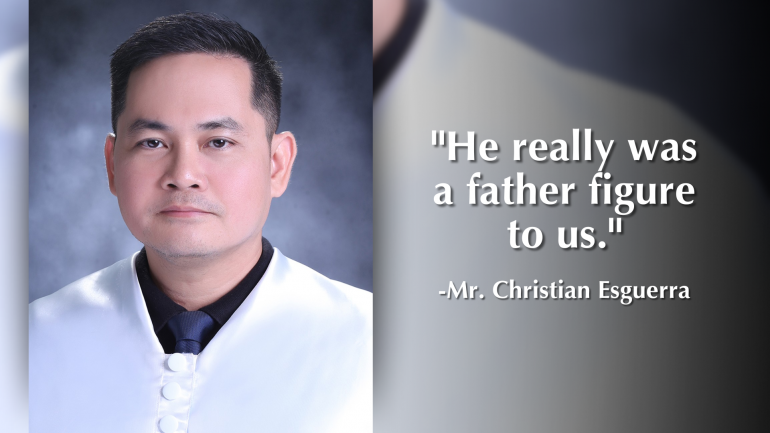
Love for Teaching
I’m one of the very first students of Fr. Eilers in the Social Pastoral Communication program at the UST Graduate School. I was basically a curious post-graduate student wannabe. I walked into the UST Graduate School looking for a program that would fit my interests, because at that time I was already a practicing journalist. I wondered what post-graduate program would be suitable for me. I didn’t want to take up mass communications or MA Journalism anymore, so I wanted to learn something I wasn’t really familiar with.
That’s when I discovered the Social Pastoral Communication program. At that time, it was headed by Fr. Eilers. Initially, he was a bit intimidating because, first of all, he was German and a bit strict.
Right away, I realized he was a no-nonsense professor. You couldn’t just gloss over the subjects he handled or the papers he assigned. But the more I got to know him, the more I realized how important the program was.
I also saw his human side. He really was a father figure to us, his students—very caring. Eventually, he became my spiritual director. He regularly invited me for discussions and reflections about my career as a journalist. At the same time, I was already teaching, and he would give advice during our exchanges. I truly appreciated them.
One thing I really remember is that he kept reminding me of how important teaching as a profession is. He said, “You multiply yourself in your students when you teach.” He emphasized the importance of character building and the values you carry as a teacher and as a person, because these are the same values you pass on to your students. I will never forget that lesson.
Of course, Fr. Eilers was an authority in this field, and his teachings and body of work were extremely useful. As a journalist, he helped me see my job not just from the perspective of secular communication, but also from the perspective of social communication. He constantly reminded us that communication theology is seeing the whole of theology from the perspective of communication, from the perspective of God who communicated Himself.
His teachings, especially on the Church’s social communications, helped me understand my work more deeply—the objectives and goals of being a journalist. I learned to view the people we cover in the media not merely as subjects, but as individuals with inherent dignity. This deep respect for those we encounter in media came from knowing Fr. Eilers.
I owe him a great debt of gratitude. Many of my classmates also share this feeling. We know he is in heaven and in the care of our Lord. We miss him, of course, but I am very glad to have had the opportunity to be under his tutelage, to learn from him, and to have him as a father figure.