





A Special Franciscan Jubilee Year has begun to mark the 800th anniversary of the death of St. Francis of Assisi (1226–2026). It runs from 10 January 2026 to 10 January 2027 and carries the theme “San Francesco Vive” (Saint Francis Lives). The theme echoes the Gospel image of “the seed that dies to bear fruit” (Jn 12:24; 1 Cor 15:36), reminding the Church that Francis’ life continues to speak powerfully today.
In recent times, even the simple faithful speak frequently of St. Francis of Assisi, partly because of the papacy of Pope Francis. He not only took the name of the saint of Assisi but also shaped his pontificate around concern for the poor and the marginalized. As he once observed, “In the history of the Catholic Church, the true renewers are the saints.” Francis of Assisi, by choosing poverty, challenged luxury, pride, and vanity—and in doing so, changed history.
A Seed of Eternal Life
The official opening of the Jubilee took place on 10 January 2026 at the Basilica of St. Mary of the Angels in Assisi. On that occasion, the Ministers General of the Franciscan Family presented a joint letter entitled “A Seed of Eternal Life,” addressed to the entire Franciscan Family and to the People of God. The letter invites everyone to rediscover what St. Francis handed down and to recognize it as a shared responsibility to be lived today.
Drawing inspiration from the Testament of St. Francis, the letter highlights enduring legacies that remain central even now. Two concrete encounters marked decisive turning points in Francis’ life: his encounter with the poor and his encounter with Christ crucified.
Francis left the comforts of Assisi and went among the poor. In his Testament, he writes: “And the Lord Himself led me among them, and I showed mercy to them.” His mercy did not begin with ideas or devotions, but with a concrete encounter. This was not a passing gesture but a radical change of life.
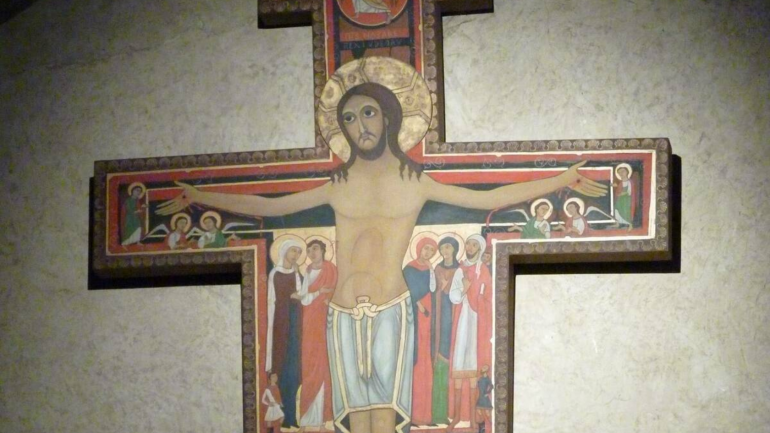
His conversion reached its fullness when he encountered the crucified Christ at San Damiano. Before the Crucified, a prayer flowed from his heart—one he would recite constantly with his brothers and later include in his Testament: “We adore You, Lord Jesus Christ, in all Your churches throughout the whole world, and we bless You, because by Your holy cross You have redeemed the world.” The eyes of the lepers and the eyes of the Crucified sowed in Francis a seed of eternal life.
Love for the Church and the Eucharist
Francis also loved the Church deeply, even when she appeared fragile and poor. He saw her as a “poor but fruitful land.” At the heart of this love was the Eucharist, which he regarded as the center of Christian life.
His devotion united two essential dimensions: love for the Church, where God humbly entrusts Himself to human hands and “each day comes down upon the altar in the hands of a priest,” and contemplation of a God who is “humility,” giving Himself to us “in the humble appearance of bread.”
Peace, Fraternity, and Witness
Francis’ love for God and the Church was expressed not only in Eucharistic devotion but also in concrete acts of mercy, peace, and fraternity. Among the most famous episodes of his life is the story of the Wolf of Gubbio, a symbol of transforming fear into trust and violence into peace. The image of Francis embracing the wolf continues to speak of reconciliation and hope.
Equally powerful was his journey to the Holy Land during the Fifth Crusade. Crossing battle lines to meet Sultan al-Malik al-Kāmil, Francis chose dialogue over weapons, showing that fraternity is possible even amid conflict. For him, fraternity was not an abstract ideal but a Gospel way of life. Living as brothers and sisters generated peace—not only within the community but also in the wider world. This spirit continues to inspire Franciscan communities as witnesses of reconciliation and harmony.
Events and Spiritual Gifts of the Jubilee Year
Among the special events of the Jubilee, the relics of St. Francis will be displayed for public veneration in the Lower Basilica of Assisi from 22 February to 22 March 2026. This was confirmed by the Sacro Convento of Assisi on 4 October 2025 and made possible with the approval of Pope Leo XIV, through the Vatican Secretariat of State, which described the gesture as “an extraordinary gift.”
Throughout the Jubilee Year, the Apostolic Penitentiary grants a plenary indulgence, under the usual conditions, to all who devoutly participate in the celebrations. The elderly, the sick, and those unable to travel may also obtain it by spiritually uniting themselves through prayer and by offering their sufferings.
In a further sign of Francis’ enduring influence, the Italian Parliament has approved a new law establishing October 4 as a national holiday, beginning this year, dedicated to the Franciscan values of peace, fraternity, and care for creation.
Eight centuries after his death, the seed sown by Francis of Assisi continues to bear fruit—calling the Church and the world to simplicity, fraternity, and lasting peace.