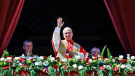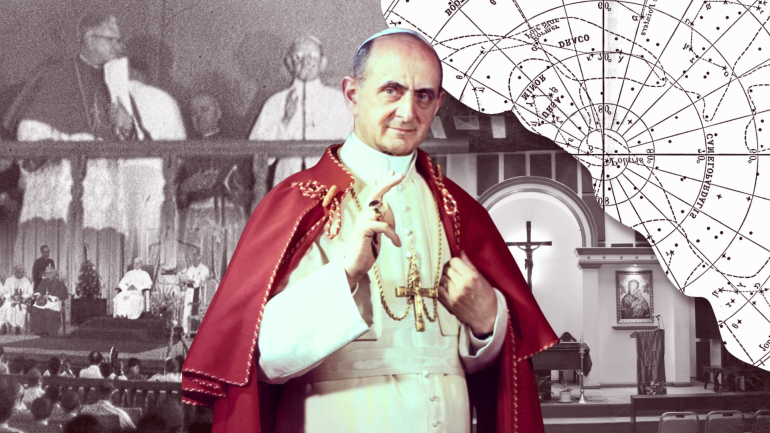
(The RVA Central Office in Quezon City, Philippines, has been blessed by visits from three saints of the Catholic Church — St. Paul VI, St. John Paul II, and St. Teresa of Calcutta. Their presence remains a lasting inspiration for RVA’s mission to proclaim the Gospel across Asia. As we prepare to rename our chapel the Three Saints Chapel in their honor, RVA launches a special series reflecting on their lives, their contribution to the Church’s mission in Asia, and their memorable visits to our broadcast center. Their witness continues to guide our work of faith and communication. – Editor)
When Pope Paul VI stepped onto Asian soil in 1970, he was doing more than making a pastoral visit. He was signaling a shift in how the Catholic Church viewed its global mission.
For the first time, a reigning pope traveled extensively across Asia and Oceania, visiting the Philippines, Australia, Indonesia, Hong Kong, and Sri Lanka. At a time when papal travel was still uncommon, the journey carried strong symbolism. Asia was no longer seen as a distant missionary field but as an integral part of the Church’s present and future.
More than five decades later, as Catholic communities across Asia continue to grow in leadership and confidence, the legacy of St. Paul VI remains significant.
Completing Vatican II
Giovanni Battista Montini became Pope Paul VI in 1963 during the Second Vatican Council, which had begun under Pope John XXIII. He guided the council to its conclusion in 1965 and oversaw the early implementation of its reforms.
Vatican II reshaped the Church’s engagement with the modern world. It strengthened collegiality among bishops, renewed the liturgy, and called for dialogue with other religions. For Asia, home to ancient civilizations and major world faiths, these developments were particularly relevant.
The council’s declaration Nostra Aetate, promulgated during Paul VI’s pontificate, redefined Catholic relations with non-Christian religions. In many Asian countries, where Christians live as minorities among Buddhists, Hindus, Muslims, and others, this shift provided a theological basis for dialogue and mutual respect.
A Turning Point in 1970
Paul VI’s 1970 journey to Asia marked a decisive moment. In Manila, he met bishops from across the continent and encouraged them to develop a Church rooted in local cultures rather than replicating European models. His emphasis anticipated what would later be widely discussed as inculturation.
During that same visit, Paul VI survived an assassination attempt at Manila International Airport. A Bolivian man disguised in clerical attire lunged at him with a dagger as he greeted the public. The pope sustained minor injuries before security intervened. The incident underscored the risks of global engagement but did not diminish the significance of the visit.
The message was clear: the papacy would not remain distant from Asia.
The Federation of Asian Bishops’ Conferences
One of the most lasting outcomes of the 1970 visit was the establishment of the Federation of Asian Bishops’ Conferences (FABC). Asian bishops gathered during the trip expressed the need for closer regional collaboration. Later that year, Paul VI formally approved the federation.
Over time, the FABC articulated three key priorities: dialogue with cultures, dialogue with religions, and dialogue with the poor. These themes reflected Asia’s religious diversity, widespread poverty, and rapid social change.
Many pastoral initiatives that characterize Asian Catholic life today, such as small Christian communities, interreligious engagement, and contextual theological reflection, were developed within this framework.
Evangelization and Development
In 1975, Paul VI issued Evangelii Nuntiandi, a major document on evangelization. He described evangelization primarily as witness rather than conquest, emphasizing credibility through lived faith. The approach resonated strongly in Asia, where sensitivity to religious pluralism is essential.
Earlier, in his 1967 encyclical Populorum Progressio, he addressed global inequality and called for integral human development, progress that respects human dignity and promotes justice. In many Asian countries emerging from colonial rule and facing economic disparity, this teaching influenced Catholic social institutions, including schools, hospitals, and development programs.
An Asian Legacy
Canonized in 2018, St. Paul VI is often remembered as the pope who completed Vatican II. In Asia, however, his legacy is closely tied to his direct engagement with the region and his affirmation of its distinct voice within the universal Church.
As Radio Veritas Asia prepares to rename its chapel the Three Saints Chapel, honoring St. Paul VI alongside St. John Paul II and St. Teresa of Calcutta, all of whom visited its central office, the occasion highlights a shared history.
Paul VI’s visit helped strengthen a Church that seeks dialogue in religiously diverse societies and combines proclamation with social responsibility. His 1970 journey marked the beginning of a more visible and confident Asian presence within the global Catholic community, a development that continues to shape the Church’s mission across the continent today.