(The RVA Central Office in Quezon City, Philippines, has been blessed by visits from three saints of the Catholic Church — St. Paul VI, St. John Paul II, and St. Mother Teresa of Calcutta. Their presence remains a lasting inspiration for RVA’s mission to proclaim the Gospel across Asia. As we prepare to rename our chapel the "Three Saints Chapel" in their honor, RVA launches a special series reflecting on their lives, their contribution to the Church’s mission in Asia, and their memorable visits to our broadcast center. Their witness continues to guide our work of faith and communication. – Editor)
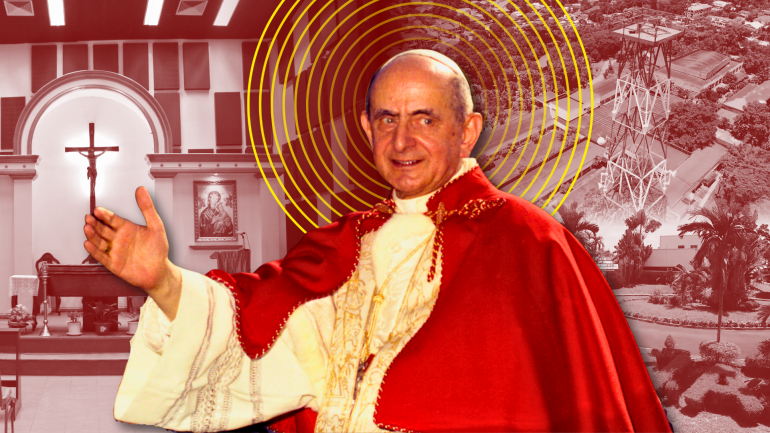
When Pope Paul VI arrived in Manila on November 27, 1970, it marked a historic moment for the Catholic Church in Asia. It was the first papal visit not only to the Philippines but to the wider region often referred to at the time as the Far East. The three-day visit signaled the Vatican’s growing recognition of Asia’s importance in the life and future of the Church.
Amid major public liturgies and official events, one visit carried particular significance: the Pope’s stop at Radio Veritas Asia, a young Catholic radio network based in Fairview, Quezon City. Established to serve as a continental voice of the Church, the station represented a new model of evangelization through modern communication.
A Vision for Asian Communication
The concept of Radio Veritas Asia began in 1958, when Asian bishops meeting in Manila discussed the need for a regional broadcasting platform that could cross political and cultural borders. In 1961, the Philippine Radio Educational and Information Center was established to implement the project. After years of preparation, the Fairview studios were inaugurated in April 1969.
Just over a year later, the station received unexpected affirmation. On November 29, 1970, the final day of his Philippine visit, Paul VI traveled to Radio Veritas Asia.
The visit came less than 24 hours after he survived an assassination attempt at Manila International Airport. A Bolivian man disguised as a priest lunged at the Pope with a dagger, causing minor injuries before security intervened. Despite the incident, Paul VI continued his schedule, underscoring his commitment to the trip and to the Church’s engagement in Asia.
“The Voice of Truth”
Inside the station’s modest studios, the Pope blessed the broadcasting equipment and presented a golden chalice, symbolizing the centrality of the Eucharist in the Church’s mission. He then addressed listeners across Asia through the microphone.
“To you, the countless millions of men and women, our brothers and sisters who live in Asia, this crossroads of cultures ancient and modern… the blessing of God, abiding peace and fraternity,” he said.
He expressed hope that Radio Veritas Asia would faithfully transmit “the voice of truth.”
“From this station may there always be diffused truth, the voice of truth, the truth about man and his destiny, the truth about the world, and above all about God,” he said.
Paul VI’s presence affirmed the Asian bishops’ vision of a communication network serving the entire continent. From its inception, Radio Veritas Asia was conceived not as a national station, but as a regional mission responding to diverse linguistic and cultural realities.

Growth Across Borders
In the decades that followed, Radio Veritas Asia expanded its reach, broadcasting in numerous Asian languages including Chinese, Vietnamese, Urdu, Tamil, and others. In regions where open missionary activity was limited, radio became an effective pastoral tool. Programs included catechesis, Scripture reflections, news, and social teaching.
Paul VI’s support in 1970 gave institutional and symbolic weight to the project at an early stage. His broader teaching would later reinforce this direction. In 1975, he issued Evangelii Nuntiandi, a major document on evangelization, emphasizing that proclamation and communication are inseparable in the Church’s mission.
His Manila visit anticipated that message in practical terms. By engaging directly with a Catholic broadcast network in Asia, he highlighted the strategic importance of media in reaching diverse populations.
Continuing the Mission
Today, more than five decades later, Radio Veritas Asia continues to serve audiences across the region through radio and digital platforms. Plans for further expansion reflect ongoing efforts to adapt to new forms of media while maintaining its original mandate.
Paul VI’s 1970 visit to Asia demonstrated a broader shift in the Church’s outlook. By traveling east, encouraging regional collaboration, and affirming communication as a missionary priority, he strengthened the Church’s institutional presence and voice in Asia.
His stop at Radio Veritas Asia was not simply ceremonial. It was a concrete expression of his conviction that Asia mattered, and that the Church’s mission on the continent required both pastoral presence and effective communication.