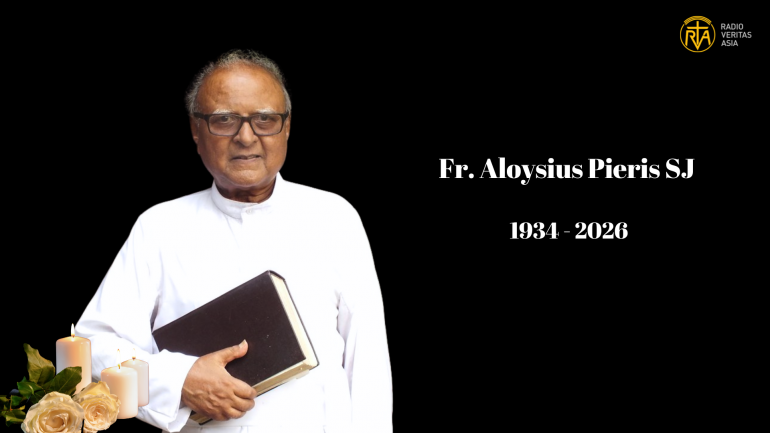
Fr. Aloysius Pieris, a distinguished Sri Lankan Jesuit known for his contributions to liberation theology, interreligious dialogue, and social justice, passed away on March 22 at the age of 92.
Widely regarded as one of Sri Lanka’s most eminent theologians and scholars, his life and work formed a profound bridge between Christian thought and Asian realities. He helped shape a distinctive “Asian Theology of Liberation” that continues to resonate globally.
Early Life and Formation
Born on April 9, 1934, in Ampitiya near Kandy, the tenth of twelve children, Pieris grew up in a setting that would deeply influence his worldview. He studied at St. Mary’s College, Ampitiya, and later at St. Aloysius’ College, Galle.
His childhood unfolded in a uniquely formative environment, close to a papal seminary and within a predominantly Buddhist culture. This dual exposure nurtured in him an early commitment to interreligious harmony. By age 12, he had begun studying Latin under a Jesuit priest; within two years, he was reading the New Testament and The Imitation of Christ in the original language.
Encouraged by his father, an educator and nationalist, he also studied Pali under a renowned scholar. By the time he entered the minor seminary in Galle at 14, he was already proficient in both Latin and Pali.
Academic Journey and Global Exposure
In 1953, after completing his London A-Levels, Pieris entered the Society of Jesus in India. There he earned a licentiate in philosophy and studied Sanskrit under a Brahmin scholar. Returning to Sri Lanka, he completed a degree in Pali and Sanskrit.
His theological studies took him to Naples during the transformative years of the Second Vatican Council. Alongside his academic work, he ministered in impoverished neighborhoods and guided youth groups, experiences that deepened his social consciousness. He also studied Scripture in Hebrew and earned a diploma in music.
Pieris later became the first non-Buddhist to earn a PhD in Buddhist Philosophy from the University of Sri Jayewardenepura, studying under the renowned monk Walpola Rahula.
Tulana: A Living Space for Dialogue
In 1974, he founded the Tulana Research and Encounter Centre in Kelaniya. More than an institution, Tulana became a living space for interreligious dialogue, artistic expression, and social engagement.
The center fostered deep encounters between Buddhism and Christianity, often expressed through art created by both monks and Christian artists. It also became a place of social memory, commemorating victims of violence from across Sri Lanka’s ethnic and religious divides.
Through its media initiatives, Tulana mentored young people in film, radio, and drama. Pieris also helped establish the Centre for Education of Hearing-Impaired Children (CEHIC), offering hearing aids and speech training to children and promoting their full integration into society.
His efforts at inculturating the liturgy, integrating local cultural forms into Christian worship, left a lasting mark on the Sri Lankan Church.
A Bridge Builder and Global Voice
Often described as a “bridge builder,” Pieris connected Church leadership with grassroots communities and brought Asian spiritual insights into dialogue with Western theology. When fellow theologians such as Tissa Balasuriya faced ecclesiastical scrutiny, he used his influence to advocate for them.
Despite international recognition, including teaching engagements at leading universities, he lived simply at Tulana. He once observed that Christian identity demands more than acts of charity, it calls for solidarity with the poor and participation in their struggle for liberation.
Legacy of Thought and Witness
A prolific writer, Pieris authored more than 30 books and over 500 research articles. His landmark work, An Asian Theology of Liberation (1988), has been translated into multiple languages and remains influential.
He also served as editor of Vagdevi: Journal of Religious Reflection and Dialogue and founding editor of the international journal DIALOGUE. He was the first Asian member of the editorial board of Concilium, a prominent European theological journal.
Fr. Aloysius Pieris leaves behind a legacy that united the “poverty of Asia” with the “spirituality of Asia,” reminding the Church and the world that the search for God is inseparable from the struggle for justice and human dignity.